


Introduction
This series has leaned on three old stories, and between them they describe what we found.
The first is Lord Haw-Haw. William Joyce reached millions of British homes from Hamburg in 1939, and his power came from two things: he sounded British, and the rumour of what he knew did more damage than anything he said. The answer to him was not a ministry for hunting him down. It was a BBC people believed.
The second is the Trust. In the 1920s Soviet secret police invented a monarchist underground, spoke the exiles’ language perfectly, and won their confidence for six years. The lesson the Kremlin took from it: you don’t need to beat your enemies’ movement if you can become part of it.
The third is the dog that didn’t bark. In Conan Doyle’s Silver Blaze, Holmes solves the case from a silence. The dog knew the thief.
In July 2025 I mapped the British ecosystem of influencers, ideologues and grifters who carry authoritarian narratives into our national conversation. In September 2026 that ecosystem got a live test, when “Russia is not my enemy” swept across X. Over five more articles I followed the slogan from a British reply thread to a scam farm in Africa, to Putin’s envoy, to a refinery in Limerick, and to a regional government in Nizhny Novgorod recruiting Western families. This is what all six found, taken together.
The full network behind all six articles is now mapped in one place: Russia Is Not My Enemy: the map. Keep it open as you read; every name below is on it.
Discussion
1. The cast list
The Information Battle of Britain was a who’s who rather than an investigation. It grouped Britain’s carriers of authoritarian narratives into right-wing populists, conspiracists, state apologists and ideological catalysts, and the platforms that host them.
Its argument was that this network is ideologically diverse but shares a handful of stories: NATO and Ukraine are the aggressors, the West is corrupt and in decline, and authoritarian “multipolar” regimes are misunderstood. Some speak the language of Marx, others of markets, but together they act as a soft-power alliance.
That list became the baseline. Over the next fourteen months, the same names kept turning up in the data: George Galloway, Tommy Robinson, David Kurten, Andrew Bridgen, Chay Bowes, the Ickes, Piers Corbyn, Turning Point UK and John Mappin.
2. The British wave and the borrowed template
Part Two began with a mistake of my own. On 24 September I posted that “Russia is not my enemy” was a massive bot campaign. Then I pulled about 18,600 posts and 9,800 accounts, and the data said otherwise.
There were two waves, not one:
A British wave, “Russia is not our enemy”. It was triggered by the Chief of the Defence Staff’s warning that Britain must prepare for longer wars, and lit by a Jacob Rees-Mogg clip that reached 7.8 million views. Its loudest carriers were Galloway, Robinson and Kurten, who has posted the exact sentence for years. The anger was domestic: a posh Tory telling working-class men they might have to die.
A template, “I’m [nationality] and Russia is not my enemy”. It moved as a relay of quote tweets from a Polish-placed account through Finnish, British and “Danish” ones, the last using a businesswoman’s stolen photo. A year earlier, the same design had appeared as a Kremlin-attributed sticker campaign in Romania.
Only 62 accounts posted in both waves. Only about 9% of accounts were created in 2026, and 78% of nationality claims matched where X places the account. These were mostly old, real, very online accounts. The fakery sat at a few key points, and a relabelling machine (an “RTRussia” account and the 23-times-renamed @Rusia_HD) repackaged British anger as a worldwide uprising.
The lesson echoed Haw-Haw’s: the voice that matters is still British, and “bot army” feeds the myth.
3. The content pool
Part Three followed one of the relay’s busiest hubs, “Mel Gibson”, which was not Mel Gibson. It was one face in a network of about 110 impersonation accounts placed by X in Africa and Nigeria, with 660,000 followers between them, posing as Trumps, Hollywood stars and the prophets of the QAnon money myth. Two of them posted the same Kremlin caption nine seconds apart.
The network sells a “QFS card” through Telegram DMs: an advance-fee fraud dressed up as the Quantum Financial System, the fantasy of a secret reset of the dollar. Kremlin content is part of the pitch, because in that myth Putin is a “white hat” and BRICS gold forces the reset.
Three commercial clusters drew on the same pool of pro-Kremlin captions: scammers in Africa, engagement farmers in South Asia chasing X’s creator payouts, and heavily renamed “Russia” and “Iran” brands in West Asia. An Italian caption about Zelensky became a fake celebrity’s post within a day and a British talking point by evening, carried by @ivan_8848, the Spain-placed aggregator with “88” in its handle, and the commentator Garland Nixon. ivan follows John Mappin, and Mappin follows him back.
The finding: it’s an economy, not an army. The coordination is real but commercial, and the Kremlin’s lines pay for themselves.
4. The envoy
Part Four climbed from the bottom of the network to the top. Kirill Dmitriev is Putin’s special envoy, head of Russia’s sovereign wealth fund, a Stanford and Harvard graduate, and the Kremlin’s main channel to Trump’s negotiator Steve Witkoff. The 28-point peace plan that leaked in November 2025 carried his idea of steering frozen Russian assets into US-led investment.
On X he talks like an Anon: “WWG1WGA”, “NCSWIC”, the 🐸. When a British QAnon account posted “I’m English and Russia is not my enemy!”, Putin’s envoy replied 🤝😇. He replied to a fake Donald Trump Jr run from Africa. He follows ivan_8848, John and Irina Mappin, a Nigerian fake “Spetsnaℤ” account, Galloway, Robinson, Kurten, Bridgen, Bowes and Turning Point USA.
Two threads ran through the piece:
Turning Point. Rep. Anna Paulina Luna, Turning Point USA’s former director of Hispanic engagement, received a Soviet JFK file from Russia’s ambassador on “Charlie Kirk Memorial Day” and Putin-quote chocolates from Dmitriev. According to his biography, Mappin, who helped launch Turning Point UK, asked Dmitriev to arrange an Orthodox blessing for Kirk.
Private dollars. No link ties Dmitriev to Tether or World Liberty Financial. But the American across the table has family money in a firm once half-owned by Abu Dhabi’s intelligence chief, and the dollar Russia uses to dodge sanctions is part-owned by the Commerce Secretary’s family firm and Reform UK’s biggest donor.
The Trust’s playbook, updated: the Kremlin no longer needs to invent a movement to join. It can join QAnon, in public, with a frog emoji.
5. The dog that didn’t bark
The Aughinish crossover tested the series’ method on a case where Russian interests were directly at stake. Rusal’s alumina refinery in Limerick sends most of its output to Russia, and OCCRP traced that alumina into the supply chains of Russian missiles and tank engines.
On X, the critics won easily: about 1,380 critical posts against 71 defence posts from about 40 authors. The defence came from four corners (the anti-imperialist left, the nationalist right, pro-Kremlin commentators and a fringe), and it drank from the same well as “Russia is not my enemy”. Chay Bowes was retweeted by 25 of the 73 defenders, ivan_8848 by 18 and Galloway by 18.
But there was no template, no hashtag and no relay. Three in four defence posts attacked the messenger instead of defending the plant, and the messenger changed with the speaker. Not one Russian state account posted about Aughinish.
The real defence was never on X. Between May and August 2026 the company lobbied 20 of Ireland’s most senior officials, including the Taoiseach and the Enterprise Minister whose department was reviewing the trade, according to its own return to the lobbying register. That review found “no adverse findings”. The finding: economic leverage beats information operations. Moscow didn’t need to bark.
6. The shop window
Meet Sasha followed one of the template’s late joiners, @sashameetsrus. Alexandra “Sasha” Jost is an American blogger reported to be on RT’s payroll and sanctioned by the EU in June 2026, who sells Russia as a refuge for traditional Westerners.
The agency behind her says so itself. OKA, the Nizhny Novgorod regional government’s personnel agency, whose founding remit includes staffing defence-industry plants, opened its relocation channel on the day Putin signed the Shared Values visa decree. It says it “organized a trip” for Sasha, calls her “our friend”, and tracked her links as sasha_jost. It did the same for Alina Lipp, and hosted Errol Musk, who pitched a farm colony for 50 Afrikaner families: the Russian mirror of Washington’s Afrikaner refugee scheme.
Around them sit a private firm, Move to Russia, which buys UK Google ads and once listed a Russia-based Dassault-group sales director as a co-founder; Maria Butina’s Welcome to Russia movement, launched at TASS; and an older American network the cast plugs into, from the NRA to Turning Point to the SPIEF stage where Sasha spoke nine days before her sanction.
Of the accounts that posted the slogan, 17% follow her. The take-up is tiny: OKA claims nearly 100 arrivals. The product is less the migrants than the story they let Russia tell about the West.
What connects them
Read together, the six articles describe one system in four layers, each quieter than the last.
The voices. British commentators and politicians with real audiences, saying what they have always said. Galloway, Robinson and Kurten carried the British wave; Bowes and Galloway led the Aughinish defence; Robinson road-tested “Russia is not the enemy of Britain” in Moscow in June. Nobody had to recruit them.
The market. Scam farms, engagement farms, renamed “Russia” brands and aggregators like ivan_8848, which carry Kremlin content because it performs. The franchise of 2019, when Russian operations subcontracted fake Americans in Ghana and Nigeria, has gone freelance.
The officials. An embassy that called the wave a “flash mob” it “fully shares”, an envoy who speaks QAnon and replies with 🤝😇, and a regional government that runs bloggers as lead-generators.
The leverage. A Russian-owned refinery defended by the Irish state in the name of Irish jobs, and private dollars that Washington, Abu Dhabi and Moscow are all learning to use.
The same names cross the layers. Galloway and Bowes appear in Part One, Part Two, Part Four and Aughinish. ivan_8848 carries captions in Part Three, follows Mappin, is followed by Dmitriev, and is retweeted by a quarter of Aughinish’s defenders. Mappin runs from Part One’s cast list through Turning Point UK to Dmitriev’s follow list. Sasha follows the Aughinish defence’s engine room and is followed by 17% of the slogan’s posters.
One rule held throughout: a follow shows attention, not command. Nothing in six articles shows anyone directing this. What the data shows is a standing network that carries whatever the moment needs, from a slogan to a scam to a refinery to a house move, and a state that has learned to stand where that traffic passes.
You can trace every one of these crossings yourself on the full map.
Conclusion
The three old stories each turned out to be half right.
Haw-Haw was right about the voice: the lines that reach British audiences are mostly made at home, by people whose grievances are real. The Trust was right about the method: the Kremlin’s officials no longer run fake movements, they join real ones and speak their language in public. And the dog in the night-time was right about where to look: when Russian interests were directly at stake in Ireland, the most effective defence was a lawful lobbying return, not a hashtag.
That matters for Britain’s new National Centre for Information Defence. If it spends its time hunting bot armies, it will find a few and miss the main event. The work is less glamorous:
Answer domestic anger with better information, faster, before a Rees-Mogg clip and a stolen face fill the gap.
Follow the business: impersonation and engagement farms that X lets run for months, turning a foreign government’s talking points into income.
Watch what officials do in public: who Russia’s envoys and embassies follow, reply to and thank, in English.
Watch the quiet channel: lobbying registers, ownership filings and the private rails the money now runs on.
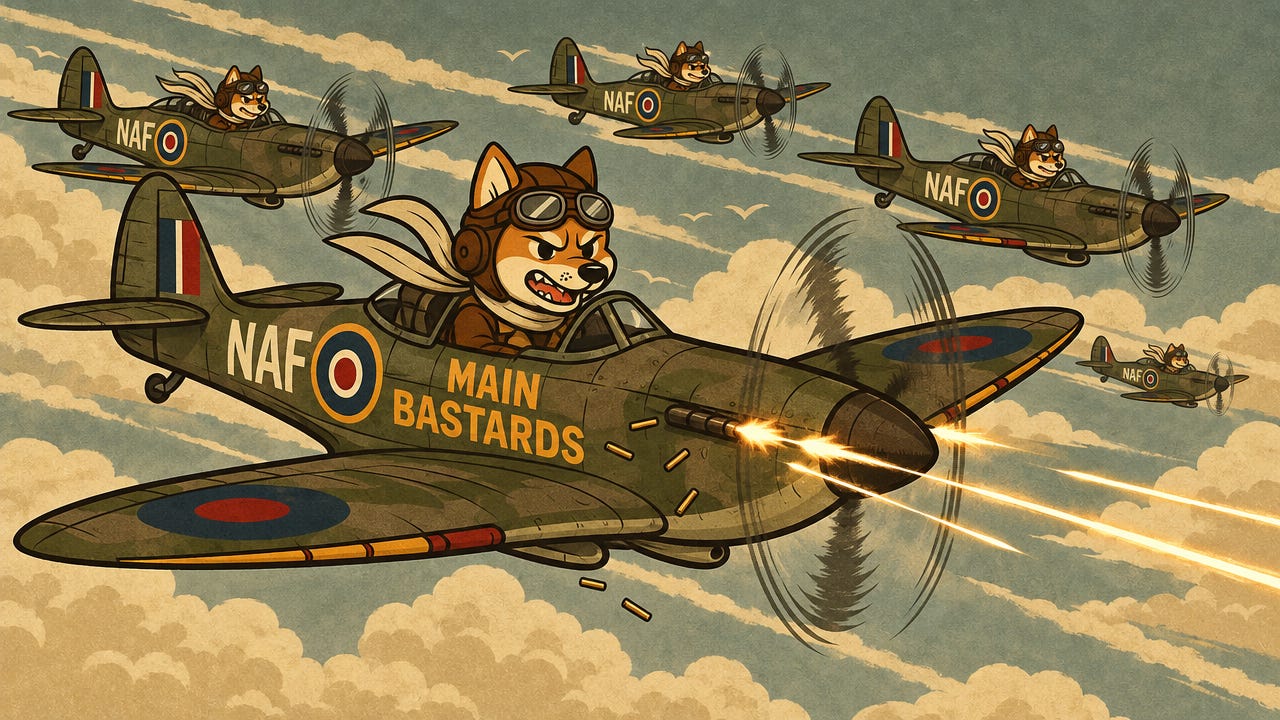
In 1940 the answer to Haw-Haw was a BBC people believed. It still is. The Main Bastards still have the better story; we just need to tell it first.
The series
🇬🇧 The Information Battle of Britain (July 2025)
“Russia Is Not My Enemy”: The Information Battle of Britain, Part Two (24 September 2026)
Mel Gibson Is Not Your Enemy: The Content Pool Behind “Russia Is Not My Enemy” (25 September 2026)
🤝😇 The Envoy: Kirill Dmitriev and the Online Front (26 September 2026)
The Curious Incident of the Dog in the Night-Time: Who Defends Aughinish? (29 September 2026)
Russia Is Not My Enemy: Meet Sasha (30 September 2026)
The map: Russia Is Not My Enemy: the full network, covering the people, accounts and organisations across all six articles.
Method notes, data sources and caveats are in each article. No one named in this series is alleged to act on Russia’s instructions.