


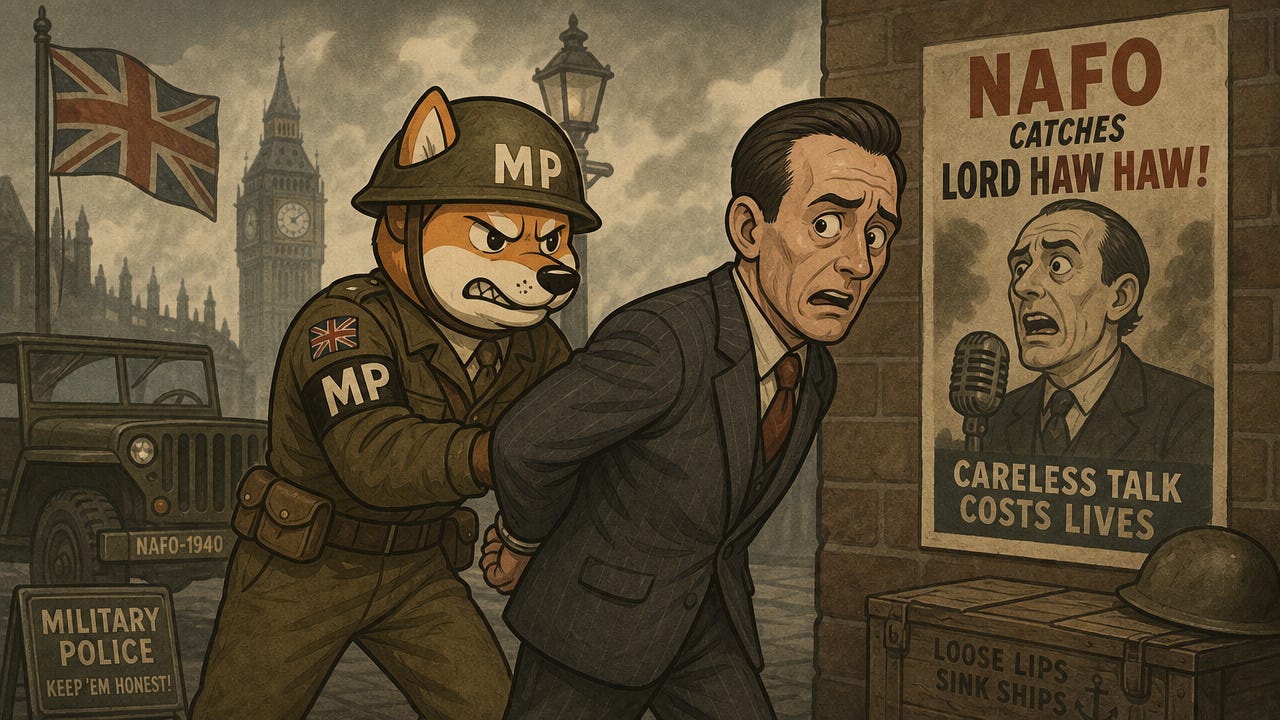
“Germany calling, Germany calling.”
— William Joyce, 1939
📻 The Man Who Called From Hamburg
In the autumn of 1939, a sneering, nasal voice began reaching British wireless sets from Germany. The Daily Express radio critic Jonah Barrington mocked the announcer’s put-on upper-class drawl and christened him “Lord Haw-Haw”. The nickname was probably first aimed at a different broadcaster, but it stuck to the man who became the voice of Nazi propaganda in Britain: William Joyce.
Joyce was born in Brooklyn in 1906, grew up in Ireland and moved to England as a teenager. By the 1930s he was one of the most prominent figures in Oswald Mosley’s British Union of Fascists, until Mosley expelled him in 1937. He set up his own National Socialist League, and in the last days of August 1939 he left for Berlin. Within weeks he was on air.
In the strange, quiet months of the Phoney War, when BBC news was stiff and thin, millions of Britons tuned in, some out of curiosity, some for the entertainment, some because he sounded like he knew things they weren’t being told. BBC research in early 1940 estimated around six million regular listeners, with many millions more listening occasionally.
His real power, though, was the myth. Stories spread that Haw-Haw had mentioned that a particular town hall clock was running slow, or had named the local factory the Luftwaffe would bomb next. Almost none of it was ever broadcast. But the rumour of his omniscience travelled faster and further than the broadcasts themselves, and it did the work Joyce couldn’t.
It ended in May 1945 near the Danish border. Joyce was recognised by his voice, shot and wounded while being arrested, and brought back to stand trial for high treason at the Old Bailey. His defence argued that as an American he couldn’t betray Britain. The court held that the British passport he had obtained by lying about where he was born, still valid when he began broadcasting, meant he owed the Crown allegiance. He was hanged at Wandsworth on 3 January 1946.
Three lessons from Haw-Haw are worth holding on to:
The voice mattered because it was British. He sounded like one of us.
The fear of the voice did more damage than the voice. Rumour was the amplifier.
What worked was better, faster information, not panic about the enemy’s reach.
🔁 Eighty Years On
In The Information Battle of Britain I mapped the British ecosystem of influencers, ideologues and grifters who carry authoritarian narratives into our national conversation. This month that ecosystem got a live test.
On the morning of 24 September, a phrase was all over my timeline: “I’m [nationality] and Russia is not my enemy.” I posted that there was a massive bot campaign. Then I did what I should have done first: I pulled the data.
Using the Sorsa API, I collected around 18,600 posts and 9,800 accounts from 1 to 24 September, and checked where X itself places more than 2,100 of those accounts. The data did not support “massive bot campaign”. What it shows is more interesting, and a lot more British.
🇬🇧 Wave One: “Russia Is Not Our Enemy”
The first thing the data shows is that there were two waves, not one.
“Russia is not our enemy” and its cousin “Russia is not the enemy” are standing slogans in UK populist reply threads, typically ticking along at 15 to 35 posts a day through early September. Around 17 September, the Chief of the Defence Staff, Sir Richard Knighton, told BBC Radio 4’s Today programme that this was the most dangerous period of his 35-year career and that Britain must prepare for longer wars. The slogan jumped that day and stayed above 160 posts a day from the 19th to the 23rd, peaking at 235 on the 22nd. The replies went to BBC News, the Ministry of Defence, Wes Streeting, Kemi Badenoch and Alicia Kearns.
Then came the match that lit the fire. At 09:27 on 20 September, the account @HerdImmunity12 posted a clip of Jacob Rees-Mogg talking about Britain possibly having to go to war, framed with a long rant about migrants, elites and the Eton set. That clip reached 7.8 million views, about five times the combined reach of every “Russia is not my enemy” post in this dataset.
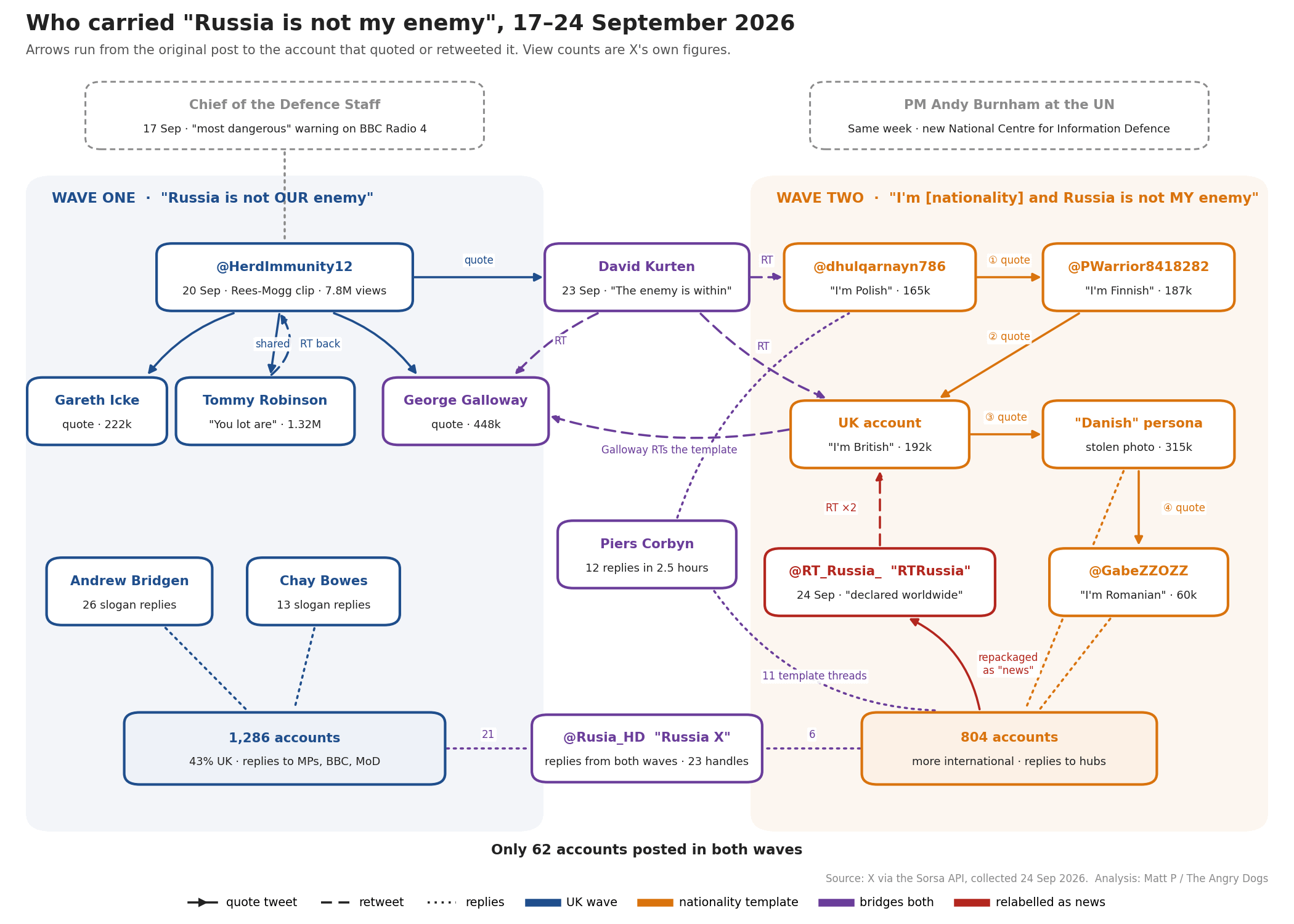
George Galloway was one of the first big names to pick it up. At 15:23 he quote-tweeted it, “’Some of you may die’ says the Member for the 19th Century”, and reached 448,000 people. Eight hours later, Tommy Robinson shared the same clip:
“Send your kids Jacob… Russia is not our enemy. You lot are.”
That post reached 1.32 million views, nearly as many as the entire nationality template put together.
Of 434 quote tweets of the clip, only one repeated the Russia line. The biggest were furious about a posh Tory telling working-class men to die: “his generation… had everything given to them” (711,000 views), and a rich man “who couldn’t knock the skin off a rice pudding” (Gareth Icke, 222,000). The anger was domestic.
Galloway kept going. On 21 September he posted “Rise up. Russia is not our enemy. #NoWarWithRussia” (76,000 views) and “STOP this insane drive to war with #Russia” (71,000). That evening he claimed Rees-Mogg had told GB News that “we did suspend Habeas Corpus during the Napoleonic Wars” and that Britain “would rise to greatness” in a war with Russia. On 22 September he told 335,000 people the war warnings were propaganda written by “MI6 handlers”. Hours later, he told 695,000 that war on three fronts was about to erupt, with the suspension of civil liberties and elections and a media takeover by the security services.
🗂️ The Original Cast
In July 2025 I listed the British voices who carry authoritarian narratives into our national conversation. In one week of September 2026, six of them turned up in this data.
David Kurten. The Heritage Party leader has been posting the exact sentence “Russia is not our enemy.” for years: in June 2023 (757,000 views), December 2023 (1.8 million), August 2026 (128,000) and again on 16 September. On 23 September he posted “Russia is not our enemy. Iran is not our enemy. Palestine is not our enemy. Yemen is not our enemy. The enemy is within.” That post was retweeted by George Galloway, by the British account in the template relay, and by the Polish account the template traces back to. If the “our enemy” slogan has a British owner, it’s Kurten. Galloway went a step further: he also retweeted the British account’s “I’m British and Russia is not my enemy”, the clearest direct link between the two crowds.
George Galloway and Tommy Robinson. Both have been stopped at British airports on their way back from Moscow.
September 2025. Galloway and his wife were stopped at Gatwick under Schedule 3 counter-terrorism powers on their return from Moscow via Abu Dhabi. The Met confirmed neither was arrested. Galloway later said he was held for nine hours, had his phone and laptop taken, and was questioned about his views on Russia and China.
June 2026. Robinson was stopped at Heathrow under the same powers on his return from Russia via Turkey. Police confirmed they interviewed him, seized his devices and released him. The week before, he had posted a video of himself in Moscow with Elon Musk’s father, Errol.
24 September 2026, the day this wave peaked. Robinson’s account said he had been stopped at an airport again and questioned about his views on Russia. The notice he posted says he was being examined, not under arrest or criminal investigation. Police had not commented at the time of writing.
Piers Corbyn. Between 22:19 on 23 September and 00:52 the next morning, he posted 12 replies, 11 of them under nationality-template posts. One was under the account the template traces back to. Five linked straight to his own post: “#BongoNick’s new anti-war poem set to music. Resist! Defy! Do not comply!” The rest were video clips. The British conspiracy scene doesn’t have to be recruited into a Kremlin-friendly trend. It turns up by itself, looking for an audience.
Andrew Bridgen and Chay Bowes. Both acted as magnets for replies. Bridgen drew 26 slogan replies over ten days. Bowes drew 13, after posts including a clip of Sergei Lavrov saying that if Europe attacks Russia “it will be a very short war” (219,000 views).
The Ickes. Gareth Icke, whose quote tweet of the Rees-Mogg clip is above, is David Icke’s son.
Schedule 3 lets officers question anyone about “hostile activity” without needing to suspect them of any crime. Being stopped is not evidence of wrongdoing, and none of the people named here has been charged with any offence connected to Russia. I’m not claiming any of them works for Moscow. The point is that Moscow doesn’t need them to. In the week the country’s most senior military officer warned of danger, the loudest voices telling Britain that Russia was not the enemy were British, and most of them were already on my list.
🎭 Wave Two: “I’m [Nationality] and Russia Is Not My Enemy”
The slogan isn’t new, and it didn’t start online. On 21 August 2025, Ukraine’s Centre for Countering Disinformation, part of its National Security and Defence Council, posted a photo of a sticker from Romania. It shows two hands shaking, one in a Romanian-flag cuff and one in a Russian-flag cuff, under the words “Rusia nu este dușmanul meu”: Russia is not my enemy. The centre called it part of a Kremlin hybrid campaign to create the illusion of a “peaceful partnership”. It said similar stickers had appeared in France and Italy, particularly through pro-Russian organisations.
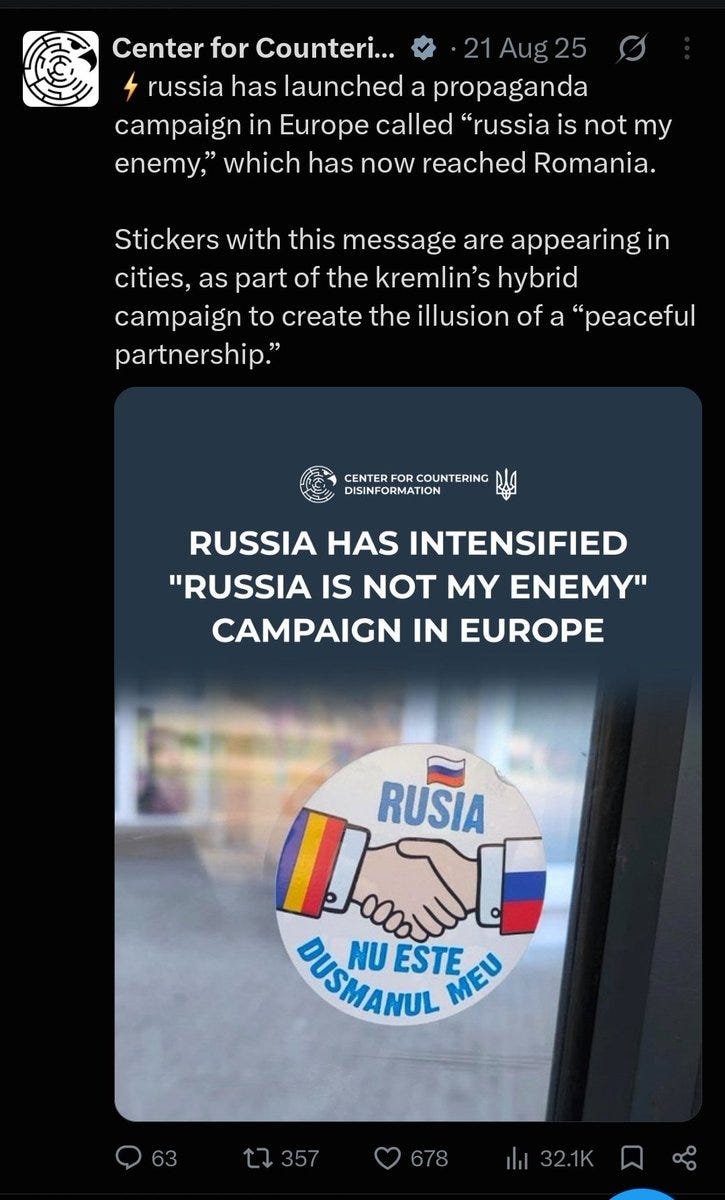
Look at that sticker again: your country’s flag, Russia’s flag, a handshake. That’s the nationality template a year early, printed on vinyl. What happened on X in September 2026 was the same design, with each poster supplying their own flag.
The fill-in-your-nationality template has a traceable owner. An account called @dhulqarnayn786, which X places in Poland and which has changed its handle five times, posted “I’m Polish and Russia is not my enemy” repeatedly from June onwards.
In September the template moved as a chain of quote tweets, and each step reached more people than the last:
21 Sep, 13:51. @dhulqarnayn786 posts “I’m Polish and Russia is not my enemy!” (165,000 views).
22 Sep, 07:56. @PWarrior8418282 quote-tweets it with “I’m Finnish and Russia is not my enemy!” (187,000). X places the account in Finland, its location field reads “Old Finland” in Russian, and its bio lists Putin and Stalin as things it supports.
22 Sep, 20:06. A UK account quote-tweets that: “I’m British and Russia is not my enemy.” (192,000)
23 Sep, 12:25. A “Danish” account quote-tweets the British one (315,000), the template’s most viral post. A Community Note on it says the account uses a profile photo taken from the Facebook page of a Danish businesswoman.
23 Sep. @GabeZZOZZ (96,000 followers, posting as Romanian) joins in (60,000 views), and the next morning posts “We started something beautiful here.” X places the account in “North America”, but it connects through a European app store. It has changed its handle seven times.
Each quote tweet carried the meme into a new national network. It was a relay, not a synchronised launch. At its peak the template ran at about 330 posts a day (in my data).
The relay kept branching. At 19:39 on 23 September, an account X places in the UK quote-tweeted PWarrior8418282’s post with “I’m Finnish, living in the UK, and Russia is not my enemy!” (10,000 views). The next morning, an account X places in Sweden quote-tweeted that: “I’am [sic] Swedish, living in Sweden…” (6,800 views). Both look like real people in the countries they say they’re in. That’s the point: once real accounts pick up a template, it doesn’t need fake ones.
🧮 Two Crowds, One Week
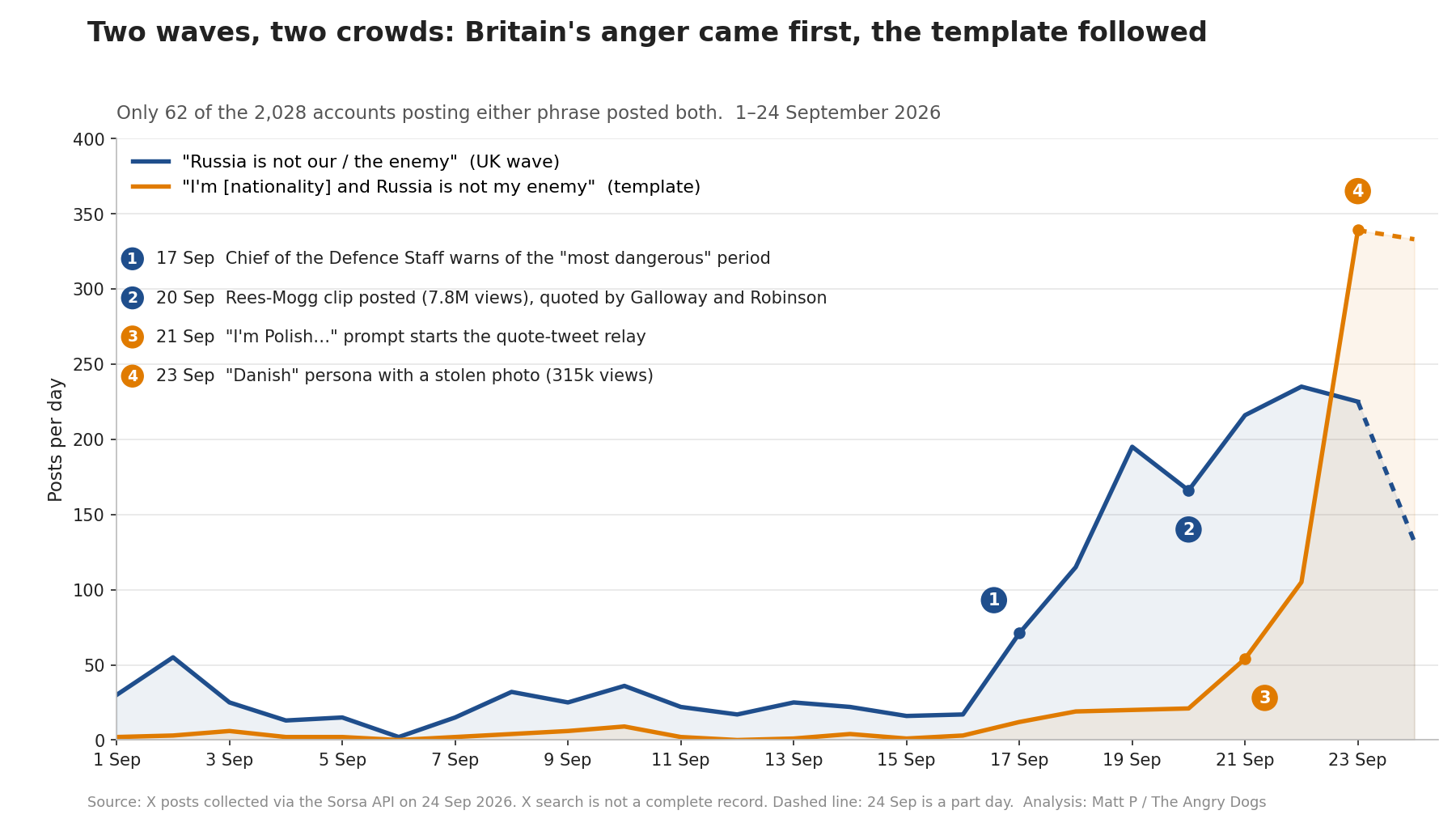
This is the finding that surprised me most. 1,286 accounts posted the British “our enemy” wave and 804 posted the nationality template, but only 62 did both.
The British wave is 43% UK accounts, and its replies go to British politicians and broadcasters. The template crowd is more international, and its replies go to the pro-Kremlin hubs. The template didn’t recruit the British crowd. It borrowed the British crowd’s moment.
And the bot theory, including my own? Only about 9% of accounts in either wave were created in 2026. Where people claimed a nationality, 78% of claims matched the country X assigns the account. These are mostly old, real, very online accounts. The fakery sits at a few key points, like a stolen face on the most viral post, not across the whole crowd.
It’s also worth saying that counter-speech won. A Russian academic living in Denmark replied with “I’m Russian and Russia is my enemy.” It reached 414,000 people, more than any nationality post in the template.
📡 The New Haw-Haw Doesn’t Broadcast. He Relabels.
At 13:48 on 24 September, an account styled “RTRussia” (@RT_Russia_) posted a video item. It claimed X users worldwide were declaring “Russia is NOT the enemy” as the phrase went viral amid UK and EU fearmongering. X places the account in North America, but it connects through an Eastern European (non-EU) app store. It was created in July 2026 and has had Premium since August. Using RT’s branding doesn’t prove any link to RT, but the function is clear. British anger goes in. A “worldwide movement” comes out, packaged as news.
Another account, @Rusia_HD (”Russia X 🇷🇺”), drew replies in both waves. It was created in March 2026, has 154,000 followers, and has changed its handle 23 times. X places it in “West Asia”, but it connects through a North American app store.
The pipeline runs like this:
Domestic anger at a genuine news story.
British voices with big audiences turning it against our own government.
A slogan that was already circulating.
A template that makes it look international.
A “news” account that reports the template as a global uprising.
Back into Russian-language feeds as proof that the West is turning.
🏛️ Meanwhile, at the UN
In the same week this wave peaked, Prime Minister Andy Burnham stood up at the UN General Assembly and took aim at Russia. He said Russian agencies had used “every means at their disposal” to spread lies: bots and fake websites, falsified newspaper articles, the forged branding of 28 British organisations including universities and the BBC, and the amplification of far-right narratives. He said the Kremlin spends around £1.3 billion a year on manipulating information. He announced a new National Centre for Information Defence, run initially from the Office for the Prime Minister and Cabinet, to work with the intelligence agencies, government departments, the police and social media companies.
He also said something that deserves more attention than it got. People struggling with the cost of living, and young people not in employment, education or training, are more vulnerable to this kind of influence.
Andrew Bridgen was quick to respond: “Apparently I am wrong - the Russians did it!” That’s the trap the new centre has to avoid. Put the week’s data next to the speech and both halves of Burnham’s claim show up. There was borrowed branding (an “RTRussia” account reporting a worldwide uprising) and a fake face at the top of the template. But most of the reach came from British voices speaking to real British anger at a Tory grandee telling working-class men they might have to die. If the new centre spends its time hunting bot armies, it will find a few, miss the main event, and hand Bridgen his next post.
🧭 Haw-Haw’s Lessons, Applied
The voice that matters is still British. Joyce was a British fascist on German radio. Today the most powerful lines are made at home, by people whose grievances are real, and then picked up and relabelled elsewhere. A National Centre for Information Defence that only looks outward will miss where most of the reach comes from.
Don’t feed the myth. “Bot army” makes this look bigger, better organised and more foreign than it is. I did exactly that on the morning of the 24th. The truth is a small trend with a few enormous nodes. That’s less frightening, and easier to answer. It’s also harder for Bridgen to mock.
Answer with better information, faster. Burnham is right that people who are struggling are the most exposed. When the country’s most senior military officer says we are in danger, those families need a plain account of what that means for them, from someone they trust, before a clip of Jacob Rees-Mogg and a borrowed Facebook photo fill the gap.
In 1940 the answer to Haw-Haw wasn’t a ministry for hunting him down. It was a BBC people believed. The Main Bastards still have the better story. We just need to tell it before someone with a borrowed face tells it for us.
🔬 Method and Caveats
Source. Data was collected through the Sorsa API from X search, timelines, quote tweets, retweeters and replies, covering 1 to 24 September 2026.
Completeness. X search is not a complete record of every post, but two independent pulls of the same window agreed to within 1%.
Location data. The country and app-store fields are X’s own inferences. A VPN can mislead them, so a mismatch is a lead, not proof.
View counts. These are X’s own figures, captured on 24 September.
Legal status. The Schedule 3 stops described are matters of public record, confirmed by police or posted by the people stopped. No one named in this piece has been charged with any offence connected to Russia.
