



“Is there any point to which you would wish to draw my attention?”
“To the curious incident of the dog in the night-time.”
“The dog did nothing in the night-time.”
“That was the curious incident,” remarked Sherlock Holmes.
— Arthur Conan Doyle, Silver Blaze (1892)
🕰️ The Soviets on the Shannon
This isn’t the first time Moscow has been at home on the Shannon.
In 1980, the Soviet airline Aeroflot struck an unusual deal at Shannon Airport. Soviet tankers delivered jet fuel to County Clare, Aeroflot stored it in its own fuel farm on the airfield, and Shannon became the refuelling stop for Soviet flights to Havana, Managua and the rest of the Americas. The Irish sold on what Aeroflot didn’t burn. For a decade, one of the busiest Soviet footholds in Western Europe sat on the bank of the Shannon estuary in a neutral country that asked few questions. It came with its own story: Shannon became famous for passengers stepping off Soviet transit flights and claiming asylum.
Across the water, Alcan was building an alumina refinery on Aughinish Island. It opened in 1983. In 2007 it was bought by Rusal, the aluminium giant founded by Oleg Deripaska. By 2026, most of what it produced was heading back up the route to Russia.
Neutral Ireland, Russian business and a lot of people looking the other way. The Shannon has seen it before. This time, the question isn’t who shouted. It’s who didn’t.
⚗️ What’s at Stake
I covered the plant in detail in the New Bretton Woods series: Rusal, Rostec, the Swedish tax ruling that Deripaska still controls the business, and Dublin’s long habit of shielding it from sanctions. What changed in 2026 was that people started watching the ships.
19 February: the campaign starts. A NAFO account began posting the cargo ships leaving Aughinish for St Petersburg: “‼️Ireland’s shame.” Ship after ship through March, with the name, the destination and the same refrain.
24 March: the investigation. OCCRP published a joint investigation with iStories, the Irish Times, the Guardian, De Tijd, Delfi and KibOrg. They traced Aughinish alumina to Rusal’s Siberian smelters, and on into the supply chains of Russian arms makers, down to Kh-101 and Iskander-M missiles and tank engines. The Irish Times reported that 68% of the plant’s 2025 output went to Russia. That night the Taoiseach promised a review.
24 April: #Alumina21. The campaign got its hashtag and its target: “Let’s get Alumina into EU Sanctions Package 21!” By May it was #Alumina22.
June: The Kyiv Independent, Euronews and Ukraine’s embassy in Dublin piled in.
8 July: The European Parliament voted by a large margin to end the trade. The campaign’s founder marvelled that “a few tweets about ships” had got that far.
24 July: The Department of Enterprise’s review reported “no adverse findings”, while conceding it couldn’t verify where the alumina ends up.
24 September: Enterprise Minister Peter Burke was questioned about it in Brussels.
📊 A Fight on X
I pulled every Aughinish post I could find from February 2022 onwards, 4,045 posts, to answer one question: who defends it?
The critics won the volume war by a distance: about 1,380 critical posts, 456 of them tagged #Alumina21 or #Alumina22. The defence managed 71 posts from about 40 authors. Another 30-odd accounts qualified as defenders only by retweeting, and 637 accounts amplified defence posts.
A small defence. But a revealing one.
🗺️ Four Corners, One Well
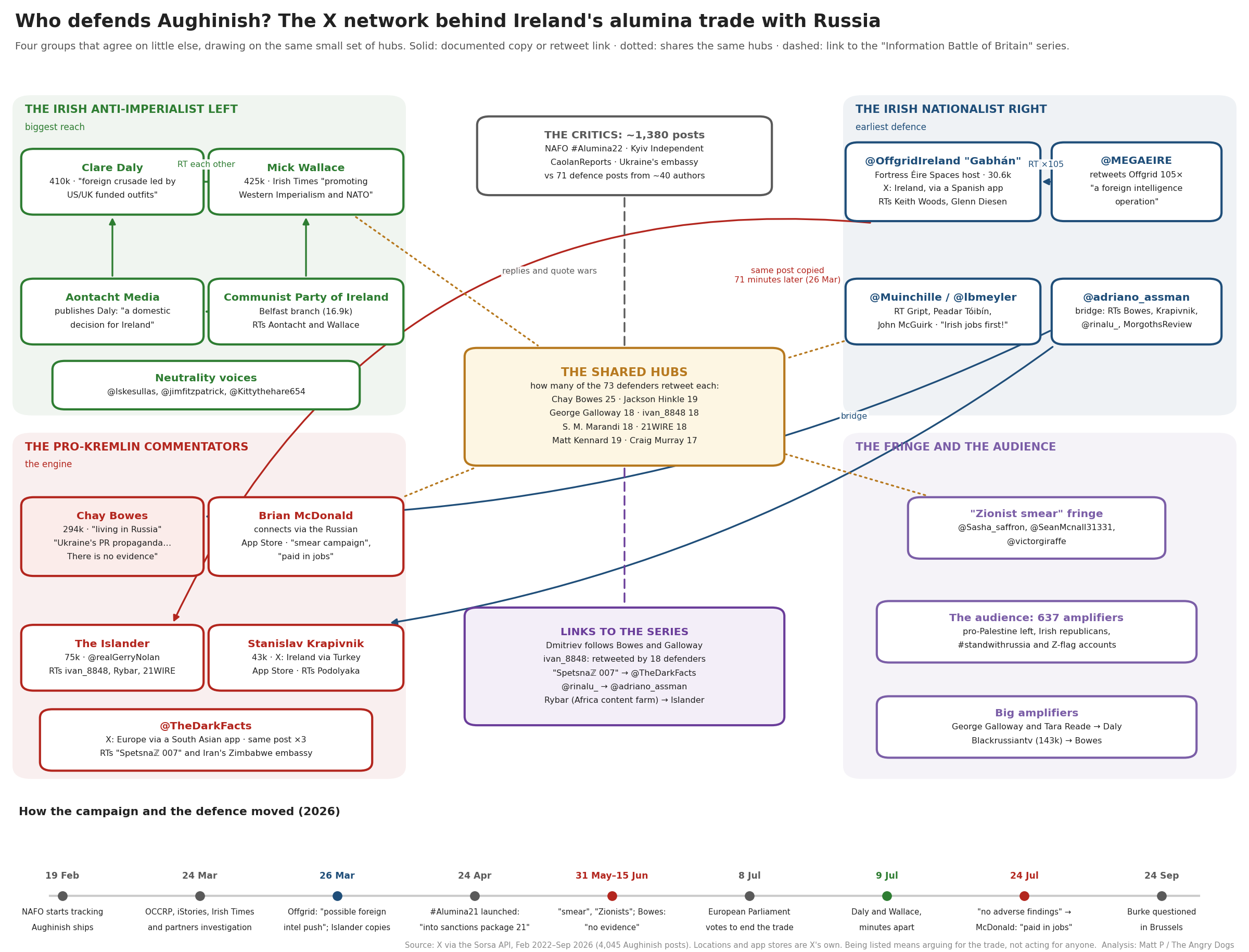
1. The anti-imperialist left: the biggest megaphone. Clare Daly (410,000 followers) and Mick Wallace (425,000) are former MEPs who still reach more people than most sitting Irish politicians.
Daly, the morning after the Parliament vote: Irish MEPs “bow to foreign crusade led by US/UK funded outfits to shut Russian owned Aughinish Alumina justifying it with lies and nonsense”. A day later: “a domestic decision”, and Ireland “shouldn’t be bounced into anything because Kaja Kallas is pressuring us”.
Wallace, within minutes of Daly: the vote was “madness”. A week later he asked whether the Irish Times was “promoting the interests of Western Imperialism and NATO”.
The Communist Party of Ireland’s Belfast branch retweets them both.
Their biggest amplifiers: George Galloway and Tara Reade, who now lives in Russia.
2. The nationalist right: first out of the blocks. Two days after the OCCRP investigation, @OffgridIreland called it a “possible foreign intel push”. In other words, it cast a consortium of European newsrooms as a foreign intelligence operation.
Who Offgrid is: “Gabhán”, a Fortress Éire Spaces host with 30,600 followers. X places the account in Ireland, but it connects through a Spanish app, and it retweets the white-nationalist streamer Keith Woods.
The echo: @MEGAEIRE has retweeted Offgrid 105 times and called the whole affair “so obvious… a foreign intelligence operation”.
3. The pro-Kremlin commentators: the engine.
Chay Bowes (294,000 followers), who describes himself as “living in Russia, Ireland, and the World”: “Ukraine’s PR propaganda wants you to think the plant is supplying Russia with weapons. There is no evidence.”
Brian McDonald (a “long time Russia-based journalist”, connecting to X through the Russian App Store): a “smear campaign”, and later, “the bill would be paid in jobs”.
Stanislav Krapivnik: X places him in Ireland, connecting through the Turkey App Store. He switched the subject to red-mud pollution.
The Islander (75,000 followers): copied Offgrid’s “foreign intel push” post word for word 71 minutes after it went up. It’s the only word-for-word copy in the dataset.
4. The fringe and the audience. A handful of accounts made it about “Zionists”. Behind them sits a crowd of pro-Palestine left, Irish republican and #standwithrussia accounts, retweeting whatever reached them first.
What joins the four groups is who they retweet. Of the 73 defenders:
HubDefenders retweeting:
Chay Bowes 25
Jackson Hinkle 19
Matt Kennard 19
George Galloway 18
ivan_8848 18
Seyed Mohammad Marandi 18
21WIRE 18
Readers of this series will know several of those names.
@ivan_8848 is the Spain-based aggregator with “88” in its handle from Part Three, and a quarter of Aughinish’s defenders retweet it.
Bowes and Galloway are both followed by Putin’s envoy, Kirill Dmitriev, as covered in Part Four.
The Islander retweets Rybar, the Russian military channel whose linked accounts OpenAI caught running an influence “content farm” aimed at Africa.
The defence of a Rusal plant in Limerick runs on the same pipes as “Russia is not my enemy“.
🎻 No Conductor
And yet, for all the shared plumbing, the defence never found a tune.
The critics had a hashtag on 456 posts. The defenders didn’t have one. The critics ran a campaign from February to September. The defenders only ever responded: to the OCCRP investigation, the Kyiv Independent, the vote and the review. No account posted more than five defences.
Their arguments cancelled each other out:
“There’s no evidence it goes to weapons.” That concedes the question matters.
“Belgium does it more.” That concedes it happens.
“It’s a legal private company.” A technical defence.
“It’s a domestic Irish decision.” A sovereignty defence.
Krapivnik attacked the plant itself while defending it from its critics.
They agreed on one thing only: someone else was behind it. Three in four defence posts attacked the messenger rather than defending the plant. But the messenger changed with the speaker:
On the left: NATO and “US/UK funded outfits”.
On the nationalist right: “a foreign intelligence operation”.
Among the pro-Kremlin commentators: “Ukraine’s PR propaganda”.
At the fringe: “Zionists”.
Nobody told them what to say. They each said what they always say.
Which raises the obvious question. In “Russia is not my enemy”, there was a template, a relay and a slogan people could perform. Here, where a Russian company’s trade and a Russian arms supply chain were directly at stake, there was nothing. Why?
🏛️ The Real Defence
Because the real defence was never on X.
The public record:
2018. When the US sanctioned Rusal, the Irish government lobbied Washington directly to protect Aughinish. It worked: the sanctions were lifted in 2019 after Deripaska agreed to give up control. The Swedish tax authority has since found that he never really did.
2022. Within a month of the invasion, the Tánaiste and the finance minister were in talks with the company about the threat sanctions posed to it. Bill Browder warned at the time about Irish ministers meeting “a key oligarch enabler”.
March 2026. Two days after the OCCRP investigation, Helen McEntee argued that the plant’s “significant role” in civilian supply must be considered before any further sanctions.
May 2026. The Taoiseach confirmed the state would keep backing the plant.
8 July. When the European Parliament voted, the Taoiseach’s own party abstained.
24 July. The government answered the investigation with a review it didn’t publish. It sent the report to Brussels, found “no adverse findings”, and conceded it couldn’t verify where the alumina goes.
Then there’s the part nobody saw.
Between 1 May and 31 August 2026, the four busiest months of the campaign, Aughinish Alumina lobbied 20 of Ireland’s most senior officials, according to its own return to the Irish lobbying register:
At the top: the Taoiseach, Micheál Martin, and his chief of staff; the Tánaiste and Finance Minister, Simon Harris; the Foreign Minister, Helen McEntee.
The review: the Enterprise Minister, Peter Burke, and his department’s Secretary General, Declan Hughes. Burke’s department produced “no adverse findings” on 24 July, inside the same four-month window.
Europe: ten Irish MEPs across Fine Gael, Fianna Fáil, Sinn Féin and the independents, lobbied in the months around the Parliament vote.
Also: four more ministers, among them the Limerick minister Niall Collins, and the TD Michael Healy-Rae.
The return records up to twenty phone calls, up to five meetings, up to five informal conversations and a letter. The pitch was “EU Critical Raw Material and risks to ongoing employment at Aughinish”, presenting a Rusal plant as part of Europe’s supply security rather than Russia’s.
One question on the form asks whether the company managed or directed a grassroots campaign. It answered: “No.”
None of this requires anyone in Dublin to care about Russia, and all of it is legal and declared. The motives are Irish: jobs in a region without many good ones, the seats of Limerick TDs, fear that Rusal would leave, and a legal loophole to stand behind. That’s how economic leverage works. A strategic foreign owner doesn’t need you to share its interests; it needs you to depend on it. Once it’s embedded in your economy, your government defends it in order to defend your voters.
The Irish government didn’t act directly for Moscow. It believed it was acting for Limerick. The effect is the same.
🐕 The Dog That Didn’t Bark
In Silver Blaze, Holmes solves the case from a silence. The stable dog didn’t bark the night the racehorse was taken, so whoever took it was someone the dog knew.
Four parts of this series have been about Russian voices:
a slogan relayed across Europe
a scam network passing round Kremlin captions
Putin’s envoy trading emojis with British QAnon accounts
At Aughinish, a Russian-owned refinery feeding a Russian missile supply chain, the dog did nothing. No embassy statement, no ministry, no state media, no envoy. Not one Russian state account posted about Aughinish in the entire dataset. The only official Russian voice in the whole debate was historical: critics dug up the ambassador’s 2018 complaint about US sanctions on the plant.
It didn’t bark because the one keeping the plant open was a familiar figure. Nobody had to run a campaign. The company’s own Irish managers had the Taoiseach’s number, the state was already running the defence, and the lobbying register says so in black and white.
🧭 What This Tells Us
Economic leverage beats information operations. Bots, envoys and influencers are the noisy end of Russian influence. The quiet end is a strategic asset embedded in someone else’s economy, defended by that country’s own government in the name of its own voters.
The quiet channel is legal, and it’s on the register. Twenty officials, dozens of contacts, one letter and a box ticked “No” for grassroots campaigning. The most effective defence of a Russian arms supply chain in Ireland was an ordinary corporate lobbying return.
The online defenders were beside the point. Forty-odd accounts, four camps and a common well of pro-Kremlin hubs produced a scattered defence of a plant that didn’t need one.
The loudest voices are the wrong place to look. We spent four parts looking for Russia’s voice on X. At Aughinish, we found out what happens when Russia doesn’t need one.
Ireland isn’t alone. Belgian and French gas imports, Hungarian and Slovak energy ties: other EU governments protect Russian-linked trade too. Ireland stands out because its trade feeds a documented arms supply chain, and because its government kept defending it after that was reported, while the company was on the phone to the department reviewing it.
The Shannon has a long memory. Aeroflot’s fuel farm is long gone. The alumina is still sailing.
The curious incident at Aughinish is that nothing happened.
The Main Bastards still have the better story. This time, they also had the numbers.
🔬 Method and Caveats
Data. 4,045 posts mentioning Aughinish, Rusal or related terms, February 2022 to September 2026, collected through the Sorsa API with seed timelines, targeted searches, replies and quotes under the biggest posts, and two rounds of snowball sampling from the defenders found.
Classification. Posts were sorted by the arguments used, and every defender named here was checked by reading their posts.
Lobbying. The lobbying details come from Aughinish Alumina Limited’s return to lobbying.ie for 1 May–31 August 2026, published 21 September 2026. The return gives ranges of contact, not dates, so it shows the company lobbied the Department of Enterprise during the period of the review, not before the finding. The register lists Micheál Martin as “Tánaiste and Minister (Department of the Taoiseach)”; he is Taoiseach.
Locations. X’s location and app-store fields are its own inferences. A VPN can distort them.
Being named here means arguing for the trade on X, not acting for anyone. No account is alleged to be directed or paid by Russia.
The government. The argument about the Irish government concerns outcomes and structural dependency, not motive or allegiance. Lobbying is lawful and was declared as required.