


There is a habit, when looking at the crypto trade and the AI buildout, of treating them as software stories. Tokens, models, weights, yields. The habit is a mistake, and it is an expensive one, because it hides the thing that actually matters. Underneath the software is a physical system: power stations, transmission lines, cooling water, refineries, mines. The software is the part you are shown. The rock is the part that is being fought over.
This piece is about the rock. It argues that the AI compute buildout, the stablecoin yield trade documented in Part 3, and the gold and rare-earth repositioning that runs underneath the whole series are not three separate trades that happen to overlap. They are legs of one trade. The financial leg extracts dollar yield on the way down. The physical leg pre-positions on the resource base for the way up. And the same names keep appearing on both legs, which is the tell.
I want to start with electricity, because everything else is built on top of it.
I. The base layer is power, not code
A data centre is a building full of expensive chips that turns electricity into either a model output or a hash. A crypto mine is a building full of slightly different chips that turns electricity into a freshly minted coin. Strip away the marketing and they are the same machine: a device for converting continuous baseload power into a financial asset, sited wherever the power is cheap and the oversight is thin.
This is not a metaphor. The numbers are explicit. Industry research compiled through 2024 put the cost of mining a single Bitcoin at up to 321,000 dollars in Ireland and around 1,300 dollars in Iran, a spread of more than two hundred to one, driven almost entirely by the price of electricity. When the only variable that matters is the cost of power, the operation migrates to wherever power is closest to free. The chips are a constant. The energy is the business.
Hold that thought, because it explains the geography of everything that follows. The AI hyperscalers, Microsoft and Amazon and Meta and Google and the Oracle-backed Stargate project and xAI’s Memphis facility, have announced capital expenditure running into the hundreds of billions for the back half of this decade, with power agreements measured in gigawatts and water consumption measured against the needs of small cities. They are going to the same kinds of places the miners went: Texas, Wyoming, Tennessee, the Gulf states, and increasingly the African continent. Cheap stranded power, weak environmental enforcement, political leaderships willing to wave through infrastructure that sits adjacent to the dollar perimeter without asking too many questions about it.
The crypto miners taught the market a lesson before the AI firms arrived to learn it: that energy can be converted directly into money through compute, bypassing the institutions that normally stand between a kilowatt and a bank balance. AI inherits that lesson with a better press operation. The physical footprint is the same. The only thing that changes is the quality of the cover story.
II. The Russian case: free gas, anonymous money
If you want to see the pure form of the trade, with the marketing stripped off entirely, you go to where the energy is genuinely free and the regulation is genuinely absent. You go to Transnistria.
Transnistria is the breakaway sliver of Moldova, Russian-garrisoned since 1992, that receives Gazprom gas by pipeline and does not pay for it. The gas is nominally added to a debt to Moldovagaz that has reached something like seven billion dollars and that nobody seriously expects to be repaid. That free gas powers the 2,500 megawatt MGRES power station, and a portion of that power has, since legislation was passed in 2018, been pointed at industrial-scale Bitcoin mining. A state-backed enterprise zone offered electricity at 0.043 dollars per kilowatt hour, among the cheapest rates anywhere on earth, and where the gas behind it costs nothing the real figure is lower still.
The RUSI analyst Neil Barnett laid out the mechanism with admirable clarity in late 2024. Mining new coins, as opposed to buying existing ones, produces tokens with no transaction history at the point of their first transfer, which denies investigators the blockchain trail they would otherwise follow. Free gas at one end, untraceable value at the other. The shadow territories of Transnistria, Donbas, and Abkhazia, all under Russian protection, became a near-perfect environment for converting plundered state energy into anonymous money.
The Donbas detail is the one worth pausing on, because it connects directly to the war and to a later part of this series. Barnett’s sources reported a mining centre at the Donetsk Metals Plant, operating under FSB protection, and noted that electricity stolen from the Zaporizhzhia Nuclear Power Plant may also be feeding the rigs. Europe’s largest nuclear facility, seized in the opening weeks of the invasion, its output potentially diverted to mint coins for the people who seized it. The Zaporizhzhia plant is treated, correctly, as a nuclear-safety crisis. It is also, quietly, a power asset, and in this system power assets are mining rigs waiting for a connection. Hold the nuclear thread too: I will come back to uranium, and to who profits from treating it as something to stockpile, a few sections on.
The coins do not stay abstract. Barnett traces the Transnistrian operation to Igor Chaika, son of Russia’s former prosecutor general, who functions as the de facto FSB chief in the territory and who told the Russian press he was ready to sink 400 million roubles into mining there. Swiss sanctions imposed on Chaika in 2024 describe him as the Russian “purse,” channelling money to FSB assets working to bring Moldova under Kremlin control. The same mining operations that enrich well-connected Russians, in other words, also fund the destabilisation of the country next door, the evasion of sanctions through partners in China and India, and, going back to the 2018 indictment of the GRU’s Fancy Bear and Sandworm units, the literal purchase of the servers used to hack a US election. Freshly mined Bitcoin paid for the domain registration on dcleaks.com. The plumbing is not hypothetical.
This is the trade in its rawest form. No yield curve, no model weights, no Davos panel. Just stolen energy in one end and deniable money out the other. Everything the hyperscalers and the stablecoin issuers do is a more respectable version of this same conversion. Transnistria is the control experiment that shows you what the machine is for.
III. From Guinea to Siberia: the aluminium loop
Now follow the physical materials, because the resource base is not only energy. It is also the metals, and here the supply chains close into loops that should not exist.
Start with aluminium, the foundational metal of war: aircraft, armoured vehicles, naval systems, missile and drone components, and the electrical infrastructure underneath all of it. To make aluminium you need alumina, and to make alumina you need bauxite. The largest alumina refinery in Europe sits on the Shannon estuary in County Limerick. It is called Aughinish, it supplies up to 30 per cent of the European Union’s alumina, and it is owned by Rusal, the Russian metals group founded by Oleg Deripaska.
A March 2026 investigation by IStories, OCCRP, and the Irish Times traced the full chain, and it is worth stating plainly because each node looks compliant on its own. The bauxite that feeds Aughinish is mined in Guinea, in West Africa, where Rusal owns three mines that supply more than half its raw material. It is refined into alumina in Ireland. The alumina is then shipped to Rusal’s own smelters in Krasnoyarsk and Sayanogorsk in Siberia, more than 400 million dollars’ worth in 2024, around 40 per cent of those smelters’ total intake. The smelters turn it into aluminium, and a substantial share is sold through a Moscow trader, the Aluminium Sales Company, into the supply chains of sanctioned Russian weapons manufacturers. Bauxite to alumina to aluminium to missile, with almost every node owned by the same group.
None of this is illegal, which is the entire point. The EU has not sanctioned alumina. Deripaska reduced his stake below the threshold after the 2018 US designation, so Rusal and its parent En+ sit formally outside the regime. Irish governments lobbied to keep the plant open in 2018 and again after the 2022 invasion, on the grounds that it was a rare European strategic asset and a major local employer. Every actor in the chain can truthfully say they complied. The materials reach the sanctioned end user anyway. This is what a successful evasion architecture looks like: not a smuggling operation, but a set of individually lawful steps that add up to a war supply line.
The campaign now running under the Alumina21 banner, a NAFO effort pushing the EU to add alumina to its twenty-first sanctions package, has assembled the evidence and the political pressure, and by spring 2026 had more than sixty MEPs signed up. It is also operating against a sharply changed market. In late March 2026, Iranian strikes on the EGA smelter at Al Taweelah in Abu Dhabi and the Alba facility in Bahrain forced uncontrolled shutdowns, with metal solidifying inside the smelting circuits and months of structural damage. Together with curtailments at Qatar’s Qatalum, the combined production loss could approach three million tonnes, and the London Metal Exchange aluminium price hit a four-year high in mid-April. The point the campaign makes is the one this series keeps making: scarcity is now an asset class, and the people positioned across the resource base profit from the scarcity regardless of how it arrives.
Here is the connection that matters for the wider argument. The Guinea end of that chain is not a neutral mining jurisdiction. It is West Africa, where Russia’s Africa Corps is now operating, and where the Sentry’s April 2026 investigation found two Rusal subsidiaries directly supporting Moscow’s military operations. The same group that owns the bauxite mines feeding Europe’s largest refinery is a facilitator of Russian armed presence in the Sahel. The aluminium loop and the Africa Corps loop are not adjacent. They run through the same company.
IV. The legitimacy layer: a peerage on the cap table
Every one of these structures needs a particular ingredient that does not show up in the trade data, and it is worth isolating because it is where the resource trade touches the British establishment directly. The ingredient is respectability. A sovereign mineral protocol, an offshore trading vehicle, a London-quoted commodity holder: each of them works better with a name on it that a regulator or a counterparty will instinctively trust. In the British system, the cheapest source of that trust is a peerage.
Consider the same Guinea bauxite corridor the aluminium loop runs through. Alongside Rusal’s concessions in the Kindia-Dubreka belt sits a memorandum of understanding for a rail and port scheme called the Central Corridor, and the signatory line on that protocol is unusual. It lists, as named principal parties, a Dublin-incorporated bauxite junior called Anglo-African Minerals, the Chinese state construction conglomerate China Railway Group, the Belt-and-Road-aligned investment vehicle Sinofortone Group, the Guinean Ministry of Transport, and a London merchant bank called Strand Hanson. The presence of the bank in that list is the anomaly. Banks advise on sovereign infrastructure deals; they do not normally sign them as a party. Strand Hanson’s own materials describe a model that includes direct balance-sheet investment into developing-market resource assets, which makes the signature less a clerical oddity than a statement of intent. The merchant bank entered itself as a principal alongside a Chinese state builder and a BRI financing vehicle, on a protocol concerning a strategic mineral corridor, in a country where Russia’s aluminium giant holds the neighbouring mines.
Strand Hanson is chaired by Lord St John of Bletso, who until the hereditary-peer changes of March 2026 sat as a crossbench member of the House of Lords. His own entry in the Lords register describes Strand Hanson as “financial services advisers on natural resources in Africa,” the adviser framing, not the signatory one. The bauxite junior, Anglo-African Minerals, produced no documented ore at scale and appears to have lost its concessions in the 2025 revocation cycles under Guinea’s military government. What the protocol generated, on the available evidence, was not infrastructure but political access and option value, with the peerage supplying the legitimacy wrapper. That is the most defensible reading, and I want to be careful to state it as the limit of what the public record shows: the strongest evidence is the signature line itself, and what comes after the signature is largely blank. There is no disclosed Strand Hanson fee, equity, or beneficial interest in the structure, and no documented commercial link between Strand Hanson and Rusal. The recurrence is the chairman and the template, not a proven single conspiracy.
The template recurs, though, and the second instance is sharper because the transaction is fully documented. Return to uranium, the commodity I left hanging at Zaporizhzhia. The same peer chairs Yellow Cake plc, a Jersey-registered, London-quoted vehicle whose entire business is buying physical uranium and sitting on it, the purest possible bet that scarcity is an asset class. In October 2021, Yellow Cake announced it would buy two million pounds of uranium oxide from a trading intermediary called Curzon Uranium at 46.32 dollars a pound, with delivery into its account at Cameco’s facilities in Canada. Curzon was sourcing that material from CGN Global Uranium, the trading arm of China General Nuclear Power Corporation, drawing on the Husab mine in Namibia. The chain, confirmed by World Nuclear News and Yellow Cake’s own placing announcement, runs: a peerage-chaired London vehicle, buying through an offshore intermediary, from a Chinese state nuclear entity, sourced from an African mine. It is the exact structural signature of the Guinea bauxite protocol, transposed onto uranium.
The intermediary is where the Cyprus dimension enters. Curzon Uranium is headquartered in Limassol, with ancillary offices in London and a Dubai free-zone address, the standard architecture for a commodity trader that wants EU membership, light disclosure, and the freedom to deal across Western, Chinese, and former-Soviet supply bases without sitting fully under any one regime. Its named head of trading for Europe and the CIS is a Russian-named executive working out of the Cyprus office. That detail warrants scrutiny rather than a verdict, because the global uranium market runs heavily through Rosatom’s state-owned trading arms, and a CIS desk inside a Cyprus uranium house is precisely the kind of node a sanctions analyst would want to open up. But the discipline this series tries to keep matters here: the documented Curzon supply in the Yellow Cake deal is Chinese, not Russian. I cannot establish a Curzon-to-Rosatom sourcing link on the public record, and I will not infer one from a domicile and a surname. The Cyprus head office and the CIS desk are a flag for further work, not a finding.
What is a finding is the establishment density around the holding vehicle, because it ties this leg back to nodes the series has already named. Yellow Cake was founded in 2018 by Peter Bacchus of Bacchus Capital, formerly Morgan Stanley’s global head of mining and metals banking, with Cantor Fitzgerald among the bookrunners on the 2021 raise that funded the Curzon purchase. Cantor Fitzgerald is the same firm, now run from Washington by Commerce Secretary Howard Lutnick, that custodies stablecoin reserves and recurs in the Tether material later in this series. The Yellow Cake board has also included the Honourable Alexander Downer, the former Australian foreign minister and high commissioner to London, the man whose 2016 conversation with George Papadopoulos triggered the FBI’s Russia investigation, and who served as the UN’s special adviser on Cyprus, of all places. The uranium vehicle therefore touches three threads at once: the peerage-legitimacy layer, the Cantor Fitzgerald layer, and the Chinese-state-resource layer.
The legitimacy is not passive. The same peer stood up in the House of Lords in March 2024, during a debate on Zimbabwe sanctions, to put it to the minister that sanctions had left “a vacuum for the Chinese and the Russians, who are occupied in mining strategic minerals.” It is a reasonable point on its own terms, and one this series would broadly endorse. What is notable is only that the speaker chairs a physical-uranium vehicle whose supply runs through a Chinese state nuclear counterparty, and a merchant bank that signed a strategic-mineral protocol alongside a Chinese state builder, and that neither interest was mentioned in the exchange. The reader can decide whether a reasonable member of the public, knowing those two chairmanships, might want them on the table when the chair rises to speak about who is mining strategic minerals and where. The point is not that the intervention was improper. The point is that the legitimacy layer is not a static letterhead. It speaks, it sits on committees, and it does so on precisely the subjects where its commercial interests lie.
The point of grouping Strand Hanson and Curzon is not to claim they are the same operation. They are not. The commodities differ, bauxite against uranium; the counterparties differ, Chinese state construction against Chinese state nuclear; the geographies differ, Guinea against Namibia and Cyprus. The only thing they share is a chairman and a shape. And the shape is the thing worth naming, because it is the British contribution to the trade this whole series describes: a London-quoted or London-advised vehicle at the front, an offshore intermediary in a low-disclosure jurisdiction in the middle, a state-aligned supplier at the resource end, and a member of the House of Lords on the masthead to make the whole arrangement read as respectable. The legitimacy layer is not a metaphor. It is a cap-table entry, and in the JUMO World case raised elsewhere in this series, a Lords-register non-entry.
V. The African resource grab and its settlement layer
Which brings us to the gold, and to the way the African resource base is being decoupled from the dollar in real time.
Russia’s footprint in Africa has been rebranded but not reduced. Wagner announced its withdrawal from Mali in June 2025; within days the Kremlin-controlled Africa Corps stepped in, absorbing 70 to 80 per cent of Wagner’s personnel under formal defence-ministry control. Across the Central African Republic, Sudan, and Mali, the pattern is consistent: Russian security services prop up an isolated junta, and in exchange gain privileged access to gold, diamonds, and other extractive assets. Transparency International’s exiled Russian arm estimated in mid-2025 that African gold smuggled through Kremlin-linked networks had generated over 2.5 billion dollars since the full-scale invasion began, most of it routed through the United Arab Emirates, the world’s largest importer of undeclared artisanal African gold and the critical blind spot in the global anti-money-laundering system.
The settlement detail is the part that belongs in this series. Increasingly, these resource flows are settled not in dollars but in gold, in Chinese yuan, and in crypto, precisely because dollar settlement exposes the intermediary banks to secondary sanctions. The same logic Barnett identified in the Transnistria mining case applies on the continental scale: where a transaction in dollars puts your Chinese or Indian banking partner at risk, a transaction in freshly mined Bitcoin or in physical gold does not. The African gold trade and the shadow-territory mining trade are solving the same problem with the same tools, and they are draining settlement volume away from the dollar system one convoy at a time.
Then, in February 2026, the United States lifted its sanctions on three senior Malian officials previously designated for their Wagner ties, including the defence minister Sadio Camara. The stated rationale was improving relations with the Sahel. The effect, whatever the intention, was to ease pressure on exactly the personnel sitting at the top of a Russian-aligned resource-extraction state. Read against the rest of this series, it is of a piece with the pattern: the enforcement architecture being relaxed at the very moment the trade it constrains is accelerating.
VI. The keystone: gold
Everything so far has been a metal with a use. Aluminium goes into airframes, gallium into chips, lithium into batteries, uranium into reactors. Gold is the one that matters here precisely because it does not need a use. It is the asset the dollar was pegged to until that Sunday in 1971, the thing reserve managers hold when they have stopped trusting the paper, and it is the metal the entire New Bretton Woods argument turns on. If the dollar’s reserve status is the public good being privatised, gold is the asset that reprices when it goes. The African convoys in the previous section are the small, dirty end of a trade whose respectable end is the largest sovereign reallocation in modern monetary history.
The numbers are not ambiguous. Central banks have bought more than a thousand tonnes of gold in every year since 2022, with 2022 itself the heaviest year of official buying since the 1960s at around 1,136 tonnes, followed by roughly 1,040 tonnes in each of 2023 and 2024. The pace eased in 2025 to about 860 tonnes, still far above the 2010 to 2021 average of under 500. Over the same long arc, the dollar’s share of allocated global reserves has fallen from just over 71 per cent in 1999 to around 57 per cent in 2025, its lowest in roughly three decades, while emerging-market central banks, China and India prominent among them, have been the dominant gold buyers. Some of the recent dollar decline is an exchange-rate effect rather than active selling, and honesty requires saying so; the contaminated vocabulary this series warned about would call the whole move a flight from the dollar, when a good deal of it is arithmetic. But the gold accumulation is not arithmetic. It is deliberate, sustained, and concentrated among precisely the states with the most reason to expect they could one day find themselves on the wrong side of a clearing system they do not control. They are buying the one asset that carries no counterparty and answers to no sanctions list.
The American response to this is the part that gives the game away, because it is not resistance but participation. In February 2025 the new US president Trump signed an executive order tasking the Treasury and Commerce secretaries jointly with establishing a US sovereign wealth fund, with the stated aim, in the Treasury secretary’s own words, of monetising the asset side of the US balance sheet. The largest dormant asset on that balance sheet is the gold reserve, the largest official holding in the world at some 261 million troy ounces, still carried at the statutory 1973 valuation of 42.22 dollars an ounce against a market price that has run past 4,000. The gap between book value and market value is now well over a trillion dollars, a paper gain the Treasury could in principle book without selling a single bar. The Treasury secretary has spoken publicly of a “Bretton Woods realignment,” and Federal Reserve guidance has confirmed his authority to issue gold certificates against the holdings. The same administration whose Commerce secretary’s family bank holds a slice of the largest stablecoin is preparing to revalue the national gold pile. The stablecoin position extracts dollar yield while the dollar is still trusted; the gold revaluation is the hedge for when it is not. Both bets sit in the same cabinet.
This is where John Thornton belongs, because he is the clearest single embodiment of the gold-side position. Thornton is executive chairman of Barrick, the world’s second-largest gold miner, a position he secured in an internal power struggle in September that removed the long-standing chief executive. Barrick’s joint ventures include Shandong Gold and Zijin Mining, both owned by the Chinese state. Thornton has sat on the China Investment Corporation’s international advisory council continuously since 2009; he has met Xi Jinping’s chief of staff in Beijing and, earlier, a Chinese vice-premier, and the Hong Kong press describes him as among the best-connected American business figures in China. Hold that against the stablecoin cabinet and the shape of the whole trade resolves. One set of actors extracts the dollar’s network yield on the way down through privately issued tokens; another pre-positions on the metal that reprices on the way up, with a foot in both the American and the Chinese gold complexes. The positions are opposite ends of the same bet on the dollar’s managed decline, and in the documented record the personnel for both leg sit, in at least one case, at the same table. The series will return to that table; for the resource argument it is enough to note that gold is not a sideline to the trade. It is the destination.
VII. The Western mirror: Ukraine and Greenland
It would be comfortable to file all of this under “things Russia does.” It would also be wrong, because the Western version of the resource grab is running on the same logic, just with better lawyers and a reconstruction-fund wrapper.
Consider Ukraine. The minerals deal signed on 30 April 2025 established a joint US-Ukraine Reconstruction Investment Fund, structured fifty-fifty, financed by revenues from new licences across fifty-seven mineral types: lithium, titanium, graphite, uranium, rare earths. Ukraine retains ownership of the resources; US firms get early access to development. The flagship is the Dobra lithium deposit south of Kyiv, the most promising in a country that holds perhaps a third of Europe’s lithium, and the consortium reported to have won the tender includes TechMet, a miner backed by the US government’s Development Finance Corporation, alongside Ronald Lauder, a long-standing Trump associate. The framing is reconstruction and security guarantees. The structure is preferential access to a war-torn country’s resource base, granted under conditions where the country has very little leverage to refuse.
I have written elsewhere in the more polemical register about how the people pushing the Ukraine “peace” framing stand to profit from the surrender, and I will not relitigate that here. The narrower point for this piece is structural. The mineral deposits sit in or near contested territory; the deal’s value depends on the war ending on terms that stabilise the ground; and the actors positioned to benefit are the ones with both the capital and the political access. Energy security and resource access outrank sovereignty in the negotiation, because the people doing the negotiating are positioned on the resource side of the table.
Greenland is the same move performed in the open. Throughout 2025 and into 2026 the US president talked, repeatedly and not always metaphorically, about acquiring Greenland, and each round of talk sent the share price of Critical Metals Corp surging, sometimes more than 25 per cent in a session. Critical Metals controls the Tanbreez deposit in southern Greenland, one of the largest rare-earth resources outside China, holding among other things the gallium and germanium that the GPU and rare-earth-magnet supply chains depend on and that Beijing currently bottlenecks. The US Export-Import Bank sent a letter of interest for a 120 million dollar loan; the administration has reportedly discussed taking a direct equity stake.
And the now-familiar overlap appears on cue. An OCCRP investigation found that the company GreenMet, which signed a partnership to help develop Tanbreez, counted among its shareholders George Sorial, former chief compliance counsel of the Trump Organization, and Keith Schiller, Trump’s former director of security who ran Oval Office operations. They are described now as passive shareholders, having resigned their board roles in early 2025. Passive or not, the structure is the one this series documents everywhere: the resource asset, the state pressure to acquire it, and the former employees of the relevant principal holding equity in the vehicle that benefits. Greenland is rare earths, but it is also gallium and germanium, the exact chokepoint inputs for the compute buildout in section I. The base layer and the financial layer are the same layer, viewed from different ends.
VIII. The convergence
Step back and the legs of the single trade become visible as one structure.
The AI compute buildout is the physical-asset side: hundreds of billions in capex, sited on cheap stranded power, demanding gallium and germanium and the rare-earth magnets that move the cooling systems. The stablecoin float documented in Part 3 is the financial-asset side: a private claim on US Treasury yield, extracting on the way down what used to accrue to the public balance sheet. The gold and rare-earth repositioning, from BRICS central-bank buying to Tanbreez to the African gold convoys, is the pre-position for the way up, for the moment when reserve status erodes and physical assets reprice. Russia supplies the geopolitical leverage that accelerates the erosion, and Russia is itself running the rawest version of the energy-to-money conversion in its shadow territories. And the settlement layer, gold, yuan, and crypto, drains volume away from the dollar with every convoy and every mined coin.
The same names recur across the legs, which is what tells you it is one trade and not three. Cantor Fitzgerald, whose Howard Lutnick is now Commerce Secretary and whose family bank holds a slice of Tether through convertible debt, custodies stablecoin reserves, bookran the uranium vehicle, and brokers commodities. Rusal owns the bauxite in Guinea, the refinery in Ireland, and the smelters in Siberia, and its subsidiaries support the Africa Corps that guards the gold. Trump Organization alumni hold equity in the Greenland vehicle while the administration talks the deposit’s price up. A single crossbench peer chairs both the merchant bank that signed the Guinea bauxite protocol with Chinese state construction and the London uranium vehicle that bought, through a Cyprus intermediary, from Chinese state nuclear. And the gold-side position and the stablecoin position, as the previous section showed, sit in the same cabinet and, in the documented record, at the same table. You do not need a conspiracy to coordinate any of this. You need only a set of actors each maximising returns within their own positions, where the positions happen to be positioned in the same trade.
There is one layer this piece has deliberately left out, because it has a part of its own coming. None of these positions is safe without political protection: someone has to make the deregulation popular, frame the enforcement as economic self-harm, and keep the borders of the trade open at the retail end. That is the work of the people who sell the politics rather than hold the equity, the Bannon network that turned a European revolution into a membership funnel, the Farage operation that turned Tether’s largest shareholder into a record-breaking donor. They are not a separate story. They are the distribution layer of this one, and Part 8 is where they get their invoice.
IX. Two companion pieces
This argument did not arrive fully formed, and two earlier essays on this site did the rough sketching that the present piece tries to finish. Both are written in a more polemical register; both are worth reading alongside this one, because each supplies a half that the resource argument needs.
The first, The Betrayal of Ukraine: Peace, Power, and the Price of Electricity, is in effect the first draft of this piece’s central claim. It lays out the same layered system, energy and hard assets at the base, compute and crypto as energy arbitrage on top, financial opacity above that, and narrative laundering at the retail edge, and it reaches the same conclusion this one reaches by a longer route: that the digital economy is physical, that scarcity has become an asset class, and that a “peace” which stabilises energy and mineral flows is a financial instrument before it is a humanitarian one. It is also where Yellow Cake and the Zaporizhzhia plant first appear in the argument, the same two anchors that open and run through the resource case here.
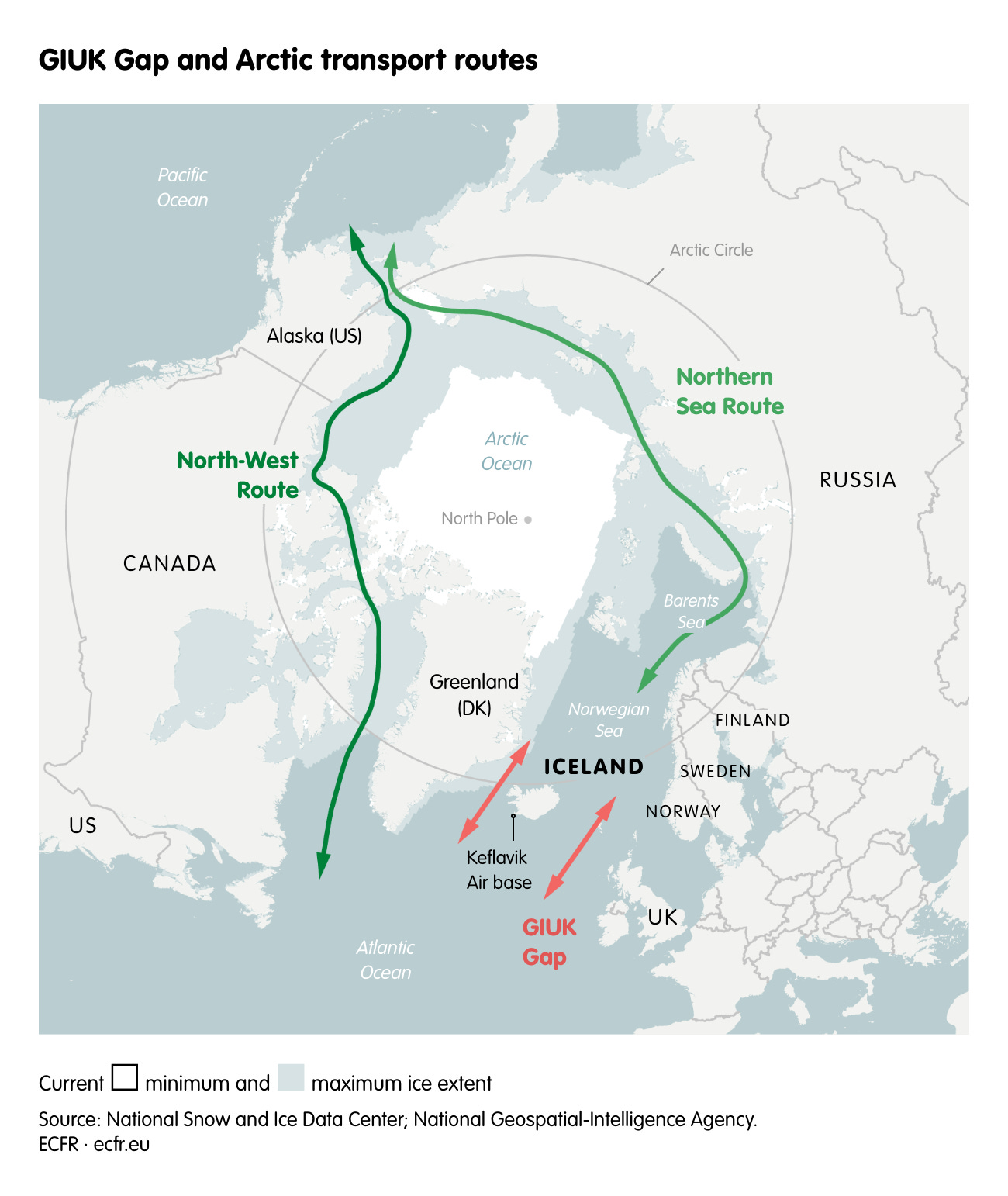
The second, GIUK, the Arctic, and the Sound of a Narrative Shifting, supplies the enforcement geography. Its subject is the Greenland-Iceland-UK gap, not as a Cold War anti-submarine line but as a compliance space: the corridor where sanctions either hold or leak, where shipping insurance is enforced or quietly relaxed, where one inconsistent enforcement jurisdiction is enough to make a whole evasion architecture viable. That piece makes the case that the reason a particular British political project matters is not its rhetoric but its function, the most plausible route to a government willing to reframe enforcement as economic self-harm rather than abolish it outright. That mechanism, enforcement loosened from inside government rather than broken from outside, is the political precondition for everything the present piece describes, and it is the subject the series returns to in Part 8.
X. The story being told, and the one being financed
We are told that AI will solve scarcity. That is the story on the panels and in the keynotes: abundance, efficiency, the marginal cost of intelligence falling to zero.
The story the buildout actually tells is the opposite. AI has not abolished scarcity; it has located it, fenced it, and priced the admission tickets, and it is paying for the tickets in a currency whose yield is being quietly privatised. The scarce things are power, water, gallium, germanium, lithium, gold, and the few jurisdictions willing to host the conversion without asking questions. The buildout is a machine for finding those things and enclosing them. Both stories can be true at once. Only one of them is being financed, and it is not the one about abundance.
The previous piece in this series traced the doctrine, from LaRouche’s employees to the State Department’s policy-planning staff, that supplies the intellectual cover for the dollar’s managed decline. The next turns to Russia’s crypto operations directly, and the bridge between the two pieces is a question this one has set up without answering. Transnistria, in section II, is the working prototype: free seized power at one end, anonymous coin at the other, in a frozen zone beyond any enforcement reach. Hold that prototype against the map Alexander Lukashenko stood in front of in March 2022, the one with the Odesa axis sweeping down the coast to link the Transnistrian garrison through the southern ports to the Donbas. The corridor he displayed was never completed; Transnistria today is severed, not connected, and the Zaporizhzhia plant sits in cold shutdown. But ask why Russia is physically building transmission toward a Donbas it has depopulated, a territory whose civilian and industrial demand is now a fraction of the generating capacity being wired into it, and which is already documented to host industrial mining. You do not reroute Europe’s largest nuclear station toward a region that cannot use the power, unless the plan is to give the power somewhere else to go. The honest formulation is not that the war was fought to build a mining corridor; it is that a Russia-friendly settlement over that ground would convert seized, sanctioned generation into unsanctioned value, the Transnistrian template scaled onto a far larger power base, under a regime with every reason to host it. That is the designed end-state the pieces point at, even though the end-state does not yet exist. The thread that joins the two pieces is the one this one has tried to make visible: that the resource base is not the backdrop to the financial trade. It is the collateral. And the collateral is being moved, mine by mine and megawatt by megawatt, to the other side of the table. The next article will discuss the post-Soviet era and describe how this strategy has evolved.
Sources for this piece include the RUSI commentary “The Other Bitcoin Boom: Crypto Mining in Russia’s Shadow Territories” (Neil Barnett, December 2024); the IStories / OCCRP / Irish Times investigation into the Aughinish alumina supply chain (March 2026); the Sentry’s “Doubling Down” report on Africa Corps in West Africa (April 2026) and Transparency International Russia’s “Gold and Crossbows” (July 2025); reporting from the Kyiv Independent, Carnegie, CSIS, and Reuters on the US-Ukraine minerals fund; OCCRP, Bloomberg, and CNBC on the Tanbreez and GreenMet dealings in Greenland; World Nuclear News and Yellow Cake’s own placing announcement (October 2021) on the Yellow Cake / Curzon / CGN uranium transaction; Strand Hanson’s archived Africa transactions page and Lord St John of Bletso’s House of Lords Register of Interests on the Central Corridor signature; Hansard (Lords, 7 March 2024) for the Zimbabwe sanctions exchange; the World Gold Council and central-bank reserve data for the gold-accumulation figures, with the US sovereign-wealth-fund executive order and gold-revaluation framework drawn from Treasury statements and contemporaneous reporting; and the Alumina21 campaign materials. The two companion essays are linked in section IX above.