


I didn’t start by looking for Russia.
Or the Arctic.
Or peace plans.
I started by noticing noise.
The wrong people talking too loudly, at the wrong time, about the same things, “peace”, “sovereignty”, “ending the war”, and doing it in ways that felt oddly self-exposing. Clout-chasing. Amateurish. Sometimes ridiculous. That usually means nothing. Sometimes it means you’re watching a system adjust in public.
So I stopped reading posts and started tracking structure.
Not what people said, but when they said it.
Not who was loud, but who stayed quiet.
Not intent, but function.
Step One: Distance, Not Access
Nigel Farage is an obvious political figure. He’s also unusually disciplined.
He doesn’t wander into chaotic edges.
He doesn’t publicly fraternise with reputationally radioactive actors.
He rarely needs to explain himself.
That matters.
When someone like that consistently stays just far enough away, the mistake is to look closer. The correct move is to look around them at the people and organisations that absorb risk so they don’t have to.
That means:
media operators
service brokers
think-tank-style outfits
peripheral hosts
patrons and facilitators
People who create access without owning outcomes.
That’s how I ended up reading his interests register properly.
One entry stood out: Imperial Media, based in Alaska.
Not because Alaska is exotic, but because it is structurally odd for a UK political figure, and structurally useful. The same operation appears across UK political media work, Icelandic political servicing, and overlaps with the Centre for Global Prosperity, a post-Cameron network. On paper, it’s consultancy. In context, it’s brokerage.
Not command.
Not control.
Friction reduction.
That was the first marker.
Step Two: Put the Map on the Table
The real shift came when I stopped thinking about ideology and looked at geography.
Greenland.
Iceland.
The UK.
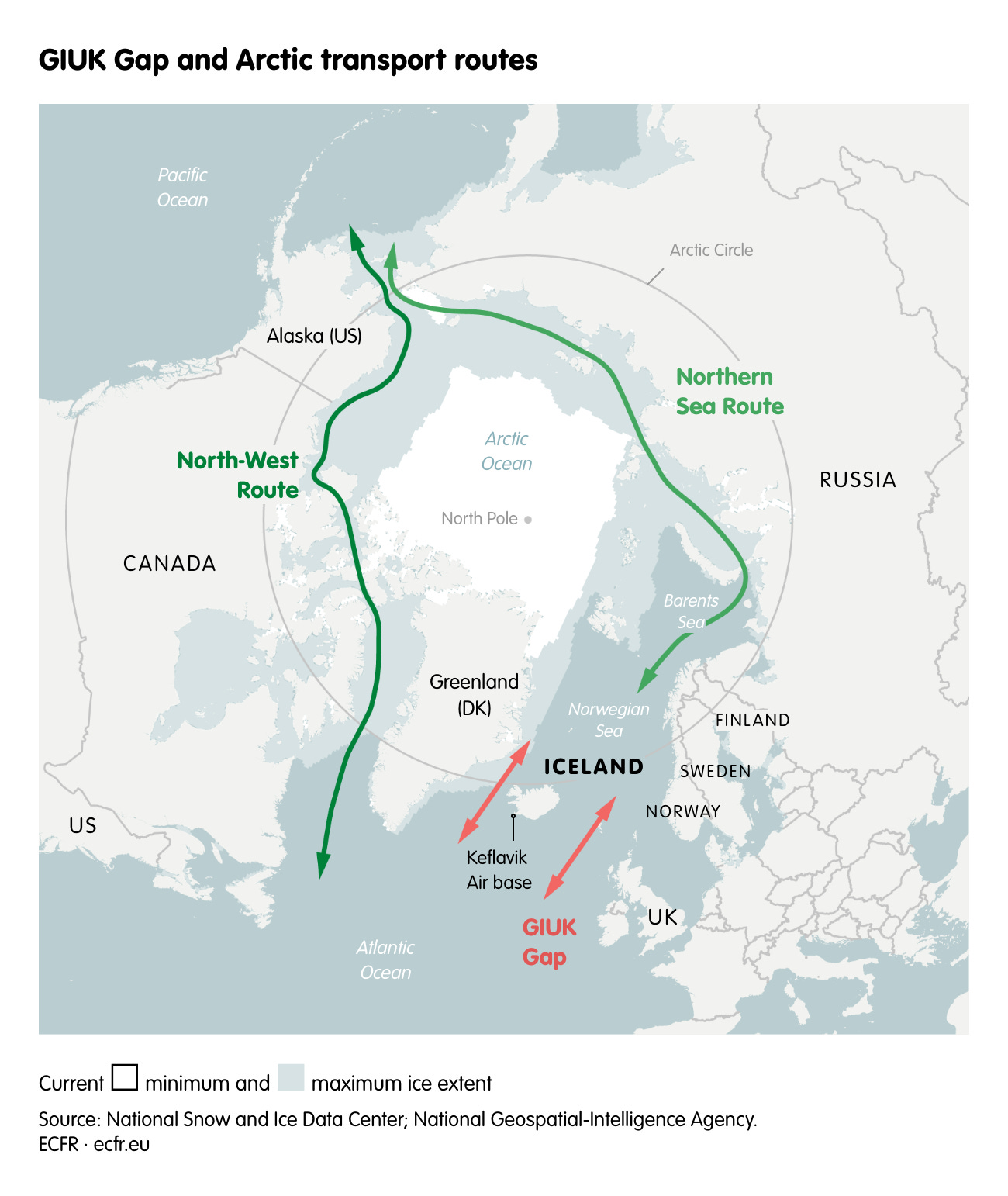
Together they form the GIUK gap: not an abstraction, but an enforcement space.
As Arctic routes open, this corridor becomes where:
sanctions either hold or leak
shipping insurance is enforced or quietly relaxed
surveillance is coordinated or fragmented
compliance cultures remain rigid or become “pragmatic”
This isn’t politics in the cultural sense.
It’s plumbing.
Once you see that, a lot of apparently disconnected behaviour stops looking random.
What People Get Wrong About “Arctic Routes”
People imagine the Arctic as a shortcut, a line on a globe.
That’s not how trade works.
Routes aren’t lines. Routes are systems.
To make an Arctic corridor real, you need:
insurers willing to underwrite risk
regulators willing to interpret rules flexibly
ports and services that behave predictably
governments that tolerate carve-outs without calling them corruption
You don’t need everyone onside.
You need one key enforcement space to become inconsistent.That’s why GIUK matters.
And that’s why the UK matters disproportionately.
The Witkoff Plan: What Actually Changed
The Witkoff “28-point peace plan” matters less for its individual provisions than for its architecture.
What’s new is not just territorial settlement language, but:
phased sanctions relief logic
economic normalisation framing
explicit attention to trade and reconstruction
an implicit Arctic and logistics horizon
This isn’t just diplomacy. It’s an economic reset proposal.
Once that exists, people start positioning before it becomes official policy.
That’s the moment when ecosystems react.
Dmitriev and Luna: Two Different Functions
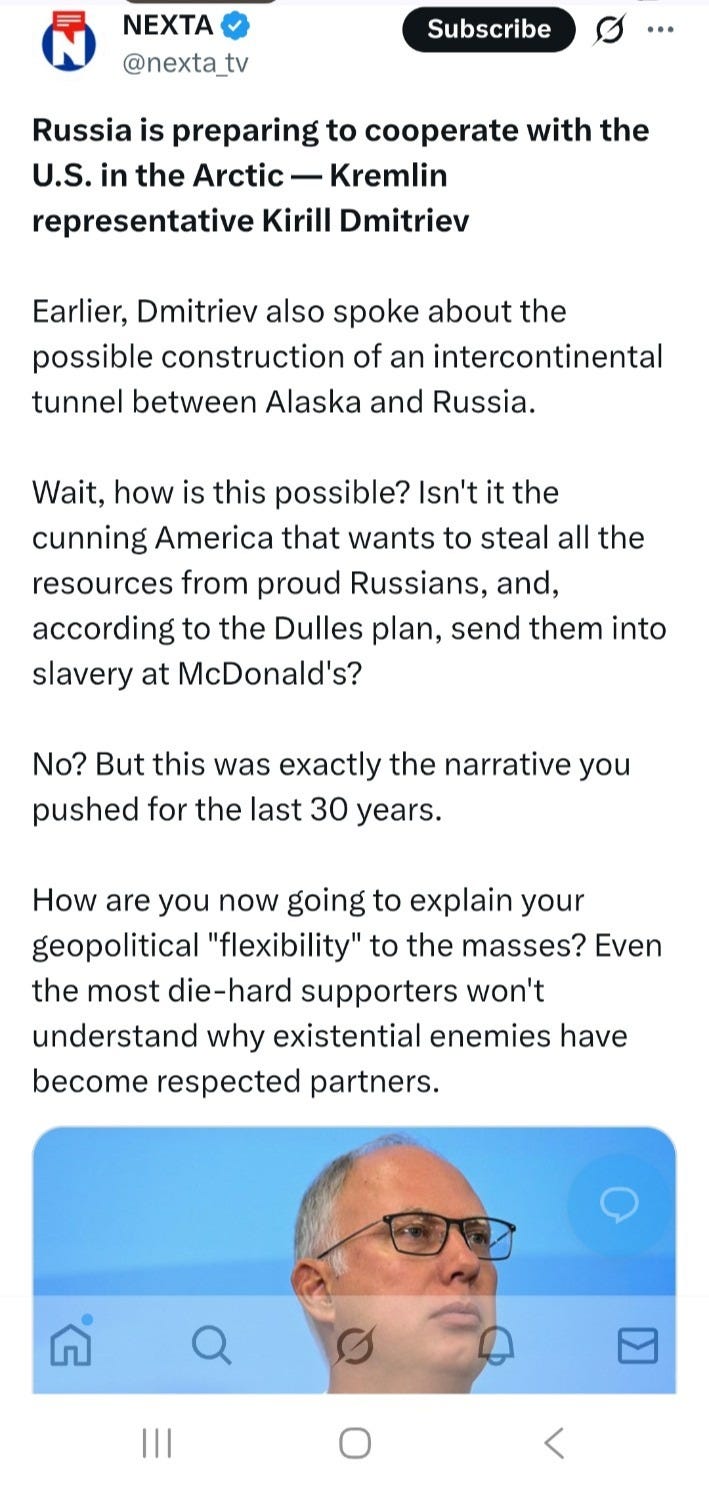
At the centre of the negotiation channel sits Kirill Dmitriev, sanctioned, but repeatedly engaged by US interlocutors. His role is not rhetorical. It’s material: trade, investment, normalisation.
Running parallel is Anna Paulina Luna.
She is not presented as the author of the plan. That’s not her function.
Her function is legitimisation.
A pro-Trump congresswoman meeting Dmitriev in Florida, talking openly about peace and trade, makes that frame sound normal inside Republican politics. That matters when sanctions relief and economic reset language are politically sensitive.
Those are two distinct roles:
Dmitriev: substance
Luna: cover
Neither requires secrecy.
The Timeline Problem
Here is what can be shown from public timestamps alone:
John Mappin engages Dmitriev before the Witkoff plan becomes public
Dmitriev publicly acknowledges and amplifies John and Irina together
On 8 October 2025, Dmitriev, John Mappin, Irina Mappin, and Anna Paulina Luna all appear in the same narrow interaction window pushing identical “peace / sanity / cooperation” framing
This happens before Reuters, Axios, or Politico report the Miami meetings
That sequencing matters.
If this were reaction, it would come later.
It doesn’t.
That’s not interpretation. It’s a clock.
John Mappin: Noise You Can Ignore, Until You Can’t
John Mappin behaves like noise:
loud
repetitive
status-seeking
eager to signal proximity
On his own, he would be ignorable.
But he isn’t alone.
The system changes when:
Dmitriev acknowledges him
Irina reinforces selectively
Luna legitimises the frame
the timing precedes public disclosure
At that point, Mappin stops being “a guy posting” and becomes a surface where the system becomes visible.
He is not running anything.
He is showing you something.
Irina Mappin: Why She Changes the Read
Irina’s behaviour is the opposite of John’s.
She is:
low-output
non-reactive
rarely emotive
absent during amplification spikes
present at transition points
She does not argue doctrine.
She does not persuade audiences.
She does not chase virality.
Her interventions coincide with junctions: validation moments, introductions, shifts in tone.
That pattern, silence punctuated by precisely timed engagement, is not influencer behaviour. It’s facilitation behaviour.
That doesn’t prove intent.
It changes the risk profile.
In influence environments, people who speak least often matter most.
Where Bridgen Fits
Andrew Bridgen behaves exactly how you’d expect a peripheral amplifier to behave:
loud
repetitive
ideologically explicit
reactive to news cycles
He matters not because of originality, but because he demonstrates how quickly Kremlin-aligned framing can be repeated inside UK political discourse once the weather changes.
He’s not a planner.
He’s a stress test.
Now the Key Question: Why Farage Has to Be in Government
Farage is not important because he tweets.
He is not important because of ideology.
He is important for one reason only:
He is the most plausible route to a UK government willing to loosen enforcement without formally breaking with allies.
Sanctions, shipping controls, insurance enforcement, port access, intelligence sharing, these are executive functions.
You cannot weaken them from the side-lines.
You need:
ministers
regulators
guidance
discretion
A conventional Conservative or Labour government is structurally constrained by:
treaty obligations
civil-service continuity
intelligence norms
alliance discipline
Even sympathetic individuals would be boxed in.
A Farage-led or Farage-influenced government changes that calculus.
Not by repealing sanctions, but by reframing enforcement:
as economic self-harm
as outdated
as negotiable
as “pragmatism”
That only happens in government.
Why Farage Must Stay Clean
This also explains his distance.
If Farage were publicly associated with:
sanctioned Russians
alt-media chaos
overt “peace activism”
conspiracy-adjacent networks
his utility would collapse.
He cannot be the person arguing for change.
He has to be the person change happens under.
That is why others absorb reputational damage.
What This Is, and What It Isn’t
This is not a conspiracy.
It doesn’t require coordination, handlers, or secret instructions.
It requires:
negotiations shifting direction
actors recognising opportunity
disciplined figures staying quiet
undisciplined figures rushing forward
That is exactly what the public record shows.
The Plain Conclusion
What is demonstrated here is not intent or loyalty.
It is pre-positioning:
narratives appear before they are needed
legitimising figures arrive before announcements
enforcement-relevant geographies recur
the same actors surface at transition points
Once you see that, the noise stops being random.
It becomes diagnostic.
And the reason Farage matters is simple:
Without him in government, nothing changes.
The next article will explain this in geo political terms and why the world is on a knife edge.
Agreed. Farage is much more dangerous than his image suggests.
Yeah that. All of it. Makes more sense to me. Thanks 😊