


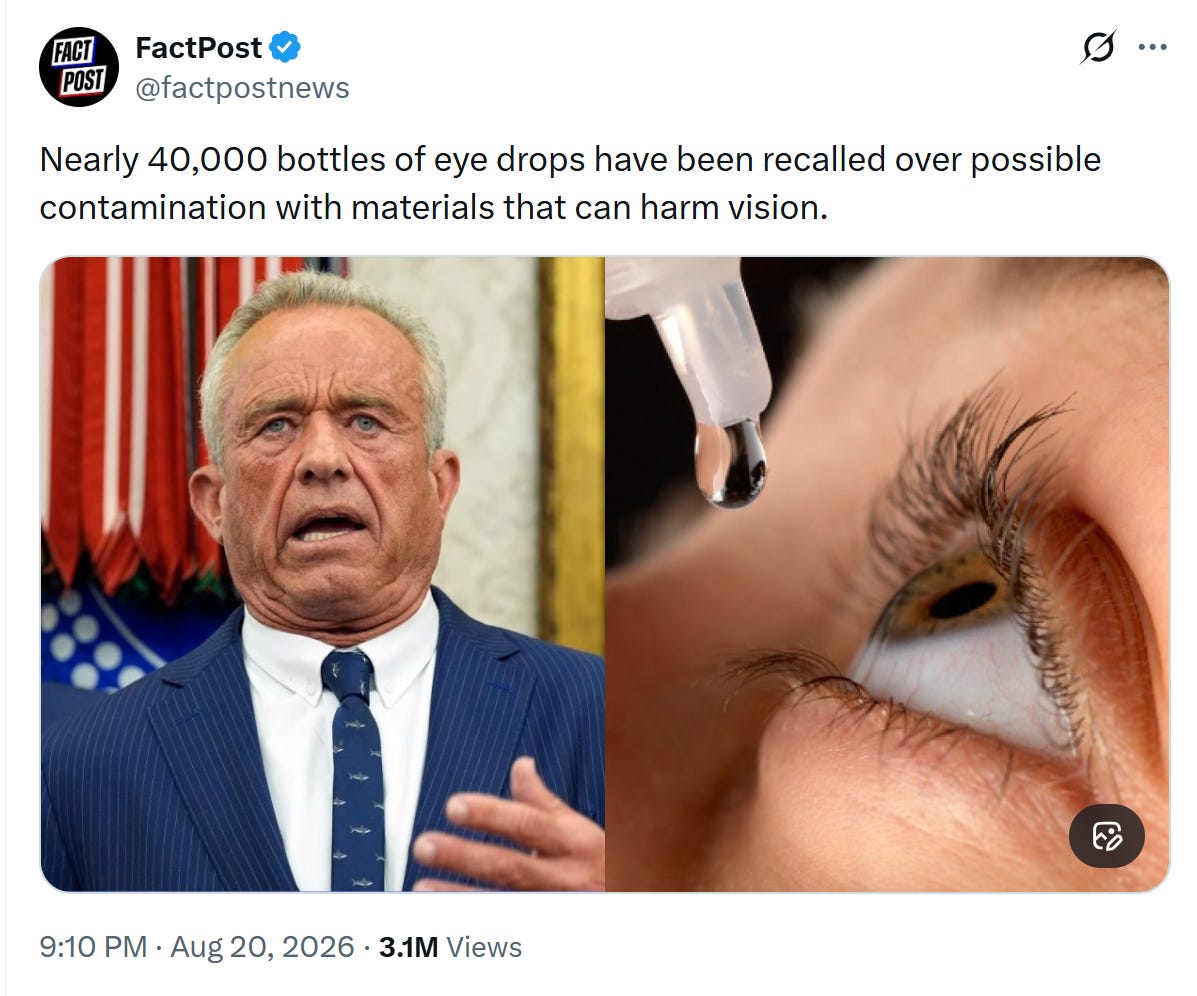
On 20 August, an account called FactPost told two million people that nearly 40,000 bottles of eye drops had been recalled over possible contamination with materials that can harm vision. Next to this text sat two photographs: a close-up of an eye receiving a drop, and Robert F. Kennedy Jr, mouth open, mid-sentence.
Every word of the text was true. Prestige Brands did recall 39,060 bottles of Clear Eyes Maximum Itchy Eye Relief. The FDA enforcement report was filed on 14 August.
Everything else about the post was a lie, and none of it was written down.
There was no contamination. The notice cited “lack of assurance of sterility”, a process failure meaning the manufacturer could not prove the product was sterile, not that anything was found in it. It was a Class II recall, the category the FDA defines as temporary or reversible problems where serious harm is remote. No injuries were reported. And 40,000 bottles is nothing: in March, K.C. Pharmaceuticals recalled more than three million bottles for sterility issues, and in late July roughly eleven million packages of eye drops were pulled nationwide for the same reason. The August recall was around 0.3% of the July one.
Kennedy had nothing to do with that recall. It was a voluntary company action appearing in a routine enforcement report, and a Class II recall showing up in a public database is evidence of the system working exactly as designed. He was in the picture because a picture makes an argument that cannot be fact-checked, and the argument was: this man is poisoning your eyes.
But the framing is wrong in a more interesting way than that.
Because Kennedy does have something to do with what is happening to American food safety. His department oversees the agency that has frozen the rule that would let anyone trace contaminated produce back to a farm. It oversees the laboratory capacity that was cut while the largest cyclospora outbreak on record was under way. The real story was sitting directly underneath the fake one, and the fake one is what got two million views.
That is the pattern this piece is about, and once you start looking for it you find it in four countries and across thirty years.
The recalls are flat. The illnesses are not.
If you want to know whether food is getting more dangerous, recall counts are the obvious place to look and the wrong one.
The US totals, per the Public Interest Research Group’s tally: around 312 recalls in 2023, 296 in 2024, 320 in 2025, and at least 160 by mid-August this year, roughly on pace. In 2018 there were nearly 400. On this measure, nothing is happening.
Now look at the illnesses. This year’s cyclospora outbreaks have produced at least 15,716 laboratory-confirmed cases and 828 hospitalisations across 47 states, with thousands more under analysis. The equivalent figure for the same season last year was 1,180. A single iceberg lettuce outbreak accounted for 9,481 illnesses, 398 hospitalisations and two deaths, possibly the largest cyclospora outbreak ever recorded. Deaths linked to recalled food went from eight in 2023 to nineteen in 2024 to twenty-two in 2025.
Recalls flat. Illnesses through the roof.
The gap between those two numbers is the entire story, because recall counts are not a measurement of the food supply. They are a measurement of the regulator. They tell you how much testing, tracing and investigating is being done. When harm rises and recalls do not, the flatness is the finding.
Here is what the flatness looks like from the inside. In 2025, regulators investigated 28 foodborne illness outbreaks in the United States. Recalls were announced for eleven. Thirteen never identified even a type of food. Four identified a food but never a brand. Six in ten outbreaks produced no recall at all, because nobody could work out where the food came from.
The farm at the centre of the largest cyclospora outbreak on record had not been inspected in seven years.
What actually got cut
Here is the part that took me longest to see, and it is the only part that really matters.
Nobody deregulated food safety. The standards are all still there. It is still illegal to sell contaminated lettuce in Britain, America and the European Union. No minister stood up and said companies may now poison people.
What got cut was the machinery that finds out.
In America, the FDA’s Food Traceability Rule, the one requiring lot-level records retrievable within 24 hours, the thing that turns “somewhere in California” into “this farm, this field, this week”, was delayed by thirty months in March 2025, then frozen in law. The FY2026 appropriations act bars any funds being used to enforce it before 20 July 2028.
The FDA’s own analysis of that delay is the most remarkable document I read for this piece. It books the savings to industry at $54 to $73 million a year. And because it is deferring a rule the agency itself judged strongly net-beneficial, it books the benefits as a negative number: minus $91 to $112 million annually in foregone public health benefit. Present value of what is given up over twenty years: roughly $1.2 to $1.35 billion.
The agency wrote down, in its own regulatory impact analysis, that this would cost more than it saved. Then it did it anyway. Then Congress made it law, which bypasses cost-benefit review altogether.
What it does not do, and what none of these documents do, is convert that foregone benefit into people. No estimate of additional illnesses. No hospitalisations. No deaths. The money is counted. The bodies are not.
In Europe, the Food and Feed Safety Simplification Omnibus arrived in December 2025, claiming over €1 billion in reduced compliance costs: €428 million a year for business, €661 million for national administrations. Read the accompanying staff working document and you find the single largest saving is loosening the scope of laboratory accreditation: €602 million, most of it from one change to plant health accreditation.
The largest saving in Europe’s food safety simplification package comes from doing less testing.
The document asserts, repeatedly, that the level of protection is unchanged. It never models this. A full impact assessment was waived on the grounds that the measures are technical quick fixes. Not one additional illness, hospitalisation or death is estimated anywhere in it.
In Britain, we did it slowly and without anyone noticing. The Food Standards Agency’s own Our Food report records 95,000 overdue inspections across England, Wales and Northern Ireland in a single six-month period, including 871 high-risk businesses. Sampling fell 4.5% year on year to 41,624 samples. Food hygiene posts are down 15.4% long-term; food standards posts down 43.8%. Some local authorities told the FSA they lack the resources to sample at all; some are affected by laboratory closures.
Meanwhile Campylobacter cases rose 17.1% to 70,352 in 2024 and Salmonella by the same proportion to 10,388. Both were decade highs, both breached the FSA’s own action thresholds, and a formal investigation followed. In 2025 they stayed there.
And the November 2025 Budget asked the FSA to streamline food standards and hygiene regulation further.
The arithmetic nobody does
Set the claimed savings against the cost of the thing they are supposed to be worth.
The US Department of Agriculture puts the cost of foodborne illness in America at $74.7 billion a year. The traceability delay saves industry around $73 million at the high end. That is a ratio of roughly a thousand to one.
The FSA’s own model puts foodborne disease in the UK at £10.4 billion annually: 2.4 million cases, 16,400 hospital treatments, 180 deaths.
Europe has no single figure, which is itself telling. But the European Food Safety Authority costs campylobacteriosis alone at around €2.4 billion a year and salmonellosis at up to €3 billion. Either one, on its own, exceeds the entire €1 billion saving from the simplification package.
I am not claiming these savings caused those costs. Nobody can claim that, and that is precisely the problem I want to put in front of you.
Because when you ask whether previous rounds of deregulation delivered, the answer everywhere is that nobody checked. The US Government Accountability Office reported in January 2026 that the FDA has missed opportunities to assess the results of its nine food safety rules and lacks any framework to demonstrate whether they prevent illness. The European Court of Auditors found the EU’s food safety model sound but over-stretched. The UK’s Regulatory Policy Committee and the OECD both note that burden-reduction regimes rarely verify whether the obligations they removed were doing anything useful.
The savings are projections. The health costs are unmeasured. And the deepest problem is circular: where the thing you deregulate is the data collection (the sampling, the accreditation, the traceability records, the notification duties), you have removed the instrument that would later tell you whether you were right.
You cannot measure what you have stopped recording. The case for cutting becomes unfalsifiable at the moment the cutting is done.
How the fear was built
For a while I assumed this was ordinary lobbying dressed in public-interest language, and in the American case there is a strong paper trail for exactly that. The traceability delay was requested by the food industry, granted by the regulator and locked in by Congress. The Food Marketing Institute’s president called it the most complex regulation the industry had ever faced and thanked the FDA for the reprieve. The Safe Food Coalition pointed out that industry had already had fifteen years.
But lobbying does not explain why it was so easy. Industry has fought the Food Safety Modernization Act since 2011 and mostly lost. What changed was not the lobbying. What changed was that gutting a food safety rule in 2025 generated almost no political friction at all.
That took forty years to build, and Britain helped.
Start with the Euromyths. Bendy bananas. Prawn cocktail crisps. Square strawberries. The European Commission maintained an actual register of these stories because there were so many of them, and a young Brussels correspondent (Boris Johnson) for the Daily Telegraph made his career filing them. Food regulation was the perfect target: it is granular, voluminous, written in technical language, and it produces genuinely funny-sounding rules when you strip the context off. Decades of this taught the British public that food regulation is inherently absurd before anyone proposed cutting any of it.
Then the American anti-GMO movement built the institutions. The Center for Food Safety, founded by Andrew Kimbrell, is a professional operation with staff, filings and a lobbying record. Elizabeth Kucinich served as its director of government affairs. The 2013 documentary GMO OMG carries her as producer and executive producer, with Dennis Kucinich on camera arguing for labelling, and Kimbrell and the Indian activist Vandana Shiva in the cast. CFS organised Shiva’s five-day Hawaii speaking tour in 2015.
Note the paradox, because it matters. This movement was demanding more regulation. Labelling mandates. Restrictions. Precaution. Its argument was not that the food regulator was too powerful. It was that the food regulator had been captured by Monsanto and could not be trusted to tell you the truth.
That claim is the load-bearing wall of everything that follows, and it was built by people who wanted stricter rules.
The frame turned out to be portable, and readers of the New Bretton Woods series will recognise where it goes. Elizabeth Kucinich also worked on the NEED Act, HR 2990, her husband’s 2011 bill to abolish fractional-reserve banking, convert Federal Reserve notes into Treasury-issued United States Money and retire the federal debt by direct issuance.
Part 2 of that series traced HR 2990’s genealogy: the American Monetary Institute and Stephen Zarlenga’s American Monetary Act on one side, and on the other a structural template Lyndon LaRouche’s organisation had been publishing since its 1975 Programme for the International Development Bank. Sovereign credit creation. The Federal Reserve as a private interest improperly inserted between the Treasury and the constitutional money power. Physical infrastructure as the ground for new issuance. Executive Intelligence Review and LaRouchePAC endorsed the bill publicly on introduction. That series follows the vocabulary onward through Asia Times, into a Treasury Secretary’s description of a “Bretton Woods realignment” on Roger Stone’s radio show, and into the Policy Planning Staff of the State Department.
What I had not previously noticed is that the same bill has a food operative on it. The series tracked Dennis. The other Kucinich was simultaneously running government affairs at the Center for Food Safety and executive-producing a documentary about agricultural capture.
Food sovereignty and monetary sovereignty are the same sentence with different nouns: a vital public function has been privately captured, and the remedy is to take it back. Seed and currency, identical argument shape, one household. The bill was covered sympathetically by American Free Press, an outlet descended from Liberty Lobby, as the thing that might unite Occupy protesters against debt slavery. That crossing is not incidental either. The frame travels across the political spectrum precisely because it names a captor without specifying a politics.
Meanwhile, somebody was assembling the audience commercially. Jeff Krasno co-founded the Wanderlust festival business in 2009 with Schuyler Grant and Sean Hoess, then founded Commune, an online wellness course platform, and now hosts its podcast. In October 2018 Wanderlust ran its first Wellspring gathering in Palm Springs. Russell Brand was the headline keynote. The bill included Marianne Williamson, the functional medicine doctor Mark Hyman, Dave Asprey, Paul Hawken and Alicia Silverstone. Two years later Brand was on Commune. Krasno’s newsletter now goes to over a million subscribers, and his recent output includes an essay titled “Big Food, Big Tobacco and The Military Industrial Food Complex”.
Nobody convened a political movement here. A company monetised an audience around the proposition that the system is making you sick, sold it festival tickets and then course subscriptions for fifteen years, and that audience was sitting there fully formed when somebody needed one.
Britain ran the same model. In July 2022 Russell Brand staged Community, a ticketed festival at Hay-on-Wye, and the name in the promotional copy alongside Wim Hof was Vandana Shiva. He did it again in 2023, billing the same pair, and sold the recordings separately as Community: The Experience. Shiva was not a guest at these events. She was an advertised attraction, twice, in a country where most people have never heard of her.
The venue choice is worth noticing. Hay-on-Wye is where Bill Clinton called the literary festival the Woodstock of the mind. Brand’s festival borrowed that aura and pointed it at conversations about awakening, spirituality and food. And it sat inside a media operation that was pivoting hard: the same podcast feed promoting Community 2023 was booking guests on the Twitter files and on the theory that America and China colluded over Covid.
The fusion happened on a podcast. When Kennedy launched The Defender podcast for Children’s Health Defense, his first guest was Vandana Shiva. The episode was titled “Bill Gates’ Global Neo-feudalism”, and her argument was that Gates, together with Big Ag, Big Chemical, Big Food, Big Tech and Big Pharma, is destroying the ecosystem and human health.
NB Kennedy has also interviewed the founders of “The Duran” which readers will know is directly funded by the Kremlin and forms part of the Pipeline series.
Look at what that episode is doing structurally. An anti-vaccine organisation launches its media arm with an anti-GMO agricultural activist. Two constituencies, one institution, welded by a single premise about regulatory capture. Gates is the solder because he works as villain for both audiences at once.
Then it acquired a broker. Marla Maples (Donald J. Trump’s second wife) told ABC’s Foreign Correspondent in July 2025 that Kennedy telephoned her days after the assassination attempt on Trump, saying he needed to get a message to the president. By her account Kennedy was speaking to Trump the next day; weeks of behind-the-scenes talks followed, and Kennedy suspended his campaign and endorsed Trump. She says she met Kennedy around twenty years ago through his clean-water work and had long held a vision of the two men working together. She has since co-founded the Global Wellness Forum, which describes its mission in terms of health, sovereignty, truth and transparency.
Her account is uncorroborated by either man and describes private phone calls, so treat it as testimony rather than fact. But it is testimony given on camera to a public broadcaster, and she is not describing proximity to the movement. She is describing brokering the alliance that put Kennedy in charge of American health policy.
Then it acquired party money, through a node the series has already mapped. Angela McArdle, then chair of the Libertarian National Committee, states on her own website that she spearheaded a joint fundraising agreement with Robert F. Kennedy Jr.
Part 8 established what else she was doing in that period. In February 2023 she appeared on a Washington stage alongside Diane Sare, a serving LaRouche electoral candidate, at a rally promoted by the Schiller Institute and co-sponsored by Caleb Maupin’s Center for Political Innovation. Fourteen months later she delivered the Libertarian Party to the Trump campaign with the Ross Ulbricht pardon as the price. She was already the bridge between the LaRouche network’s framework and the Mises Institute’s monetary heterodoxy before she was anything else.
She now chairs the Mises Caucus, where she says her work focuses on outreach to the Bitcoin community and the MAHA community. She resigned from the LNC in February 2025 amid an internal finding of gross fiduciary violations and has been a Republican since 2026.
So the bridge has a third span. The same operator who connected the LaRouche estate to the paleolibertarian estate, and who converted that alignment into a presidential pardon, describes her current work as connecting the crypto constituency to the health movement. Monetary sovereignty and food sovereignty, bundled, arriving from the opposite political direction to Elizabeth Kucinich and carrying the identical architecture.
And then it acquired legislation. In July 2026 Senator Mike Lee introduced the GRACE Act, which would strip federal education funding from institutions that do not permit religious exemptions to vaccine requirements and would bar them from requiring any documentation from families claiming one. It was endorsed by more than fifty organisations including Children’s Health Defense. Lee also cosponsored, with Rand Paul, the End the Vaccine Carveout Act, removing the liability shield that has protected vaccine manufacturers since 1986. That shield is the single central legislative target of Kennedy’s entire career.
Look at the form the GRACE Act takes. It does not ban a vaccine. It abolishes a documentation requirement and prohibits verification. Exemption paperwork gone, checking forbidden, framed as relieving a burden on families.
That is the same architecture as the traceability freeze. Different sector. Identical mechanism.
One thing this is not. It is not a conspiracy, and I want to be blunt about that because the material invites the corkboard and the corkboard is wrong. Nobody coordinated this. Krasno was selling yoga tickets. Kimbrell was suing the EPA. Elizabeth Kucinich was lobbying for labelling. The Euromyth desk was filing copy. Most of these people would loathe each other in a room, and several of them, Shiva emphatically included, would be horrified to find their arguments used to gut a food traceability rule at the request of the food industry.
What propagated was not a plan. It was a vocabulary. Capture, sovereignty, freedom, the corrupted regulator. It was assembled by people who wanted stricter rules, monetised by people selling wellness, and then inherited by people who wanted no rules at all.
And here is the turn that makes the whole thing worth writing down. A movement founded on the claim that the food regulator serves industry rather than the public arrived in office and immediately reduced the regulator’s ability to detect anything, at industry’s explicit request, while the largest cyclospora outbreak on record was in progress.
The argument underneath
Strip away the personalities and there is a serious argument at the bottom of this, which is why it works.
Senator Mike Lee gave it in Utah in March 2022, standing next to Rand Paul, holding a pocket Constitution. Yes, btw Mike Lee accussed NAFO of being funded by the CIA.
“When we’re talking about Fauci, we see a problem that has really ensnared us in a system of big government, it’s what some refer to as the tyranny of expertise. If America ever sees tyranny, it will come in the form of experts, masterminds, people who are so smart that people will defer to them in all things.”
Paul, at the same event, put it more precisely: “What matters is how much power he has. If he were a doctor in Peoria, you could ignore him and get yourself a new doctor. But he’s in charge of everybody.”
That is not an anti-vaccine position. Paul said at the same event that he is not against the vaccine and encouraged his wife and in-laws to take it. It is an argument about a class of people who have been granted authority to determine facts and act on them without asking permission.
And once you have heard it, everything I have described stops being a series of separate cuts.
Traceability records. Comparative effectiveness research. Foreign facility inspections. Laboratory accreditation. Notification duties. Renewal reviews. Sampling programmes. Gain-of-function oversight. Vaccine exemption documentation. Every single one is an instance of delegated technical authority: a body of credentialed people empowered to find something out and act on it whether or not you agree.
Cutting them is not an oversight. From this position, it is the point. The machinery that checks is the tyranny.
We have heard this in the UK
Britain got there first, and in fewer words.
On 3 June 2016 Michael Gove told Faisal Islam that people in this country had had enough of experts. What he was actually saying, before Islam cut him off, was that people had had enough of experts from organisations with acronyms who kept getting things wrong. Gove has spent a decade correcting the record and he is right about the truncation. He is also right that his narrow point had force: the Treasury and IMF short-run forecasts were wrong.
But he conceded the thing that matters. Some people, he later admitted, may have felt licensed by his remarks to challenge all forms of expertise.
The truncated version is the one that travelled. A statement about experts being misrepresented, itself misrepresented, and the misrepresentation is what changed the politics.
The vocabulary that followed is American, incidentally. “The blob” was first applied to obstructionist officialdom by William Bennett, Ronald Reagan’s education secretary. Gove and Dominic Cummings imported it for the education establishment; it then spread to the civil service, the courts and the BBC. Gove’s reference was the 1950s film about an amoeba-like mass that nothing can stop. It is a precisely chosen image, because a blob has no arguments and no case to answer. Only mass and appetite. You cannot debate it. You can only cut it.
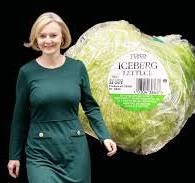
Then Liz Truss ran the experiment.
On her first day she approved the sacking of Tom Scholar, permanent secretary at the Treasury since 2016, as a strike against “Treasury orthodoxy”. The mini-budget went out without an Office for Budget Responsibility forecast. Within days, gilts and liability-driven pension positions did what they did, and the Bank of England intervened.
Economists still argue about the relative contribution of global interest rates and the structural fragility of LDI. The sequence is not in dispute. Remove the institutional check, skip the independent forecast, watch the result on a screen in real time.
Forty-nine days.
This is the only clean natural experiment in the whole subject, and we ran it here. Everywhere else, the harm from removing scrutiny is slow, diffuse and deniable: cyclospora cases nobody attributes to an uninspected farm, food standards posts down 43.8% with the surveillance that would prove the consequence also cut. Truss compressed the entire causal chain into seven weeks.
And then the frame ate its own refutation. The blob was subsequently blamed for her downfall too, her worldview sabotaged from within. The clearest demonstration on record of what happens without expert scrutiny was absorbed as further proof that expert scrutiny is sabotage.
That is the tell. Not that the argument is wrong. Oakeshott and Hayek are serious thinkers and the case against unaccountable delegated authority is a real one. It is that in this deployment the argument cannot lose. There is no result that counts against it. And arguments that cannot lose do not stop. They keep removing things until something breaks fast enough for people to notice.
What the history actually shows
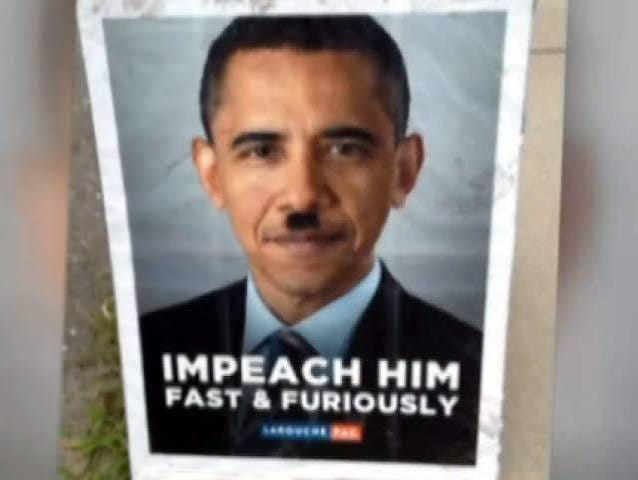
The strongest version of the anti-expert case reaches for the worst thing it can find. Lyndon LaRouche’s followers spent 2009 telling American town halls that Obama’s comparative effectiveness research council was reviving the Nazi T4 euthanasia programme. The Obama-Hitler posters at those meetings came off LaRouche tables.
This is the same organisation whose monetary vocabulary the New Bretton Woods series has been tracking across fifty years and into a cabinet. It is worth being precise about what that does and does not establish here, because the two applications do not run parallel.
On money, the doctrine and the movement described above are aligned: HR 2990 is the 1975 template in statutory language, and the series follows it forward from there. On food, they are opposed. The LaRouche organisation is aggressively technology-optimistic, pro-nuclear, pro-industrial agriculture, and treats environmentalism and population concern as Malthusian. Its current writers attack Kennedy and Shiva by name over farming and energy. There is no single network here and it would be wrong to draw one.
What crosses over is narrower and more interesting: the technique of naming a captured public function and offering restoration. Applied to currency it produces sovereign money. Applied to seed it produces food sovereignty. Applied to medicine it produces medical freedom. Applied to a comparative effectiveness research council in 2009 it produced death panels.
And on that last one, it is worth being clear about what T4 was, because the analogy inverts under inspection.
T4 was carried out by physicians. Credentialed ones, in institutions, under expert authority. What was absent in 1939 Germany was not expertise. The regime was intensely technocratic, and the medical profession joined the Nazi party at higher rates than any other profession. Racial hygiene had chairs, institutes, journals and doctorates.
What was absent was independent expertise. A professional body that could dissent. Courts that could intervene. A press that could report. Peer review that could contradict. Both twentieth-century totalitarianisms achieved their worst outcomes by destroying the plurality of expertise while keeping the credentials. Lysenko did not represent a lack of scientists but the elimination of the ones who disagreed, and Soviet agriculture paid for it for a generation.
The comparative effectiveness research council was a body publishing findings that could be challenged. T4 was what happens when nobody can challenge anything. They are opposites.
The historical record does support the concern about delegated authority without accountability. It does not support less expertise as the remedy. It supports more of it, plural and contestable and independent.
And here is the specific price of getting that backwards. Section 1233 of the American health bill would have reimbursed doctors for talking to Medicare patients about living wills and end-of-life wishes. Voluntary. Backed across party lines. It was withdrawn after the death panel campaign, and the Institute of Medicine called that a significant setback to advance care planning.
In 2026, the Trump administration introduced advance care planning rules of its own. Asked whether the “Doctor Death” label should now pass to Mehmet Oz, Ezekiel Emanuel, who had worn it for seventeen years, declined the swipe and called the move bold.
Same policy. Different party. No panic. Seventeen years lost.
What this costs, and what to ask for
I have written before about the nonsense tax: the price we pay not because people believe false things, but because responding to the false things consumes the capacity that would have fixed the real ones.
This is the clearest case I have found, and it repeats across every domain I looked at. A real grievance exists. A theatrical version of that grievance captures the attention. The specific, boring, achievable reform that the grievance actually justifies goes nowhere.
Senator Wyden’s staff spent eighteen months establishing, with contemporaneous emails, that the National Rifle Association had functioned as a foreign asset. The investigation depended on voluntary document production, committee Republicans declined to cooperate, and the referral went to a Treasury office that had already ignored his previous letter. Nothing happened. The same week, the unfalsifiable version of the same question filled every timeline.
Rand Paul’s committee has voted on party lines to hold Anthony Fauci in contempt after he invoked the Fifth Amendment 111 times, in a referral that former prosecutors expect to collapse against a man holding a pardon. Meanwhile the actual oversight yield sits in a transcript nobody reads: Fauci acknowledging in transcribed interview that the social distancing guidance “sort of just appeared” and was likely not based on scientific data, and that mandates could increase hesitancy for years. The material that would support real reform of emergency public health decision-making is right there. It is not what anyone is fighting about.
And a Class II sterility recall of 39,060 bottles of eye drops, which is evidence of the enforcement database working exactly as designed, got two million views as proof that the system is broken.
So here is what I want, and it is deliberately small enough to be refusable only in bad faith.
Publish the interval. Every jurisdiction in this piece, the US, the UK and the EU, records the date of first illness in an outbreak and the date of the first public warning. None of them publishes the gap between the two as a headline statistic. It is the only number that measures the thing that actually matters: how long you were eating it before anyone told you.
It fails visibly under every model. In Britain and Europe, where surveillance data is published, it would expose the inspection gap directly. In systems that collect heavily and publish little, it would expose the silence. It cannot be gamed by counting recalls, and it cannot be dismissed as red tape, because it is a measurement of the regulator’s own performance.
And cost the health column. Every simplification measure should carry a quantified estimate of expected additional illness, and a mandatory post-implementation review with the relevant data collection retained specifically so the review is possible. The FDA has already shown this can be done. It put the foregone benefit in the table. It simply declined to say what that meant in people.
Neither of these is a defence of every rule. Some obligations genuinely were pointless, and the case that FSMA 204 was hard to implement on the original timeline has merit. This is not an argument that regulators are always right. It is an argument that we should be able to find out.
Because the through-line of everything above is that we have been steadily removing our own ability to know whether any of it is working. And when the traceability record is gone, the sample is not taken, the accreditation is narrowed and the interval is unpublished, the loss is not only the regulator’s.
It is mine. It is yours. You cannot hold power to account with data that was never collected.
The people who built this vocabulary spent forty years arguing that the regulator could not be trusted to tell you the truth about your food. They have now arranged things so that nobody can find out what the truth is.
Nobody voted to stop looking.
Sources for every figure in this piece are available on request: FDA regulatory impact analyses, the EU staff working document SWD(2025) 1030, FSA board papers and the Our Food report, GAO-26-107394, USDA ERS costings and PIRG’s recall tally.