


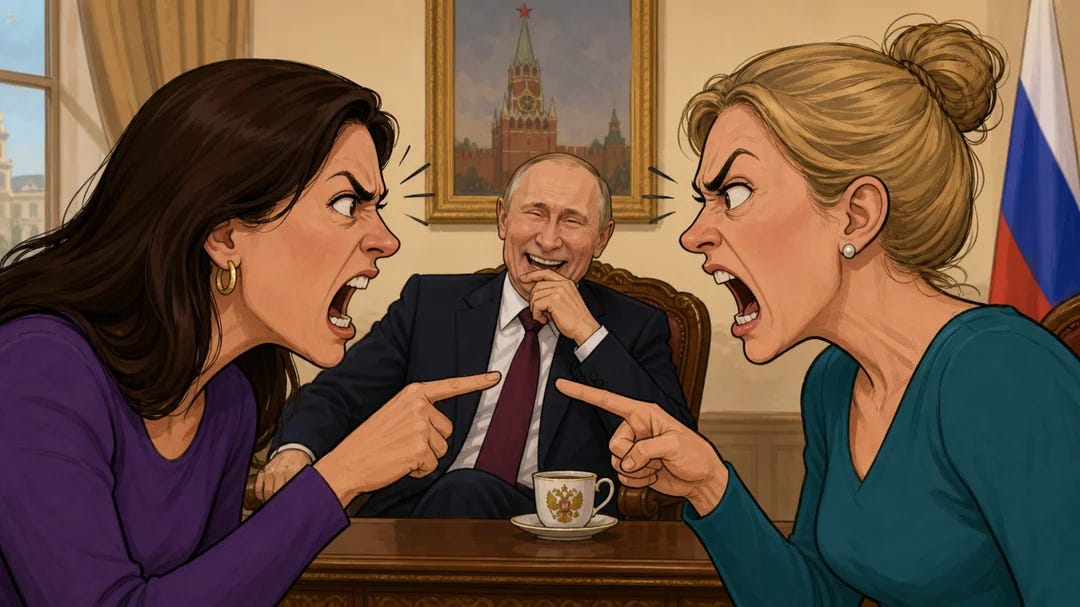
Let us begin with the disappointing part, since the disappointment is the finding.
This investigation started with a question about whether a foreign hand lay behind Scottish gender-critical feminism. Whether the policy analysts who took apart the Gender Recognition Reform Bill, the litigants who took the Scottish Government to the Supreme Court, and the author who paid for a good deal of it had been seeded, steered, or funded from Moscow or Tehran. It is the sort of question that, in 2026, one is more or less obliged to ask about any successful British political campaign, and it is the sort of question to which the answer is usually a disappointing no.
The answer here is a disappointing no, and it was no at every stage. Murray-Blackburn-Mackenzie formed in late 2018 and published its “policy capture” analysis in Scottish Affairs the following year. For Women Scotland was founded the same year and litigated all the way to a Supreme Court judgment on 16 April 2025. Beira’s Place opened in December 2022 on J.K. Rowling’s money. No documented contact connects any of them to any state broadcaster. Clemson University’s topic-coding of the Iranian bot network operating in Scottish independence discourse found three subjects (UK politics, independence, Gaza) and no gender. Neil Datta’s research into anti-gender funding in Europe traces Russian oligarch money to continental anti-abortion groups, and not to a single UK gender-critical organisation. A sixty-thousand-word anti-fascist investigation into red-brown convergence, written across 2016 and 2017 by people who were looking for precisely this and inclined to find it, contains no mention of Scotland, Rowling, Cherry, Sturgeon, or transgender politics at all.
The domestic fight was real, domestically made, and domestically paid for.
That turned out to be the point. Because the network that does exist, and it is considerably larger, older, and more formally constituted than a handful of familiar faces on RT, does not need to build either side of a Western argument. It needs the argument to exist and to be bitter. Then it sells each side back to its own audience, in the vocabulary that audience already uses, and collects the division. The domestic campaigners on both sides are never in the room, because having them in the room would spoil the product.
What follows is how that network was assembled, what it did with Britain’s transgender debate, and how a small pro-independence party in Scotland became, for a few years, its most convenient delivery vehicle.
The old infrastructure
The oldest piece of it predates almost everything else on the map by a generation, and it is one that readers of the New Bretton Woods series on this site will recognise.
In 1992, the year after the Soviet Union dissolved, the Schiller Institute established a branch in Moscow. Lyndon LaRouche presented a memorandum to the State Duma in 1995 and delivered his own report to the Russian parliament that year, where his economic theories were well received by the Communist Party. The Institute has maintained a Moscow presence ever since. Its vice-chairman, Harley Schlanger, holds a standing column at the Russian International Affairs Council (a body created by presidential decree in 2010) with pieces dated from 2018 to 2023, and appears on Press TV’s Spotlight programme. Thirty-four years of continuous groundwork, tended by the same people.
The next layer was built between 2006 and 2014, and built with money.
Natalia Yakunina founded Sanctity of Motherhood in 2006. Her husband Vladimir, at the time the head of Russian Railways, ran the St Andrew the First-Called Foundation and the Centre of National Glory. Konstantin Malofeev founded the Saint Basil the Great Charitable Foundation in 2007, and subsequently Katehon (the think tank on whose supervisory board Aleksandr Dugin sits) and Tsargrad TV. In 2008 Dugin told Radio Free Europe that the Russian tradition on rights and values had more in common with the Islamic world than with Western liberalism, and that both traditions rejected the secular, individualist Western conception of human rights. The Fourth Political Theory followed in 2009.
That 2008 statement is worth holding onto. It is the doctrinal justification for a Moscow-Tehran partnership, articulated four years before the partnership’s broadcast arm formally existed.
From around 2010 (the dating is Kristina Stoeckl’s, from archival work on the World Congress of Families) Yakunin and Malofeev became the WCF’s principal Russian sponsors. Malofeev attended the WCF’s seventh conference in May 2013 and offered to fund two-thirds of a congress in Moscow. Aleksey Komov, head of international projects at Malofeev’s foundation, sat on the WCF board as its Russian representative.
Then came 2014, and two meetings in the same year that show the whole structure at once.
In March, Malofeev convened a private gathering in Vienna through the St Basil foundation. Dugin attended. So did Heinz-Christian Strache and Johann Gudenus of the Austrian Freedom Party, Marion Maréchal-Le Pen and Aymeric Chauprade of the Front National, Bulgaria’s Ataka, and the Spanish Carlists. Dugin’s line, reported afterwards, was that “we are supported by a pro-Russian fifth column in Europe.” It is Dugin describing himself, and should be weighed as such, but the attendee list is independently established.
In September, after Crimea sanctions forced the WCF to drop its branding, the same money hosted the “Large Family and Future of Humanity” forum in Moscow, on the 10th and 11th, under the names of the Centre of National Glory, St Andrew the First-Called, St Basil, and the Patriarchal Commission for Family. Natalia Yakunina was vice-president of two of the four hosts. Among the attendees was the Society for the Protection of Unborn Children, represented by Pat Buckley of the European Life Network. SPUC’s director John Smeaton confirmed on his own blog that his staff were in Moscow and had “made a major contribution to the conference,” and published the address delivered there by Dr Thomas Ward of the National Association of Catholic Families, which was notably warm toward Russia. That is SPUC documenting itself, but it is SPUC documenting itself against its own interest, which is the more reliable kind.
The forum closed on 11 September 2014. The Scottish independence referendum was held on the 18th. This is a coincidence (maybe), and it is recorded here because someone else will find it and it is better to have said so first.
The religious-traditionalist network’s British terminus is SPUC, and it goes no further. The Scottish gender-critical feminists are secular, feminist, and on the opposite side of the abortion question from everyone in that room. The Moscow money never reached them and never tried to. What the 2014 meetings demonstrate is narrower and more useful: that a Russian foundation could convene the European far right in Vienna on demand, and the international religious right in Moscow six months later. Vienna is a city that will recur.
The treaty
The broadcast architecture was formalised in a document that has come to light only recently, and which this site has written about before: a charter, headquartered in Tehran, granting diplomatic-style immunities to member outlets, with an Executive Council of five founding members. IRIB. RT. Al-Mayadeen. Al-Iraqiya. CCTV. Iran holds two of the five seats.
The same body of material includes an Iranian strategy memo describing “psychological operations,” an invoice recording systematic payments to Western contributors, and financial flows routed through donor-advised funds, shell non-profits, and cash carried by diplomats.
This changes what everything else means, and it is worth being precise about how. Before the charter, the recurrence of the same names across RT, Press TV, Al Mayadeen, and CGTN could be read as the coincidence of a small market. There are only so many people in Britain willing to take an Iranian broadcaster’s money, and they were bound to overlap with the people willing to take a Russian one’s. After the charter, that reading is not available. Those are not four relationships. They are one relationship with a member institution, and the roster is shared because the institution is shared.
Press TV had launched on 8 July 2007. Ofcom revoked its British licence in 2012 over editorial control exercised from Tehran, and Eutelsat dropped Iranian state channels the same year. The channel never left London.
The vehicle was Rad Media World Ltd, company number 07426994, incorporated on 2 November 2010, which is to say two years before the revocation it would be used to survive. Its founding director was Hamid Khairoldin, Press TV’s UK director. From 1 November 2012 the director has been Seyedmehdi Mirtaleb, formerly secretary of the dissolved UK Press TV Ltd alongside Khairoldin. The company sat at Building 10, Chiswick Business Park, held a Home Office Skilled Worker sponsor licence, and operated alongside a sister company, London Broadcasting Partners Ltd. The chain is documented at Companies House.
A single month’s bank statement, from August 2020, shows the machine at work. In on the 11th: £2,559.40 from HMRC under the Job Retention Scheme, which is to say British furlough money. Out on the 13th: “Mick Napier Contribution Fee £275.00” and “John Wight Contribution Fee £600.00.” Ten days earlier, on the 3rd, two invoices settled to Tony Gosling, £625 for February and £775 for March through June. Twenty-three thousand four hundred pounds arriving between the 6th and the 8th from an entity styled “Globe Me,” in five tranches numbered 12348 and 12349 and split into parts. A payment to UK Visas and Immigration at Vulcan House. A staff salary. Across the full period, as this site has reported, the two companies drew more than £27,000 in furlough grants between June 2020 and March 2021 and used it to pay Press TV’s contributors.
Napier had been approached directly. On 24 April 2019, when Google cut Press TV off from YouTube and Gmail, the manager of international relations at IRIB World Service wrote to him at his Scottish Palestine Solidarity Campaign address to encourage “prominent analysts, experts and political commentators like yourself to continue to participate in delivering such news.” The email is in the Black Reward tranche, and its provenance should be stated as such wherever it is used. It is also, in its particulars, corroborated by the bank statement sixteen months later.
Al Mayadeen launched in Beirut on 11 June 2012, founded by former Al Jazeera staff. George Galloway was paid £18,000 for the first four months of 2014 to present two programmes a month from its studios. That figure is from the Register of Members’ Financial Interests, which is a better source than most.
The British roster that emerges is small and stable. Galloway: RT, Press TV, Al Mayadeen. Yvonne Ridley: Press TV, Al Jazeera, Islam Channel. Patrick Henningsen: RT, Press TV, CGTN, Al Mayadeen, and a decade co-hosting UK Column. Richard Medhurst: Press TV’s The Communiqué from 2020 to 2022, paid, with an email on file asking the Assad government to arrange him an interview. Tommy Sheridan: Sputnik presenter and columnist from 2018 to 2022. Craig Murray: RT contributor. Napier, Wight, and Gosling: invoiced.
Napier and Wight, both Scottish. Both were paid in the same month, from the same account, on the same day.
What the output layer did
RT’s British operation was built for a specific audience, and it knew who that audience was. The Reframing Russia project at the University of Manchester identified thirty-five distinct audience segments across RT’s output. Its youth-facing arm, ICYMI, targeted what the researchers described as “Anglophone white males whose comments reflect an attachment to a populist, anti-elite worldview.” This is peer-reviewed work, in the International Journal of Press/Politics, and it establishes something the rest of this section depends on: RT segmented its audiences deliberately, and tailored output to each.
Its coverage of British transgender politics tracks that audience, and tracks the level of British division, with a precision that is difficult to explain any other way.
The earliest item is from around 20 November 2015. Vicky Thompson, a twenty-one-year-old transgender woman, had been found unresponsive in the all-male HMP Leeds after telling friends she would kill herself if sent to a men’s prison. RT ran it as cruelty by the British state. On 14 January 2016, at 12:33 GMT (the page carries a machine timestamp), it covered the Women and Equalities Committee’s Transgender Equality report under the headline “Transgender people face deep-seated prejudice in UK.” Sympathetic, and aimed at Britain.
Through 2017 and 2018 the frame stayed mixed, which is the honest description. Gender-neutral school uniforms were reported through parental anger. A January 2018 report on abuse of trans adults and a trans woman on hunger strike in a male prison were reported straight. The 2018 Gender Recognition Act consultation was covered in July as a clash between trans-rights groups and gender-critical feminists, with Fair Play for Women quoted at length. RT was not silent in these years. It was reporting the argument, and the argument was not yet very loud.
Then, on 13 September 2019, a senior RT staff writer, Igor Ogorodnev, published the first explicitly gender-critical op-ed the channel had run for a British audience: “Teach my child acceptance, BBC, but not the unscientific nonsense that is 100+ genders.” In December, Sophia Narwitz wrote in defence of Debbie Hayton around the Maya Forstater tribunal. From June 2020, Rowling became a recurring subject. On 12 February 2021, Galloway, under contract, presented a programme titled “Will ‘trans-friendly’ wokeness see the end of womanhood as we know it?”, with an accompanying op-ed. Hayton, a transgender woman writing gender-critical commentary, acquired a dedicated RT author page and produced a concentrated run of pieces through 2021, including one asking whether the SNP wanted to copy “Norway’s gender revolution.” In 2022: “Scottish trans policy puts women in danger, says JK Rowling.” Ofcom revoked the licence on 18 March 2022.
Nothing about Russian domestic policy changed between 2015 and 2019. It was consistently hostile to trans people throughout, and in the same years Malofeev’s Tsargrad and the state channels ran material that was crude by any standard. What changed was Britain. In January 2016 the Women and Equalities report landed without a culture war attached to it. By September 2019 the question was among the sharpest cleavages in British public life. RT’s editorial voice followed the cleavage and not the ideology. And the carrier it chose for the hard line was a transgender woman, which is a choice that makes no sense at all to a traditionalist and perfect sense to someone whose product is friction.
The academic literature says the same thing. Martha Stolze’s analysis of RT Deutsch, published in the Journal of Gender Studies on 30 December 2025, coded 160 articles and found 81 per cent carrying an anti-gender frame and 78 per cent carrying, alongside it, what she calls a master frame of “a deceiving, immoral, values-imposing, divided and weak west.” Gender, in her phrase, functions as a gateway. EUvsDisinfo had already observed that internationally-facing outlets like RT avoid overt anti-LGBTIQ+ demonisation, perhaps for fear of alienating more sophisticated audiences, and instead “capitalise on and exacerbate so-called culture-war issues.”
The selection criterion appears in writing, in an internal planning document from Ruptly, RT’s video agency, covering the 18th to the 28th of February 2021. Among that fortnight’s scheduled items: “Madrid, Spain. Spanish Council of Ministers to discuss the ‘trans law’, a bill that would allow transgender citizens to change their official gender without medical checks, among other changes that have sparked an intense social debate.” Self-identification legislation, flagged for coverage, with the division given as the reason to cover it.
The same planner lists Querdenken marches in Nuremberg, Generation Identitaire in Paris with its counter-protest, the Boogaloo Boys in Atlanta, antifa with firecrackers in Milan, the Yellow Vests, the Indian farmers, and Navalny’s appeals. And for 27 February: “Milan, Italy. Communists join forces with right-wing groups for a nationwide protest against Draghi’s government.” Red-brown convergence, entered as a shoot.
The other vocabulary
If RT sold Britain’s gender argument back to its right-leaning heterodox audience in the language of feminism, the question is what the Iranian side sold, and to whom.
For a long time the open-source answer to that was frustrating. Press TV and Al Mayadeen published no substantial gender content for Western audiences at all. Searches of their English services turned up nothing that could be called a pro-trans pole, and the thesis that the network amplified both sides of the argument seemed to fail on the Iranian half.
The leaked correspondence shows why. The Iranian channel was not looking in the same place.
On 29 August 2021, a Press TV staffer named Ahmad Nouroozi replied to an application from a Colombian-born, SOAS-trained anti-Zionist video-maker living in Armenia, whose stated specialism was Palestine and whose covering letter did not mention gender once. Three messages into the exchange, on the morning of 1 September, Nouroozi asked a question that nothing in the correspondence had led up to:
“What is your take on globalized sex norms & dividing people to straight, gay, trans, etc?”
The applicant replied with the anti-imperialist frame in full. LGBT discourse as a Western cultural export and instrument of soft power. Pinkwashing. Sexual identity politics as the selfish individualism of the American imagination. Forty minutes later, Nouroozi offered him an internship producing social-media videos, with a path to articles and a posting as Press TV’s correspondent in Armenia.
That is gender used as a screening question in state-broadcaster recruitment, with the question, the passing answer, and the job offer in a single thread, timestamped. It is Black Reward material and should be cited as such. It is also the most probative single document in this entire investigation, and the reason is what it shows about the second vocabulary.
Press TV was not screening for pro-trans views. The network has no use for those. It was screening for hostility to Western gender norms expressed in the language of anti-imperialism, for an audience that speaks that language. Exactly as RT delivered hostility to progressive gender norms in the language of single-sex spaces and the end of womanhood, for an audience that speaks that one. A British gender-critical feminist and a SOAS anti-Zionist would find each other’s arguments repellent, and would say so. Both arrive, by routes that do not touch, at the same destination. The network runs one position in two incompatible dialects, and neither audience ever hears the other.
Two smaller documents fill in the edges. In April 2019, Press TV’s International Documentaries desk in Tehran was actively soliciting a screener for a film called Make Poland Great Again, whose sales material described “the cleavage of Polish society” and named “issues of sexuality, gender and religious education” as the fault lines. The cleavage was the selling point, and the buyer asked for the screener. In January 2022 an inbound pitch arrived from a freelancer in Karachi about Pakistan’s first transgender doctor, which is the sympathetic pole offered to Press TV on a plate. Whether the channel ran it is a checkable question, and it has not yet been checked.
The Ruptly planner is RT’s mechanism in its own hand. The Nouroozi email is Press TV’s. Between them they are the network’s gender policy, written down, on both sides of the Moscow-Tehran seam.
Scotland
Sputnik opened a bureau in Edinburgh’s Exchange Tower in August 2016, with a daily programme, World in Focus, two Scottish presenters, and an executive producer. It closed in April 2021. What survives of its output is independence, Brexit, foreign affairs, and Assange. No gender content has been found in it, and the correct statement of that is “not found” rather than “confirmed absent,” because Sputnik’s UK archive is thin and its audio was never properly indexed.
The Alex Salmond Show began on RT in 2017, produced under contract by Slàinte Media, a company Salmond had co-founded with Tasmina Ahmed-Sheikh. Salmond was always careful to say that he had never been directly employed by RT, that Slàinte was an independent Scottish production company in which he held a minority share, and that Slàinte was contracted to make the programme. The distinction is real and worth preserving. It is also the distinction that allowed the arrangement to run for five years.
Then came February 2021.
Galloway’s “end of womanhood” went out on RT on the 12th. Alba was founded that month. In April, days before the Holyrood election, Alba launched its women and equalities policy, co-chaired by Ahmed-Sheikh (the co-owner of the company producing Salmond’s RT programme) and Caroline McAllister, with Rhona Hotchkiss as guest speaker. The pitch was explicit. Women disenchanted with the SNP’s position on gender recognition. Six weeks from the output layer producing the content to an electoral vehicle deploying it as policy.
Hotchkiss is the single documented contact between the domestic gender-critical network and this one. She sat on the Beira’s Place board and contributed to the 2024 Constable anthology The Women Who Wouldn’t Wheesht. Her appearance at Alba’s launch runs upward, a campaigner speaking at a party event, and not the other way. It is the only edge that crosses between the two networks on the whole map, and it points in the wrong direction for any theory of foreign origination.
Alba then appointed Yvonne Ridley as its national women’s convener. Ridley had the deepest state-media career of anyone in the set (Press TV, Al Jazeera, Islam Channel, and twenty years alongside Galloway from Respect’s national council onward) and no record whatsoever in gender policy. In 2024 she posted that a trans woman is “a woman assigned male at birth” with a female gender identity. She deleted it, apologised for a “senior moment,” and stepped back. Two founding members, Eva Comrie and Denise Findlay, resigned over how she had stated party policy. Salmond wrote to members to disown the remarks.
For most of this investigation Ridley was the fact that broke every theory. The network’s most embedded Scottish operative had articulated the opposite of whatever was supposedly being transmitted. Under the two-vocabularies reading she resolves without strain. There was no position to transmit. Gender was an assignable brief handed to an available name, and she had no view because the network had no view. When she produced the wrong dialect for the audience, the party disowned it.
Ash Regan defected from the SNP in October 2023 and became Alba’s only MSP. Salmond died in October 2024. Alba entered financial crisis in February 2026, and Kenny MacAskill announced its deregistration on 8 March. Ridley had by then joined Galloway’s Workers Party of Britain and become leader of its Scottish branch. In the May 2026 Holyrood election she stood in Glasgow Cathcart and Pollok and polled 586 votes. The Workers Party’s Glasgow list ran her first and Galloway second. No seats.
Alongside all of it ran a second thread, carried by the same people. Salmond was acquitted of every charge in March 2020. A campaign to “clear his name” therefore cannot mean overturning a conviction. It asserts a conspiracy, and a conspiracy of that shape necessarily includes the women who gave evidence. Craig Murray served eight months for contempt over his reporting of the trial and has taken the case to Strasbourg. In March 2025 he disclosed that Salmond had privately asked him to decline his elected seat on Alba’s executive, and confirmed other members’ accounts of being called “a bitch, a witch, a troublemaker” on their way out. People who have fallen out talk, and Murray has started.
And beneath the political layer there was a synthetic one. Clemson’s Darren Linvill and Patrick Warren documented, in September 2024, a network of more than eighty Iranian-operated accounts that had produced a quarter of a million posts and roughly four per cent of all traffic on X concerning Scottish independence, ninety per cent of them posing as young Scottish women. Cyabra, a commercial vendor whose figures are plausible but not independently audited, put the fake share of accounts discussing independence at twenty-six per cent. The accounts went dark, synchronously, during Iran’s internet blackouts on 13 June 2025 and again on 8 January 2026. X’s own transparency data traced them to the Iranian App Store via Dutch VPNs, and the accounts were suspended. Douglas Alexander confirmed the Rycroft review would examine it.
Their subjects were independence, the monarchy, the Tories, and Gaza. Not gender. The Iranian state built a fake Scottish women’s movement, at scale, over years, and never once pointed it at the argument Scottish women were actually having. Which tells you the argument was already loud enough on its own, and that someone in Tehran knew it.
The assembly
By 2023 the pieces were being put together in the open, and the people doing it were not hiding.
George Galloway founded No2NATO No2War. Its website is hosted under the Workers Party’s own NationBuilder account. Its provisional leadership was Galloway, Chris Williamson, and the ASLEF vice-president Andy Hudd. Williamson presents Palestine Declassified on Press TV, with David Miller as resident expert and Mick Napier among the guests; the running order for one edition is in the leaked material, with Williamson’s sign-off scripted. Two of the three founders of Britain’s anti-NATO front present programmes for the same Iranian state broadcaster.
On 29 June 2023, No2NATO broadcast its third programme, titled “War Logs.” Galloway chaired. The panel was Anastasia Battle, Patrick Henningsen, and Richard Medhurst, and the broadcast was recorded by Henningsen’s own outlet, 21st Century Wire, on 6 July. Three of the four held Press TV histories. Three of the four had worked for Al Mayadeen. Three of the four had worked for RT. The fourth, Battle, is editor-in-chief of Leonore, the Schiller Institute’s cultural journal, and the co-founder and chair of the International Peace Coalition, the anti-NATO front that Helga Zepp-LaRouche had initiated three weeks earlier in early June. Jose Vega, another No2NATO regular, sits on Leonore‘s design staff. The LaRouche network that had been in Moscow since 1992 and the Press TV roster that had been in Chiswick since 2010 were on the same broadcast, under the same chair, within a month of the LaRouche front’s founding.
The rest of the roster is what a coalition looks like when only one thing unites it. David Clews of Unity News Network in Renfrewshire, described by Searchlight (a campaigning source, to be weighed as one) as a self-declared “race realist.” Angela McArdle, then chair of the United States Libertarian Party. The Irish MEPs Clare Daly and Mick Wallace. The former ambassador Peter Ford. Simeon Boikov, documented in 2016 with the far-right Zabaikal Cossack Society of Australia, hosting an episode under the name “Aussie Cossack.” Broadcast #4 put Clews on a panel with Galloway.
In April 2026, No2NATO signed the Paris Declaration at the SOVINTERN Congress in Moscow. Its own website says so, and adds that it did so at the request of South Korean delegates representing the World Anti-Imperialist Platform. SOVINTERN was founded at the House of the Unions on 27 April 2026, organised by A Just Russia under Sergey Mironov, and opened with a welcoming address attributed to Vladimir Putin. A Just Russia is the managed-opposition party assembled under Vladislav Surkov, expelled from the Socialist International in 2022 for supporting the war. The circuit that opened with a Schiller Institute office in Moscow in 1992 closed with a British anti-NATO front signing in Moscow thirty-four years later, and the front published the fact itself.
Austria, meanwhile, was where the Iranian side got documented, and this site supplied some of the documents. DER STANDARD reported on 7 October 2025 that Press TV’s Austria correspondent was Dieter Reinisch, a historian of IRA terror and a board member of the Austrian Journalists’ Club, and that emails held by the paper established Medhurst had worked for the channel since 2020 and drawn regular payment. The ÖJC had hosted Medhurst for over an hour as an “Aufdeckerjournalist” and framed the investigations against him as an attack on press freedom. The interviewer was Reinisch, his Press TV colleague. Neither man’s shared employer was disclosed to the audience. Austrian security police had raided Medhurst in Vienna the previous February; the investigation is live, he denies wrongdoing, his lawyer has challenged it in the Vienna higher regional court, and press-freedom organisations in two jurisdictions have objected. A former feminist influencer, Nicole Schöndorfer, was by then writing for Al Mayadeen and describing Hamas fighters as martyrs. Recruited from the progressive left, in the second vocabulary, on the third channel.
Vienna, again.
What this does and does not say
It says that a formal broadcast network with a Tehran charter and a shared roster ran Britain’s transgender argument back at Britain in two dialects, feminist on RT and anti-imperialist on Press TV, and moved RT’s own line from sympathy to hostility as British division deepened. It says that the selection criterion was written into RT’s planning documents and that gender was a screening question in Press TV’s hiring. It says that a Scottish party built around a man with an RT production contract adopted the same axis as electoral policy within six weeks of the content going out, staffed the brief with a Press TV veteran, and imploded on it. It says that two Scottish activists were paid from a Chiswick company running on British furlough money in the same month, while a fake Scottish women’s movement was being operated from Tehran. And it says that the people who assembled all of this into an anti-NATO coalition signed a declaration in Moscow in April, and announced it.
It does not say that the network created Scottish gender-critical feminism, funded it, or touched it. It did not, and a piece that implied otherwise would be wrong, and would be taken apart by people better placed than most to do the taking.
It does not say that any individual named here acted unlawfully by writing or presenting for a foreign broadcaster. They did not. Undisclosed state funding of commentary is a transparency failure and not a crime. The furlough money is a different question, and belongs in a different paragraph.
It does not say that the two dialects were coordinated by a single hand. The Ruptly planner and the Nouroozi email show each side’s mechanism independently. Whether anyone above the charter’s executive council instructed both is not documented, and it is better to say so than to imply it.
Alex Salmond was acquitted of all charges in March 2020 and died in October 2024. Richard Medhurst is under investigation and denies wrongdoing. The individuals in the Press TV correspondence, a job applicant and a freelance pitcher, are private people who did nothing wrong. The significance is entirely in what Press TV asked and how it answered.
To Conclude
Britain has argued with itself about sex and gender, and the argument was its own. A network built over three decades in Moscow and formalised in a treaty in Tehran did not start that argument and could not have. What it did was buy the rights to both sides. The conservative traditionalist for one side, feminist and anti-imperialist case for another, each broadcast back to the people already inclined to believe it, in the words they already used, until the argument was louder than it would otherwise have been.
In Scotland, for a few years, it found a party willing to run that content as policy, and a woman with twenty years on its payroll willing to front it. When she got the dialect wrong, the party disowned her. When the party collapsed, she went back to the man she calls her brother.
The women who had actually made the case were never in the room. That was the design. The design worked precisely because they were never in the room, and it is the absence, not the presence, that is the evidence.