


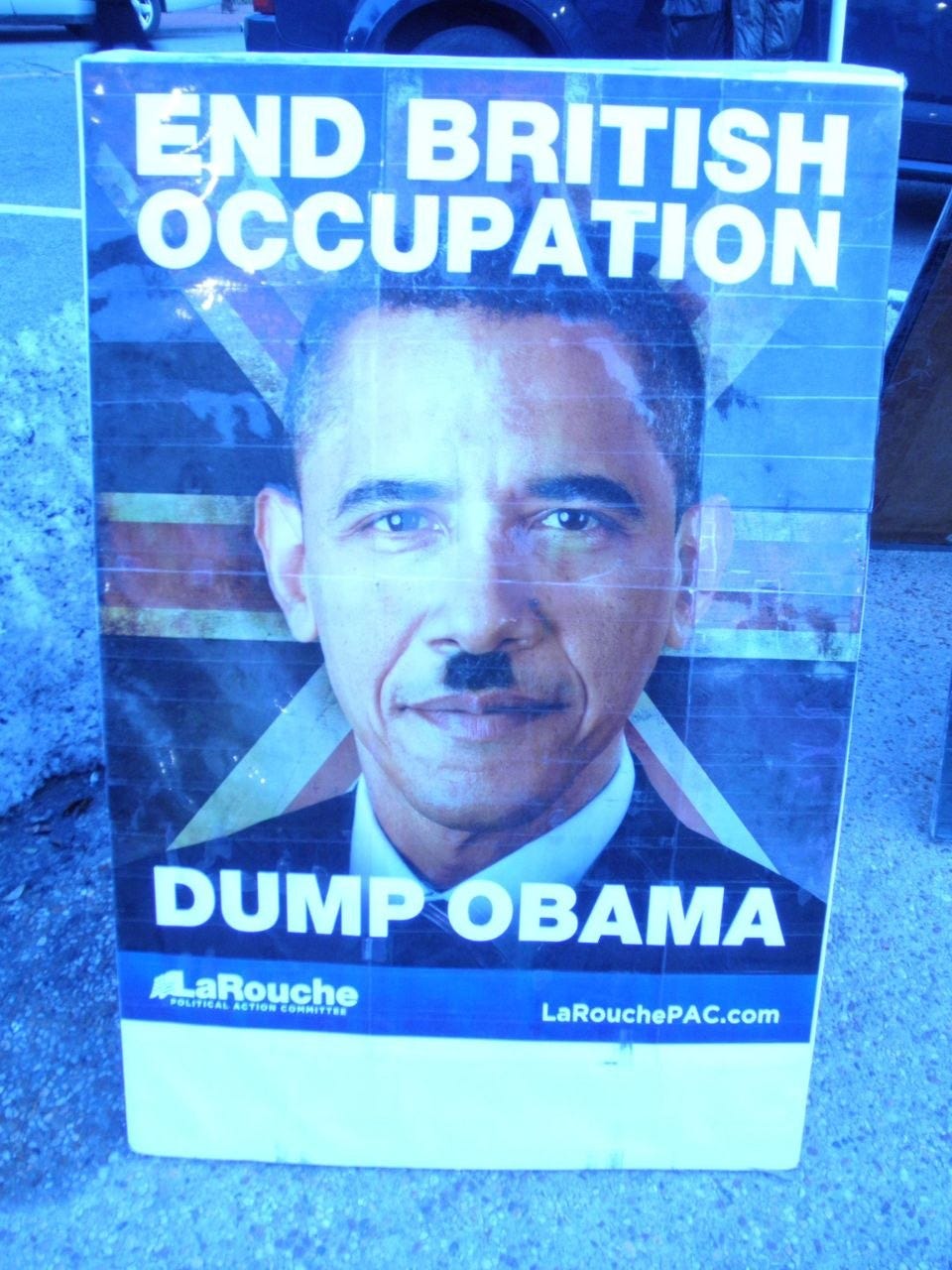
Let us begin with the embarrassing part, since the embarrassment is half the point.
Lyndon Hermyle LaRouche, Jr., born 1922 in Rochester, New Hampshire, died February 2019 in Round Hill, Virginia, was by the end of his life a figure with the following items on his public record. Eight presidential campaigns. A 1989 federal conviction for mail fraud and conspiracy to commit mail fraud, for which he served five years of a fifteen-year sentence in the Federal Medical Centre at Rochester, Minnesota. A documented belief that Queen Elizabeth II was running the international drug trade. A documented belief that the British Royal Family was waging biological warfare on the United States through the medium of jazz. A cosmological doctrine, articulated across hundreds of essays in his own publications, in which the historical struggle between “humanist” and “oligarchical” forces was traced through Plato, Cusa, Leibniz, Riemann, and his own contributions to economic theory. A cult around his person, in his lifetime, of the type documented in court filings, in defections, in the late Dennis King’s 1989 book, and in the recollections of a generation of journalists who covered the airport fundraising booths. He was, by any reasonable description, a deeply strange man, and many of his followers were either deeply strange themselves or had been made so by their association.
This is the part of the story conventionally told. It is told because it is true, and because it has the additional virtue of being entertaining. It is also, very precisely, the cover under which the rest of the story has been carried out.
The rest of the story is this. The vocabulary now used to describe the international monetary system, the vocabulary used in BRICS communiqués, in Schiller Institute conferences from Berlin to Johannesburg, in Asia Times leaders, in Roger Stone’s radio interviews with the man who is now Treasury Secretary of the United States, was developed in LaRouche’s organisation across the 1970s and 1980s. It travelled. It travelled by employment record. And it arrived, in May 2025, in the Policy Planning Staff of the United States Department of State, where the man who ran LaRouche’s economic publications from 1976 to 1982 now sits as a Senior Advisor.
The 1975 proposal
In April 1975, LaRouche’s organisation published a document titled A Programme for the International Development Bank. This was four years after Nixon closed the gold window. Bretton Woods, in its original form, was dead. The Eurodollar market was eating the City. The Latin American debt crisis was nine years away from breaking, but the underlying arithmetic was already legible. Into this LaRouche dropped a proposal which, in its broad outline, has not changed in fifty-one years.
The proposal was this: a new international clearing institution, capitalised in gold and supported by the issuance of long-term, low-interest, dollar-denominated credit, directed at the construction of capital-intensive infrastructure in the developing world. Not aid. Not debt forgiveness. Not commodity stabilisation. Productive credit, against physical projects, on the security of the goods produced. Steel mills. Nuclear power stations. Railways. Ports. Water systems. The infrastructure that converts a primary-commodity economy into a manufacturing one.
The vocabulary that surrounded the proposal mattered as much as the structure. “Sovereign credit creation.” “Physical economy” as opposed to “monetarist” or “financial-oligarchical” economy. The “decolonisation” of finance. The contrast between productive lending and what the proposal called speculative lending. The framing of the Bretton Woods institutions, the IMF and the World Bank as they had developed by 1975, as captured by a class of bondholders whose interests were structurally opposed to the developing-world states the institutions had been built to serve.
It is easy, reading this in 2026, to mistake it for a piece of Schiller Institute material from last month. The vocabulary is identical because the vocabulary did not change. It was developed, then deployed, then redeployed, for fifty years.
The operational infrastructure
LaRouche did not have a presidential campaign in 1975. He had something rather more useful. He had a publishing house, New Solidarity International Press Service, and a weekly news magazine, Executive Intelligence Review, founded in 1974. EIR’s masthead in those years reads like a roster of names the rest of this series will need to keep returning to. The Economics Editor, from 1976 onwards, was David Goldman. The Research Director of the parallel Fusion Energy Foundation, LaRouche’s pro-nuclear, pro-beam-weapons think tank founded the same year, was Uwe Henke von Parpart, who appears on the FEF and EIR mastheads under both his birth name and the party name “Parpart” he had adopted within the organisation.
In 1984, Helga Zepp-LaRouche (his wife, his political successor, and a German national operating since the early 1970s out of Wiesbaden) founded the Schiller Institute. The Institute was, from the start, the international face of the organisation. Conferences in Germany, Italy, France, Mexico, India, the Philippines. A specific focus on the developing world. A specific focus on producing the kind of dignified, conference-format prestige output that EIR’s airport fundraising surface presentation could not.
The pattern that mattered, and that became operational by the early 1980s, was this. LaRouche himself (convicted felon, presidential-campaign curiosity, author of cosmological tracts) could not be a respectable interlocutor for heads of state and finance ministers. He did not need to be. The organisation supplied a layer of nominally separate vehicles, each with its own letterhead, each capable of delivering a version of the doctrine in the dialect appropriate to its audience. Fusion Energy Foundation for the nuclear-industrial and defence audience. EIR for the financial-press audience. Schiller Institute for the Global South diplomatic audience. The Caucus Distributors and various political committees for domestic American politics.
And the operators were rotated, on the public record, across the vehicles.
Indira Gandhi, April 1982
In April 1982, Lyndon and Helga LaRouche travelled to New Delhi and met Prime Minister Indira Gandhi. The meeting is documented in the May 1982 issue of EIR, which is, to be precise, EIR documenting itself, but the underlying facts are independently established in the Indian press of the period, in the Indian Council of World Affairs records, and in the diaries of attendees at the various lectures and receptions LaRouche delivered during the trip. The trip included Jawaharlal Nehru University, the Bhabha Atomic Research Centre, the National Institute for Science and the Indian Institute of Technology’s Physics Department.
The reception in LaRouche’s honour, jointly hosted by EIR and Fusion magazine, was attended (by EIR’s own count, which is to be taken with the usual caveats) by some seventy people including members of parliament, senior diplomats, and what the issue describes as “leading scientists, industrialists, academics, journalists, and economists.” It is implausible that all seventy were LaRouche sympathisers. It is rather more plausible that the LaRouche organisation, by April 1982, had built enough of an institutional surface in New Delhi to fill a reception room with people who could plausibly be photographed at it.
From Delhi, LaRouche flew directly to Mexico City and met President José López Portillo. From that meeting came Operation Juárez, the August 1982 policy document in which LaRouche proposed that the Latin American debtor states should jointly declare a restructuring of their external obligations (the “debt bomb” framing) as a lever to force a “new international economic order.” Various leading Latin American newspapers carried the proposal in late May 1982. Nicaragua’s Daniel Ortega subsequently raised the framework at a Non-Aligned summit.
None of this resulted in a New Bretton Woods. That is not the point. The point is that the doctrine, by 1982, had been delivered in person, at head-of-state level, on two continents, by an organisation whose American surface was airport fundraising booths and pamphlets denouncing Jane Fonda. The respectability gap between the surface and the diplomatic reach was not a bug. It was the operational design.
The personnel pipeline
Goldman left LaRouche in 1982. He has described his time in the movement, in subsequent interviews, as a period in which he was “a radical and an atheist.” From 1984 he was an economic strategist on Wall Street: Credit Suisse credit strategy from 1998, Bank of America fixed-income research from 2002, Cantor Fitzgerald subsequently. He began writing the “Spengler” column in Asia Times on the first of January 2000. He did not reveal his identity as Spengler until 2009. In March 2015, he and Parpart took control of Asia Times HK Ltd., the Hong Kong vehicle that runs the publication. Asia Times regularly features Pepe Escobar, paid $900 by Iran to lie about Nordstream. Pepe was featured in earlier articles in Angry Dogs.
Parpart had left LaRouche earlier than Goldman did, in the same broad period, and had been writing for Asia Times since the 1990s. His former role at FEF, the Research Director who appeared on Good Morning America on the morning of 25 March 1983 to explain the strategic significance of Reagan’s SDI announcement two days earlier, was, in its time, a piece of operational reach the LaRouche organisation has subsequently claimed, with some plausibility and considerably more theatre, as evidence that SDI itself was their idea.
In May 2025, Goldman joined the Policy Planning Staff of the US Department of State as a Senior Advisor. The Staff was founded in 1947 by George Kennan at the request of George Marshall, and is described in its own materials as the Department’s internal think tank. His listing appears on the State Department website. The personnel chain runs: 1976 EIR Economics Editor; 1982 departure from the organisation; four decades on Wall Street and Cantor (Lutnick) and at the Larouchite Asia Times; 2025 Senior Advisor at State. The chain is documented in employment records.
Harley Schlanger, who appears on EIR’s Houston masthead in the early 1980s and remained inside the LaRouche organisation through and after the 1989 conviction, was the man Roger Stone was introduced to in 2016. Stone has described the introduction in his own interviews. Stone subsequently delivered a keynote at a Schiller Institute conference in September 2018, interviewed LaRouche himself on Stone Cold Truth in November 2016, and conducted further LaRouchePAC interviews into 2020. We will return to Stone in Part 5.
The legislative footprint: HR 2990
The personnel pipeline is one route by which the doctrine travelled. The legislative footprint is another, and the most striking single artefact of it is a bill called the National Emergency Employment Defence Act of 2011, introduced as HR 2990 in the 112th Congress on the 21st of September that year by Dennis Kucinich, the Democrat representing Ohio’s 10th district, with John Conyers of Michigan as co-sponsor.
The bill ran to seventy-five pages of statutory language and proposed the following. The abolition of fractional-reserve banking. The conversion of Federal Reserve notes into “United States Money” issued directly by the Treasury. The retirement of the federal public debt by the issuance of new Treasury money as existing instruments matured. The creation of a Monetary Authority within the Treasury to regulate the money supply against inflation. The direct issuance of credit by Congress, without taxation or borrowing, for infrastructure investment, Social Security stabilisation, and what the bill called “full employment.”
A reader of Part 1 of this series, or of LaRouche’s 1975 Programme for the International Development Bank, will recognise the structural template immediately. Sovereign credit creation. Physical infrastructure as the productive ground for new monetary issuance. The Federal Reserve framed as a private-banking interest improperly inserted between the Treasury and the constitutional money power. The retirement of debt by direct issuance rather than refinancing. The language of “Hamiltonian credit” against the language of “monetarist” or “speculative” finance.
The bill’s most direct intellectual genealogy runs through the American Monetary Institute, the Chicago-based outfit founded in 1996 by Stephen Zarlenga, whose 700-page The Lost Science of Money (2002) is the canonical post-Greenback statement of the doctrine of sovereign Treasury money issuance. AMI is not LaRouche, and Zarlenga’s intellectual lineage is its own. But the structural prescription that emerged from his American Monetary Act, which Kucinich’s staff worked into HR 2990 over five years from 2005 onwards, is materially identical at the level of monetary architecture to what LaRouche had been proposing since the mid-1970s. Both call for the destruction of fractional-reserve banking. Both call for the conversion of bank-issued credit into sovereign Treasury issuance. Both call for the application of that issuance to large physical-infrastructure programmes. Both frame the existing arrangement as a privatised usurpation of a constitutional public function.
By 2011 these were not separate vocabularies. LaRouche’s organisation had spent the 2008–2011 period campaigning openly for the reinstatement of Glass-Steagall as the “first step” toward what its publications called a “Hamiltonian credit system” and a “New Bretton Woods.” A LaRouche statement of December 2010, titled On the Urgent Need for a Hamiltonian Credit System, used the precise vocabulary HR 2990 would deploy ten months later. EIR and LaRouchePAC publicly endorsed the bill on introduction.
HR 2990 received no committee hearing and died in the 112th Congress. It was reintroduced in subsequent sessions and has not advanced. As a piece of monetary architecture it is a curiosity in American legislative history. As a piece of evidence it is rather more than that. It is the doctrine in statutory drafting language, introduced by a sitting Member of Congress, with a bill number and a co-sponsor and a Congressional Research Service summary on the Library of Congress website.
We will return to Kucinich himself in Part 5. The bill is here to make a narrower point: by 2011, the structural template LaRouche had been publishing since 1975 was reaching the floor of the United States House of Representatives in the drafting language of a sitting Congressman. The vocabulary had crossed the threshold from doctrine into legislative text. That is what successful intellectual smuggling looks like.
The doctrine, present tense
In November 2024, the man Trump would nominate twelve days later as Treasury Secretary appeared on Roger Stone’s 77 WABC radio show. The episode is publicly archived. The same week, on a separate podcast (Ted Seides’s Capital Allocators) Scott Bessent articulated, in the cleanest form he has put it on the record, the framework he intended to bring to Treasury:
“I felt very strongly that we’re in the midst of a great realignment, and of a Bretton Woods realignment coming, in terms of global policy, global trade. There’s a lot of what I taught at Yale and studied my whole life. I’d like to be part of it, either on the inside or the out.”
It is, on the face of it, the language of a sophisticated macro investor reflecting on the historical moment. It is also, very precisely, the vocabulary developed by Lyndon LaRouche’s organisation in 1975, refined through forty years of Schiller Institute conferences and EIR special reports, carried into Asia Times and the financial press by Goldman and Parpart through the 2000s and 2010s, drafted into a House bill by Kucinich’s office in 2011, and arriving on a New York talk radio show in the mouth of the incoming Treasury Secretary of the United States in November 2024.
The smuggling is the trick. The vocabulary, by the time Bessent uses it in 2024, no longer reads as LaRouchite. It reads as serious commentary on the international monetary system. The forty years of intermediate use by Asia Times and Reuters macro columnists and Bretton Woods Committee panels and Davos sidebar conversations, and a sitting Congressman’s bill, have done the laundering. By the time the framework reaches the cabinet, the fingerprints have been wiped.
This is what we will spend Part 5 establishing in operational detail. The vocabulary contamination of mainstream Anglosphere commentary on the dollar system is not an unfortunate accident of the discourse. It is the proof that an influence operation, running across half a century, worked. We will look at the specific pipelines (the Asia Times / Pepe Escobar / RT syndication chain, the Schiller Institute / BRICS-forum content sharing, the Goldman-to-Policy-Planning journey, and the operational figures who appear on Schiller Institute stages and at LaRouche-network rallies) in the depth they deserve.
The closing point
A man convicted of mail fraud in 1989, in a federal courtroom in Alexandria, Virginia, has had more sustained influence on twenty-first-century monetary-policy vocabulary than every Nobel laureate in economics combined. The vehicle was his employees and the bills they helped to draft. The doctrine survived the doctrinaire. The intellectual estate was, in the most precise sense, an estate: an inheritable asset, professionally managed after his 2019 death by Helga Zepp-LaRouche in Wiesbaden, by Goldman and Parpart at Asia Times in Hong Kong, and by Harley Schlanger across the conference circuit. It is now an asset with positions in the State Department of the United States, statutory drafting language in the Congressional record, and an articulated relationship with the Treasury.
The Queen Elizabeth drug-trafficking material was the cover. The cosmological pamphlets were the cover. The airport fundraising booths and the Jane Fonda denunciations and the eight presidential campaigns were the cover. The cover was so thick, and so genuinely embarrassing, that it functioned as a kind of insurance: any journalist or policy analyst who attempted to take the underlying doctrine seriously could be discredited by association with the cover. The cover protected the asset.
The asset is now operational.
Next week, Part 3: the development of crypto and stablecoins. How Hayek’s dream of denationalised money got debt-financed, and why $260 billion in private claims on US Treasury yield is the business model the cypherpunks were never told they were building.
Previously: Part 1, Bretton Woods: a history.
(although for now, in part 2, i don't see why it would not be a good idea..but we read on..)