


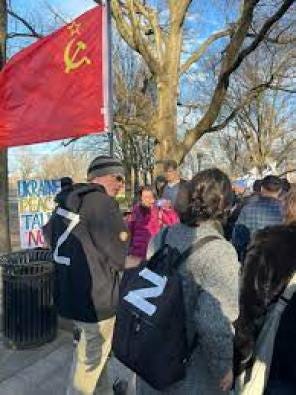
Part 7 ended at an airport. The doctrine had spent fifty years preparing to narrate a fact, and at Hostomel the fact refused to occur: the air bridge was denied, the paratroopers were ground down, and the state-television triumph reel was left describing a victory that never happened. A press office, however well funded, cannot broadcast a map that the army could not draw. Which leaves the doctrine with one route to market. If the advance cannot be made true by force, it must be made true by persuasion, sold to Western audiences as the reasonable, the inevitable, the already-decided. That is the retailers’ job, and this part opens their books.
It opens them from the bottom. The leaked PressTV records expose a working sales force, a bench of ostensibly independent commentators wired into a state broadcaster’s payroll and switchboard, and above that bench a far more powerful retail layer that does not appear on any invoice because it does not need to: it reaches into a British party, an American cabinet, and the boardroom of a Gaza reconstruction authority. The commentators sell the doctrine to the disaffected. The principals sell it to the electorate and the state. This part names both, from the call records up to the cabinet. The question of who ultimately gets paid, the cap table beneath all of it, is held for Part 9. This part is about who does the selling.
The switchboard


Among the material released in the Black Reward hack of the Iranian state broadcaster’s systems are guest lists, call-detail records and payment ledgers that can be decoded into contact graphs. Before reading anything into them, the necessary caution, and it governs this entire section: a call-detail record is a record of contact, not of complicity. Presence in these graphs establishes that a number connected to another number, nothing more. It does not establish that a person knew who was on the other end, took instruction, shaped a word of output, or understood what the broadcaster was for. Several of the people who appear are public commentators with public affiliations; their appearance here is a traceable connection and is offered as exactly that, and no individual at the periphery of these graphs is characterised beyond the fact of appearing in the decoded set. With that stated and meant, the structure the records reveal is worth describing, because the structure is the finding.
The graphs fill in the bench and reveal its width. At one pole sits the anti-war and anti-imperial left (Medea Benjamin), the Workers World and World Beyond War (see Part 7) orbit, the pro-Palestine activist circuit, the names that recur on every New Horizon roster and every “multipolar” panel. At the other pole, on the same decoded infrastructure, sit nodes from the revisionist right: the Institute for Historical Review, the principal Holocaust-denial body in the United States, and the antisemitic Culture Wars publication of E. Michael Jones (recently in discussion with Candace Owens). That a Holocaust-denial outfit and an anti-war charity reach the same switchboard is the horseshoe this series has argued from the start, now visible not as a similarity of vocabulary but as a shared set of contacts. A recurring internal extension in the records, 1446, supplies a crossover point to the New Horizon conference apparatus that Part 7 documented as Dugin’s repeated Tehran destination; that crossover is the load-bearing observation, and it rests on two facts already public and already cited, the United States Treasury’s 2019 sanction of New Horizon and Dugin’s attendance. The graphs illustrate the network those facts describe. They are shown as illustration and nothing heavier.
Part 7 kept one exhibit from these books: the PressTV “Live” payment sheet listing a small guest fee to the executive director of a doubly-decorated peace charity, against a live shot in February 2019, the charity’s leader on the books of a broadcaster a Western treasury later named as an intelligence recruitment platform. That belongs where Part 7 placed it, as proof of the doctrine’s reach into a sincere Western tradition. What belongs here is the wider point the sheet illustrates: the bench is paid, the payments are small, and the smallness is not exculpatory. A hundred dollars does not buy a conviction. It records a relationship. The records show a great many such relationships, and when you plot them they do not scatter. They converge.
That convergence is the commentariat. It is real, it is wired, and it is, in the end, the cheap tier of the operation, hundreds of dollars a booking, a bench of the disaffected talking to the disaffected. The expensive tier does not appear in these books at all, because the expensive tier is not paid by a Tehran broadcaster. It is paid by the trade itself, and it sits in parliaments and cabinets. The rest of this part climbs from the switchboard to the principals.
Farage and the Reform artery
Begin in Britain, because the disclosure regime, for all its holes, still produces a paper trail.
Christopher Harborne is British-born, Cambridge-educated, resident in Thailand since 1996, a Thai citizen under the name Chakrit Sakunkrit, and the holder of a reported twelve per cent of Tether, the issuer behind roughly 184 billion dollars of circulating USDT. The Sunday Times Rich List of May 2026 placed him sixth, with an estimated 18.2 billion pounds, the wealthiest British-born person on it, almost all of it traceable to the Tether stake. He is also the largest single donor in the history of British party politics. Since 2019 he has directed more than 24 million pounds to Reform UK and its predecessors, roughly two-thirds of everything the party has ever raised: 9 million in August 2025, described at the time as the largest single donation by a living individual in British history, then a further 3 million in November 2025 and another 3 million in March 2026. Fold in his earlier Conservative-era giving under Boris Johnson and the lifetime figure reaches around 30 million pounds.
Set the donations beside the policy. Reform’s platform includes a state-held Bitcoin reserve, a ten per cent flat rate of capital gains tax on crypto, opposition to Bank of England limits on stablecoin holdings, and broad deregulation of the digital-asset sector. On 12 November 2025, the same day the donations log records a 3 million pound Harborne gift, Nigel Farage published an op-ed in City AM pledging no cap on stablecoin ownership under a Reform government, with stablecoins, tokens pegged to currencies such as the pound or the dollar, at the heart of the revolution. A man whose fortune is a twelve per cent claim on the largest private stablecoin float in the world funds, to two-thirds of its budget, a party whose flagship financial policy is the removal of limits on stablecoin holdings. The pattern proves no quid pro quo and alleges no crime. It does not need to. The alignment is not at the level of a single decision. It is at the level of every line of the platform.
There is more in the file. The Parliamentary Standards Commissioner has opened a formal inquiry into whether Farage should have declared a 5 million pound personal gift from Harborne, made in early 2024, weeks before Farage announced his Clacton candidacy. That payment is the sharp object, and it is sharp precisely because it is undeclared. The 24 million in party donations is, whatever else, transparent: registered, attributed, lawful on its face. The 5 million is the opposite on every axis. It went to Farage personally rather than to the party, it was not declared, it has been explained only retrospectively and inconsistently, as personal security, then as admiration for Farage’s Brexit work, then as “not political in any sense,” and most recently wrapped in a claim that Russian intelligence hacked his phone to expose it. That last claim, whatever its merits, explains how the gift became public; it does not explain why it was not declared. Those are different questions, and only the second is the Commissioner’s. The Commons guidance is plain that where there is any doubt a benefit should be registered, which makes a 5 million pound payment from the country’s largest donor, received on the eve of a candidacy, a hard thing to characterise as beyond doubt. Whether any of it touched a Russian-linked source is a separate question a cabinet minister has now put on the record, and one this series files under provenance rather than declaration. The source-of-funds question is Part 9’s. The non-declaration is the retail tell: the part someone chose to keep off the books.
The other artery: Zebec, and the wheel of fortune
Harborne is the visible artery, the one with a name on the filing. There is a second, and it runs through an offshore shell that appeared at Reform’s conference fully formed, less than a month after it legally existed. This is the thread Part 4 promised would return.
Part 4 left a figure on the table. Changpeng Zhao built Binance into the largest exchange in the world, pleaded guilty in November 2023 to violating the US Bank Secrecy Act, paid a 50 million dollar personal fine and a 4.3 billion dollar corporate fine, served four months in a federal camp, and emerged with his equity intact at around 33 billion dollars and a soft landing in Abu Dhabi. The British leg of that network is quieter. Nicholas C. Andrews was a director of Binance Markets Ltd, the exchange’s UK arm, from 2015 to August 2020, and before that sat on the board of Wells Fargo Securities International; the Paradise Papers tie him to a Malta-registered compliance entity. On 6 August 2025 a company called Zebec Technologies plc was incorporated in London, Companies House number 16632387, with 50,000 pounds of stated capital, a single person of significant control, and Andrews as sole listed director from day one. The single controlling shareholder is Zebec Group Holdings Ltd, registered in the British Virgin Islands. UK company law normally requires disclosure of the ultimate natural person behind a firm; naming an anonymous offshore parent as the only PSC, as the Observer reported, appears to be in breach of that requirement.
A month later, at Reform UK’s Birmingham conference on 5 and 6 September 2025, this brand-new shell was sponsoring a policy panel, “Strengthening the Rule of Law,” billed alongside the DeFi lending firm Aave and within sight of fringe sessions sponsored by Japan Tobacco International. A company incorporated in August, controlled from the BVI, fronting a rule-of-law panel in September. Under the Electoral Commission’s guidance, paying to sponsor a party conference panel is treated as a political donation, and only a permissible donor may make one: for a company, a UK-incorporated firm that actually carries on business in the UK. Zebec clears the first half of that test and the second half is exactly the question. If a shell with 50,000 pounds of capital and a BVI parent was not genuinely trading, then any value it passed to Reform was foreign money through a domestic letterbox, the precise pathway the foreign-donor ban exists to close. No 50,000 pound donation from Zebec appears in the Commission’s register, which suggests the fee was booked as a commercial exhibitor charge rather than a declared donation. That is the wheel of fortune in miniature: the same money, depending on which slot it lands in, is either an innocuous stand rental or an impermissible foreign contribution, and the structure is built so that nobody has to say which.
Set the two arteries side by side. Harborne is the megadonor model: visible, enormous, traceable. Zebec is the shell model: tiny, offshore, deniable, routed through a director whose previous board seat was at Binance’s UK arm. Reform’s conference ran on both at once, which makes it the cleanest single illustration of the retail layer doing its actual job, converting offshore crypto-sector money into domestic political protection by whichever route attracts least scrutiny.
Trump and World Liberty Financial
The American case is the same shape, disclosed less, which is itself the tell.
World Liberty Financial is the crypto venture majority-controlled by the Trump family, co-founded by Donald Trump Jr., with Steve Witkoff’s son Zach among the founders and running it. Of the WLFI governance token, a third went to insiders, with a large tranche earmarked for the Trump family entity. Its product is USD1, a dollar stablecoin launched in March 2025 that passed 4 billion dollars in market capitalisation by April 2026. The reserve mechanics are the entire point and are not hidden, because they do not need to be: USD1 is backed by cash and short-duration US Treasury bills, custodied by BitGo Trust, with reserves managed by BlackRock, and holders receive no interest. The yield on the reserve portfolio accrues to World Liberty Financial. At four to five per cent on a 4 billion dollar float, that is on the order of 160 to 200 million dollars a year of gross interest, into a structure beneficially controlled by the sitting President’s family. This is the mechanism Part 3 described in the abstract, now wearing a name: yield that previously accrued to the US Treasury, and through it to the public balance sheet, redirected to a private holder. The only novelty is the identity of the holder.
The capital came from where the series teaches us to expect it. A 500 million dollar stake was taken by Abu Dhabi interests linked to Sheikh Tahnoon bin Zayed Al Nahyan. The Abu Dhabi firm MGX settled a 2 billion dollar investment into Binance entirely in USD1, after which Binance opened USD1 trading pairs. The float is partly Gulf sovereign money cycled through the President’s family token into the world’s largest exchange. Cantor Fitzgerald sits adjacent throughout: Howard Lutnick, now Commerce Secretary, whose family bank holds roughly five per cent of Tether through convertible debt and which has acted across the sector as custodian and broker. The same names recur, as they have in every prior part, because it is the same room. Whose room, exactly, and who profits from it, is Part 9’s accounting. For Part 8 the point is narrower: the President’s family is a retailer of the stablecoin, and the policy that protects the stablecoin is administration policy.
And the personnel surface in the other file too. The Special Envoy for Global Partnerships Paolo Zampolli appears in the Epstein documents, as do Trump, Lutnick, and Witkoff senior, and figures in the Bannon orbit. The point is not the salaciousness. It is that the social graph of the people positioned across this trade and the social graph of those disclosures are, to a striking degree, the same graph.
Musk, Thiel, and the techno-utopian retail

Part 7 set out the deepest layer of the doctrine, the one that gives it the temperature of a religion: the Russian cosmism that promises to raise the dead, and its Western mirror, the TESCREAL bundle that promises to bring forth the unborn, with Thiel, Musk and Bankman-Fried named as its adherents. Part 8 need not rebuild that argument. It need only show the retail end of it, because the techno-utopian doctrine has a salesman and a financier, and they occupy the same trade as everyone else in this chapter.
This is the second branch of the LaRouche tree. Parts 2 and 5 traced the monetary branch, the New Bretton Woods doctrine running from Leesburg to the State Department. But the organisation always carried a second doctrine alongside the first, the techno-futurist one: fusion, beam weapons, the conquest of scarcity through grand state-science. When Reagan announced the Strategic Defense Initiative on 23 March 1983, it was the Fusion Energy Foundation that supplied the public explanation, with an FEF spokesman on CBS the next evening and its research director Uwe Parpart, the same man who would later co-run Asia Times in the chain Part 5 traced, on Good Morning America the morning after; the organisation has claimed paternity of SDI ever since. That branch frames technological transcendence as a civilisational duty in exactly the way the monetary branch frames dollar displacement as a moral one. Musk is no product of the LaRouche network. But he is the most successful retailer alive of the doctrine that branch sells, that a sufficiently grand future justifies whatever it costs to reach it, and he sells it the way it is meant to be sold, as a lifestyle. SpaceX and Tesla and Neuralink are not only companies. They are the advertising hoardings for a future in which scarcity, mortality and Earth itself are problems to be engineered away.
That worldview has a Russian mirror, and the mirror met its Western reflection in Moscow. In June 2025 the Tsargrad Institute, the vehicle of the sanctioned oligarch Konstantin Malofeyev, hosted the Forum of the Future 2050, where panels tied cosmism to the race to Mars and the speaker list gathered the multipolar bench this series has tracked: Lavrov, Dugin, the regulars of the New Horizon and state-media circuit. Among the speakers was Errol Musk, the father of the man this section concerns. The point is not to make the son answer for the father’s stage. It is narrower and stranger: the techno-transcendence doctrine has a Western retail form and a Russian retail form, and in the summer of 2025 they shared a podium, selling the same future to the same end.
If Musk retails the worldview, Peter Thiel funds the priesthood that gives it authority. The Angry Dogs set this out at length in Canonized by Coin: the longtermist and effective-altruist canon of which Nick Bostrom became the prophet was not earned on merit but scaffolded by money, hundreds of millions routed through Open Philanthropy and adjacent vehicles to build an altar at which the right futures were declared important and the wrong harms trivial. Thiel is the patient capital behind that project and its offshoots: the Thiel Fellowship that funded the young Vitalik Buterin; Founders Fund, an early institutional holder of Bitcoin and Ether that exited near the 2022 peak for a reported 1.8 billion dollars and re-entered in 2023; a stake in the Ethereum-treasury miner Bitmine; and Palantir, which he co-founded and of which he remains the largest shareholder, now the data layer wired into the American security state. He does not retail. He funds, and he places people: his fifteen-million-dollar backing of JD Vance’s 2022 Senate campaign seated a protege in the Vice Presidency. The pessimist dialect of the same exit-from-democracy worldview, Curtis Yarvin’s neoreaction, which Thiel has bankrolled, and the Dark Enlightenment of the former Warwick philosopher Nick Land, has been described by scholars of the Moscow forum as itself a bridge between the American and Russian illiberal right. Musk sells the optimistic version to the crowd. Thiel funds the canon, the personnel, and the positions. The worldview is the same; only the shopfront differs.
And underneath the advertising sits a question the chapter cannot avoid. Tesla trades, in May 2026, at a price-to-earnings multiple of well over 350 on its trailing earnings, against an auto-industry median near 18, on a return on equity below five per cent. The company earns like a mid-cap industrial and is priced like a prophecy. There is a roughly three-quarter-trillion-dollar gap between what the asset earns and what the market pays for it, and the thing holding that gap open is not a discounted stream of cashflows. It is belief: a narrative and a founder, the same fuel that holds a meme coin’s price above its non-existent fundamentals. Tesla equity is even now migrating onto the rails of that comparison literally, trading as a tokenised asset across crypto venues while the SEC’s 2026 moves on Nasdaq, the NYSE and a paused “innovation exemption” dissolve the wall between a share and a token. So the question poses itself without needing to be forced: is Tesla itself a memecoin? The honest answer is that the company is not, but the equity increasingly behaves like one, and that behaviour is the proof of concept for the whole privatisation. Musk did not enter the trade when he bought a stablecoin or minted Dogecoin. His own net worth was the first token he minted, value conjured by narrative and defended by reach, and Dogecoin only made the mechanism explicit. The 2022 acquisition of X was financed substantially by sovereign-wealth and crypto-aligned capital and very nearly secured against that same Tesla stock; X Payments has chased money-transmitter licences across US states; the xAI build-out at Memphis sits on the physical-asset side of Part 6’s trade; and the Department of Government Efficiency theatrics put a federal platform under a meme coin’s name, which is either the most expensive joke in the history of administration or an advertisement, and the two readings are not mutually exclusive.
The table
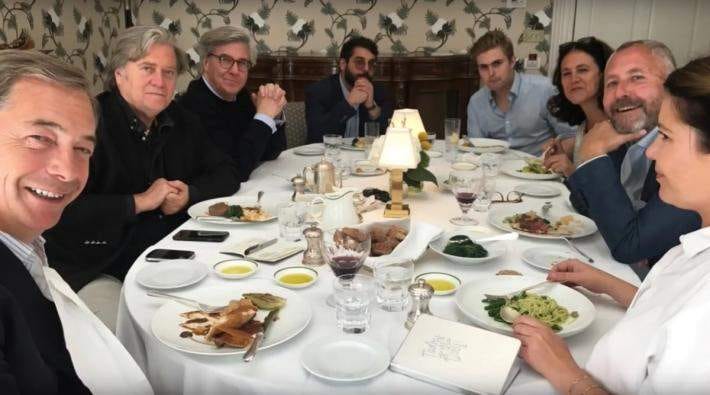
There is a photograph that gathers most of this into one room. In November 2025 the Byline Times editor Peter Jukes documented a dinner held in Brussels in 2017, the dinner at which Steve Bannon launched The Movement, his pan-European populist vehicle, fronted by Nigel Farage, structured by the Belgian lawyer Mischaël Modrikamen and by Laure Ferrari, and advised on the 501(c)(4) opacity that would shield its funding by Jeffrey Epstein. Jukes told that story as a Russian one, and told it well. It is only part of the picture.
There are eight people in the photograph. Jukes traced seven. The eighth is John Thornton, and his presence extends the scene from a European political project into a story that also reaches Beijing’s gold complex. Thornton is now executive chairman of Barrick Mining, the world’s second-largest gold miner, a post he took in September 2025 after ousting the chief executive Mark Bristow. Barrick’s joint ventures include Shandong Gold and Zijin Mining, both owned by the Chinese state, and Thornton has sat on the China Investment Corporation’s International Advisory Council continuously since 2009. He is the gold-side seat at a table otherwise occupied by the people who sell the politics. Why does a gold miner with Chinese-state joint ventures sit at the founding dinner of a European populist movement? Because, as Part 6 set out, gold is the second trade: the stablecoin operators extract the dollar’s yield on the way down, and the gold-side holders pre-position for the way up, for the moment the dollar’s reserve status erodes and the metal the central banks have been buying by the thousand tonnes a year reprices. Those are not two trades with an overlapping cast. They are two legs of one trade, and the 2017 photograph is the clearest single proof, because the personnel for both legs are at the same table, advised by the same man on how to keep the funding dark. The retailers in this chapter and the gold position in Part 6 are not connected by inference. They are connected by a place setting.
Blair, and the full width of the bench
Lest this read as a phenomenon of the right and the fringe alone, note where the same product turns up in respectable dress. The Tony Blair Institute for Global Change, funded by Larry Ellison, sells governments a future of digital identity and AI-administered statecraft, the grown-up, evidence-based register of the same technological-transcendence pitch Musk retails to the crowd. In January 2026 Blair took a founding executive seat on the Trump administration’s Board of Peace for Gaza, alongside Kushner and Witkoff, to oversee reconstruction as an investment opportunity, and in May 2026 he was urging his own party’s leadership to abandon net zero and move closer to Trump. The boy from Sedgefield is not a contradiction of this chapter. He is its “centrist” retailer: the liberal-technocratic shopfront for the identical doctrine, funded by the identical kind of capital. Whose capital, precisely, is a question for Part 9, where the retailers step aside and the invoices are read out. For now it is enough to see that the bench runs the full width of the spectrum, from the alternative-media commentators on a Tehran switchboard, through Clacton and the Lincoln Memorial, to a cabinet and a Gaza board. That breadth is not a coincidence. It is what a successful product looks like.
The framing
None of these benches needs central coordination, and the temptation to look for a controlling memo is exactly the error the methodology of this series is built to avoid. Each actor maximises returns within his own position. The paid commentators sell the doctrine to the disaffected for a hundred dollars a booking. Harborne funds the party whose policy is his asset’s tailwind. The Trump family owns the issuer whose yield is the public’s foregone revenue. Musk sells the future that makes extraction feel like progress, and Thiel funds the canon that makes it feel like wisdom. Blair sells the whole thing in a suit. The outputs align because the positions are positioned in the same trade. No conspiracy is required where a cap table, a shared switchboard, and a common enemy will do.
That common enemy is the last thing the retailers share, and it is where the doctrine and the sales force meet. On 28 February 2025, in the Oval Office, around the signing of a deal on Ukraine’s rare-earth minerals, the President of the United States told the President of Ukraine that he did not hold the cards, that he was gambling with the Third World War, and that he had not been thankful enough; the Vice President asked whether he had said thank you once in the entire meeting; and afterward the President conferred with the Vice President, the Secretary of State and the Treasury Secretary, the last of them the man whose Bretton Woods vocabulary Part 5 traced to Leesburg, and decided the Ukrainian was not in a position to negotiate, and had him removed. Read on its own it was a row about manners. Read against this series it was the doctrine’s oldest assumption spoken aloud from the most powerful retail platform on earth: that Ukraine is a transient obstacle delaying a settlement history has already written, an ingrate refusing to read his assigned line. The script was supposed to be describing a finished fact by the spring of 2022. Hostomel is the reason the man was still on the stage to refuse it. The retailers would write him out. The army could not.
The next case
There is one more thing the doctrine assumes, and it is the assumption that should trouble the retailers most, because Ukraine has already tested it in public. The premise of the whole construction, traced from Glazyev’s economics through Dugin’s civilisational frame to the cathedral floor, is that the physical seizure validates the narrative: that you take the ground, and the story of the inevitable multipolar settlement becomes true by having happened. Ukraine was the test case for that premise. It did not fail at Hostomel in a single afternoon and vanish. It failed slowly, expensively, in full view, over years, the air bridge denied and the army ground down and the sanctions imposed and the resolve, against every expectation in Moscow, sustained. The seizure that was supposed to write the narrative instead wrote a different one, about cost.
Which puts a question to Beijing, and through Beijing to the Western retailers selling the inevitability of the settlement: is Taiwan worth the gamble, knowing what Ukraine cost? The series does not predict the answer, and it is worth being honest that the answer is genuinely contested by serious people. The case for the window is real. The demographic clock is running against China, the military build-up has a horizon that American commanders associate with 2027, though as a measure of when the capability converges rather than a date anyone has chosen; Western attention is visibly fatigued and visibly transactional, the Oval Office scene above being the proof; and the prize is not territory but the most concentrated strategic asset on Earth, the Taiwanese semiconductor fabrication on which the entire compute build-out of Part 6 depends. From inside that frame the move can look not merely possible but overdue.
The case against is equally real and Ukraine supplies most of it. An amphibious assault across a hundred miles of sea is one of the hardest operations in warfare, an order of magnitude harder than the land advance that stalled outside Kyiv, against a defender that has watched Ukraine’s playbook for four years. The demonstration effect cuts the other way: the sanctions architecture that was improvised against Russia in weeks now exists as a tested template, the Western resolve that Moscow bet would crack did not, and the chip interdependence that makes Taiwan the prize also makes it the hostage, because a fabrication complex is worth nothing if the war that takes it also destroys the tacit knowledge and the supply chains that make it run. The thing you seize to win the future may be the thing the seizure annihilates. Ukraine is the evidence; both columns of the ledger draw on it, and the series leaves the ledger open rather than closing it on the reader’s behalf.
But here is where the doctrine of Part 7 bears on the arithmetic, and where this part hands to the next. The long-termists calculus, the reasoning that justifies any present cost by appeal to the trillions of future minds or the thousand-year civilisation or the inevitable multipolar destiny, is precisely the frame in which a catastrophic gamble looks rational. If the future is large enough and certain enough, no present price is too high to pay for it, not Ukraine’s cost, not Taiwan’s, not the dismantling of the monetary order that underwrites the living. That is the danger in the salesman’s pitch that is not contained in any single donation or invoice. The future-people calculus does not merely sell the trade. It dissolves the brake. A decision-maker who has been persuaded that history has a destination and that he is its instrument has been relieved, from inside the frame, of the obligation to count the cost in the present, because the present has been priced at zero against an infinite future. That is the most expensive idea in the series, and the one with no entry on any cap table.
Which is the question Part 9 has to answer, because the cost is not abstract and somebody bears it. If the retailers sell a future in which the present is free, Part 9 reads the invoice the present is actually being charged: the cap table behind the politics, the names that recur across the stablecoin, the gold, the compute and the Gulf-capital legs, and the public balance sheets, in Washington, in London, in Brussels, that are paying for a future sold to them as inevitable by people positioned to profit from its arrival. The retailers named the future. Part 9 names the bill.
The retailers sell the politics. The politics protects the trade. The trade funds the retailers. It is a closed loop, and closed loops do not need a conductor. The only thing that breaks the loop is a fact the apparatus cannot narrate, and the last one cost a continent four years and counting. The next one is being weighed now.
Forward to Part 9, where the retailers step aside and the invoices are presented: the cap table behind the politics, and the names that recur across the stablecoin, gold, compute and Gulf-capital legs of the single trade. Back to Part 3, on how stablecoin float became a private claim on Treasury yield; Part 4, on the Binance arc that ends at a Reform conference; and Part 7, on the doctrine these retailers sell at retail, and the airport where the army’s version of it failed.