


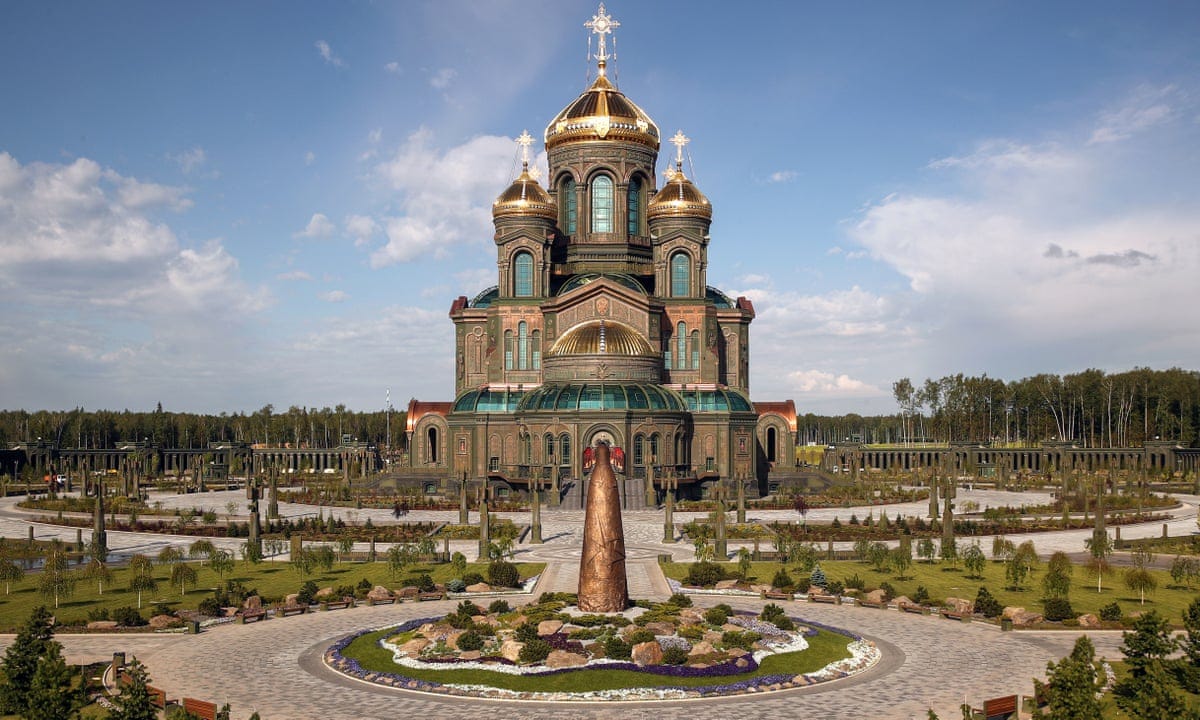
Begin with the strangest fact, because everything else in this part hangs from it. The official ideology of the Russian state, the one poured into its newest cathedral and written into the papers of the men closest to its president, holds that the dead will be raised. Not metaphorically. Physically, by science, in time, and given somewhere to live among the stars. This is not a marginal belief held by cranks at the edge of the system. It is the inherited metaphysics at the centre of it, and once you can see it, the monetary doctrine the rest of this series has been tracing stops looking like economics with odd religious trimmings and starts looking like what it is: a holy war, with the dollar cast as the thing standing between the living, the dead, and the future. This part is about the machine built to fight that war, and the week in 2022 when the machine met a fact it could not raise.
Part 6 followed the physical trade: the alumina out of Limerick, the rare earths, the gold, the mining joint ventures that move strategic material across the boundary between the sanctioned and the legitimate. This part follows the other half of the same enterprise, which is the story the network tells about itself. Every extraction needs a justification, and the justification is not improvised. It is manufactured, by a doctrine half a century old, formalised into a media instrument headquartered in Tehran, and retailed into Western audiences through a network of voices that present themselves as independent and are nothing of the sort.
The hinge between the two halves is a place we will return to at the end: Transnistria, the strip of eastern Moldova that has been garrisoned by Russian troops since 1992 and run by a separatist administration no state recognises, the enclave where the doctrine was supposed to stop being a doctrine and become a fact. Hold that thought. The story has to travel a long way before it arrives there.
Part 5 established that the New Bretton Woods vocabulary reached the Kremlin by a personnel chain rather than by coincidence: the same Leesburg, Virginia wellspring that fed the State Department through one set of employees fed the Eurasian Economic Commission through another. This part shows what was built on that vocabulary once it arrived. Not an argument. An apparatus. A doctrine with named architects, an inherited eschatology that gives the doctrine its quasi-religious urgency, a formal multi-state media instrument that turns the whole package into broadcastable product, and a financed retail tier of Western commentators who carry the framings into audiences that would switch off the moment the same words arrived on a Russian state letterhead. The whole construction rests on a single assumption: that the physical seizure would be quick and clean, and the narrative would simply describe an accomplished fact.
The captured peace movement shows how far the doctrine reaches into the West. The map and the airport prove the assumption was wrong.
I. The architects
The doctrine has two authors, and they do different jobs.
The room they share is the Izborsky Club, founded around 2012 as what one survey of the Russian conservative landscape calls an anti-liberal super think tank, assembled under the banner of social conservatism. It gathered the neo-imperial statepatriots of the 1990s around Aleksandr Prokhanov, the Eurasianists around Aleksandr Dugin, and a bench of heterodox economists led by Sergei Glazyev, alongside Mikhail Delyagin and Mikhail Khazin. Over its first eight years the club drew significant funding from the presidential administration. That is the structural fact worth holding onto: the ideologist and the economists were not freelancers shouting from the margins. They sat in the same state-funded room, and the state paid the rent.
Glazyev is the economic engineer, and he is the one who carries the lineage this series has been tracing. Readers of Part 5 will recall the bridge: Glazyev as presidential aide for Eurasian integration from 2012, then the Eurasian Economic Commission’s Minister for Integration and Macroeconomics, then, from April 2025, State Secretary of the Union State of Russia and Belarus. The vocabulary he deploys from those offices is the LaRouche vocabulary, and the connection is not inferred. After Glazyev was pushed out of the Yeltsin administration in 1993, he found a sympathetic correspondent in the American conspiracy entrepreneur Lyndon LaRouche, whose economic worldview closely matched his own. The relationship outlasted LaRouche himself. On the centenary of LaRouche’s birth in September 2022, with Russian tanks already in Ukraine, Glazyev published a tribute through LaRouche’s own organisation: Lyndon LaRouche, he wrote, turned out to be right, may his memory live forever. A serving senior economic official of the Russian state, paying homage to a man convicted of mail fraud in a Virginia federal court, in the middle of a war. The LaRouche strand of the doctrine, the sovereign-credit, gold-remonetisation, dollar-displacement economics, runs through Glazyev and the documents put it there.
Dugin does the other job. He supplies the civilisational frame, the part that gives the dry economics its moral charge and its enemies. His influence travelled through The Foundations of Geopolitics and The Fourth Political Theory, which offered Russian elites and the officer corps a narrative of national exceptionalism and civilisational mission at exactly the moment a post-Soviet identity was up for grabs. The content of that narrative is a binary: an Atlanticist order, principally the United States and the United Kingdom, cast as a homogenising force that dissolves national cultures, set against a Russia-led Eurasian order that promises to preserve them. There is no monetary architecture in Dugin. There is identity, civilisation, and the permanent enemy.
The neat thing is that Dugin himself draws the boundary. Asked in 2022 to define the scope of Eurasianism, he files Glazyev under practitioners, the modern applied economic part of the project, and adds that this applied part is quite far from how the first Eurasians understood their ideals. The ideologist concedes that the economist is doing something adjacent to his own work rather than identical to it. That concession is the division of labour stated from the inside. Two currents, the economic and the civilisational, the LaRouche inheritance and the neo-Eurasian one, merging in a single state-funded vessel into one exportable doctrine. Glazyev tells you the dollar system is a moral wrong to be dismantled. Dugin tells you why dismantling it is a civilisational duty. Between them they produce a complete product, and the product needs distribution.
The distribution begins, in Dugin’s case, in Tehran. It is tempting to file him as a writer of books, an armchair theorist whose Eurasianism reaches Iran only as text. The record says otherwise. Dugin has been invited to Iran repeatedly, and the invitations come from a specific quarter: hardline outlets and entities tied to the Revolutionary Guards, including the newspaper Javan, the state broadcaster Ofogh, which translates as Horizon, and Raja News. In early 2015 the filmmaker Nader Talebzadeh brought him to Tehran as a special guest of the third New Horizon Conference, and in 2018 he returned as the star guest of the edition held in Mashhad. New Horizon is not an academic gathering. In February 2019 the United States Treasury sanctioned it and four of its organisers, Talebzadeh among them, for facilitating contact between American citizens and the Quds Force, stating that the conferences had given Iranian intelligence officers a platform to recruit attendees and gather information while propagating anti-Semitism and Holocaust denial. The conference rosters across the years read like a directory of the network this part is mapping: the Grayzone contributor Gareth Porter, the German Duginist Manuel Ochsenreiter, and the Polish politician Mateusz Piskorski, later charged over cooperation with Russian intelligence.
What Dugin did at the podium was the civilisational frame doing diplomatic work in real time. He told a New Horizon audience that Moscow had intervened to save the region, that the West creates chaos and destroys and bombs but proposes nothing. More revealing still, Talebzadeh has quoted Dugin wishing that Khomeini could write to Russia’s leaders again, as though the country needed the instruction. That is the civilisational doctrine reaching out to absorb Iran’s revolutionary ideology into the anti-Atlanticist bloc, not as a rhetorical flourish but as a courtship conducted in person, on sanctioned ground, hosted by the very Guards-adjacent media apparatus that the next section’s charter would formalise into a treaty. Dugin is not the theorist of the Eurasian project alone. He is one of its travelling envoys, and the destination he kept returning to was Tehran.
II. The relics
There is a layer beneath the economics and the civilisational frame, and it is the strangest and least examined part of the whole construction. It is the layer that explains why this project has the emotional temperature of a religion rather than a policy, why its adherents talk about history as though it has a destination and Russia a sacred role in reaching it. The name for it is cosmism, and it is the oldest thread in the bundle.
Russian cosmism begins with Nikolai Fedorov, a nineteenth-century Moscow librarian who held that the common task of humanity, its single moral obligation, was the abolition of death and the literal, physical resurrection of every human being who had ever lived. This was not metaphor. Fedorov meant that science would one day reassemble the dead from their scattered particles, and that the resulting population would need somewhere to live, which is why the conquest of space was part of the programme from the beginning. His followers carried the two halves forward. Konstantin Tsiolkovsky, the rocketry pioneer whose equations made spaceflight possible, imagined space travel as the next stage of human evolution, with humanity eventually transforming into radiant, energy-based forms inhabiting the cosmos. Vladimir Vernadsky, the geochemist, supplied the concept that matters most for what follows: the noosphere, a stage of planetary development in which human thought itself becomes a geological force, a thinking layer wrapped around the Earth, capable of directing evolution. Thought, in Vernadsky’s account, is a form of energy.
The doctrine looks like mysticism and it half is, but its hold on the Russian state mind is documented and specific, not atmospheric. The clearest early proof that cosmism was always a crypto-religion of the state is Lenin’s mausoleum: the decision to preserve the body indefinitely, against ordinary Bolshevik materialism, makes sense as what scholars of cosmism have long argued it was, a resurrection-machine, a body kept intact until the science Fedorov promised could return it to life. And the line into the present Kremlin is traceable. Vernadsky’s noosphere shaped Lev Gumilev, one of Putin’s openly favoured thinkers, and it surfaces, unmistakably, in the writing of Putin’s own chief of staff. When Anton Vaino was appointed to that post in August 2016, the BBC’s Russian service drew attention to a 2012 article he had co-authored, “The Capitalization of the Future,” describing a device he called the nooscope: an instrument, in the paper’s words, for recording changes in the noosphere and studying the collective consciousness of mankind. Asked by the BBC to explain it, Vaino’s co-author Viktor Sarayev offered a sentence that could serve as an epigraph for this entire series: Newton invented the telescope, Leeuwenhoek the microscope, and they had invented the nooscope, a device that “scans transactions between people, things and money.” The mysticism and the money are not two subjects in that sentence. They are one. Aleksandr Dugin, the civilisational architect of the previous section, draws on the same cosmist inheritance in his account of the Russian idea. The eschatology is not decoration on the doctrine. It is the doctrine’s reason for being in a hurry: if history is going somewhere and Russia is its appointed vehicle, then dismantling the existing world order is not vandalism but midwifery.
Which brings us to the building. Forty miles west of Moscow, in a military theme park called Patriot Park, stands the Main Cathedral of the Russian Armed Forces, consecrated in June 2020 for the seventy-fifth anniversary of victory in the Second World War. It is the physical text of the whole ideology, and it reads like one. Its dimensions are coded: the main dome drum is 19.45 metres across for the year 1945, the belfry stands 75 metres for the anniversary, and a smaller dome is 14.18 metres because the war on the eastern front lasted one thousand four hundred and eighteen days and nights. Its steel frame is engineered, according to its own specification, for a strength factor of three hundred to fifteen hundred years, a cathedral built to a timescale that is not architectural but eschatological. Leaked images during construction showed mosaics of Putin and Shoigu, and another of Stalin, all quietly removed after, the church said, the President’s own intervention. The museum beside it was reported to display Hitler’s peaked cap as a trophy relic. The theologians of Orthodox churches outside Russia have named the ideology the cathedral expresses, Russkiy mir, the “Russian world”, and called it a heresy.
And then there is the floor. The floors of the cathedral are made of metal melted down from captured Wehrmacht weapons and tanks, so that, in the building’s own stated symbolism, every worshipper walking across them is delivering a blow to the fascist enemy. Read through the cosmist lens the building otherwise wears on its sleeve, this is not merely a war memorial’s poignancy. It is an attempt to do something with the dead and their machines: to take the materiel of a defeated enemy, transmute it, and convert the accumulated patriotic emotion of millions of footsteps into a kind of stored national energy, thought and feeling made physical, projected upward. That last clause is this series’ reading and is offered as such, not as the architects’ stated intent. But the building invites the reading. A structure that encodes its dimensions in war-dates, engineers itself to last fifteen centuries, and floors itself in the transmuted metal of its enemies is not behaving like ordinary commemoration. It is behaving like a machine for putting energy into Vernadsky’s noosphere. The eschatology has been poured into a foundation.
There is a second resurrection performed in that complex, and it is the one that gives this part its title its second meaning. In the museum beside the cathedral, an interactive display invites the visitor to hear words of wisdom from Joseph Stalin, the great leader, speaking on Red Square. The dead tyrant is raised and given voice, edited for the occasion. This is not an isolated theme-park flourish; it is the visible edge of a deliberate, decade-long state project. When Putin took office there were a handful of Stalin monuments in Russia; there are now well over a hundred, more unveiled each Victory Day, and in May 2025 a statue removed during de-Stalinisation in the early 1960s was reinstalled in the Taganskaya metro station. School textbooks have for years recast him from mass murderer to the beloved father who won the Great Patriotic War, and the editing is precise: the purges are downplayed or omitted, because Putin is interested in Stalin the wartime saint, not Stalin the killer of millions. By 2023 nearly two-thirds of Russians, and almost half of those under twenty-five, told pollsters they viewed him positively. The cult of the leader and the cult of the war are the same cult, and it functions, as one historian of it puts it, like an official state religion, with its catechism, its parades, its holy days and its temple. The man who industrialised death in the 1930s is resurrected as the patron saint of the war against the living in the 2020s, his crimes lifted out and his victory left in. A doctrine that promises to raise the dead is, in the meantime, selective about which dead it raises and what it deletes from them on the way up.
It would be comfortable to file all this as exotic, a peculiarly Russian derangement with no Western counterpart. That comfort is not available. The West has its own cosmism, and it is currently the operating belief system of the wealthiest men alive. In 2023 the researchers Timnit Gebru and Émile Torres gave it a name, TESCREAL, an acronym bundling transhumanism, extropianism, singularitarianism, cosmism, rationalism, effective altruism and longtermism. The C is not a coincidence of nomenclature; modern cosmism is a direct descendant of the Russian original, and longtermism, the bundle’s politically active edge, openly mixes Russian cosmist ideas with effective-altruist calculus in the work of its Oxford champions. The promises are Fedorov’s promises in Californian dialect: immortality through technology, the colonisation of space, the uploading and maximising of future minds across the universe, salvation engineered rather than received. Its adherents are named and unembarrassed. Peter Thiel funds the life-extension and seasteading edges of it; Elon Musk has called longtermism “a close match for my philosophy” and frames the settlement of Mars as a duty to the cosmic future. And its most instructive figure is Sam Bankman-Fried, who was converted to effective altruism as a student by the same Oxford philosopher who supplies longtermism its texts, who justified the accumulation of an eleven-figure fortune as “earning to give” to the far future, and whose cosmic salvation narrative turned out to be sitting on top of one of the largest frauds in financial history. The doctrine was the cover story. The extraction was the business. That is the Western cosmism in a single career, and it is the subject Part 8 will open, because the men who retail it are the same men who appear in this series’ cap tables.
For now, hold the symmetry, because it is exact. The Russian doctrine promises to raise the dead; the Western doctrine promises to bring forth the unborn, the trillions of future minds whose merely possible existence is invoked to justify almost any cost imposed on the people alive now. One civilisation venerates the dead of 1945 and engineers a cathedral to resurrect them; the other sells the dead of the year 1,002,025 and engineers a portfolio to provide for them. Both are markets in people who do not exist, run for the benefit of the few who claim to speak for them. The cathedral floor and the longtermist foundation are the same gesture in different metals. The question the series keeps asking of both is the only one that matters: what is the salvation narrative actually raising money for? Part 8 takes up the Western half, the retailing of the future people, and finds the same answer the East gives, written this time on a cap table. Émile Torres has a substack here.
III. The charter
A doctrine becomes an operation when it acquires an instrument. The instrument exists, it is written down, and it leaked.

The Charter of the Aligned Media Outlets and Organizations Union is a formal, treaty-style agreement headquartered in Tehran. Its Executive Council has five founding members: IRIB, the Islamic Republic of Iran Broadcasting; RT, of Russia; Al-Mayadeen, of Lebanon; Al-Iraqiya, of Iraq; and CCTV, of China. Iran holds two of the seats. The charter’s official languages are English, Russian and Persian, with the Persian text designated authoritative, which tells you plainly enough whose instrument it is. Members commit to aligning and reinforcing common positions on major international developments, they receive diplomatic-style immunities, and they pay forty thousand dollars a year for the privilege.
This did not appear from nothing. It is built on top of existing plumbing: the Islamic Radio and Television Union, established in 2007 and run by the IRGC’s Quds Force, which already coordinates more than two hundred media affiliates across some thirty-five countries, and which the United States Treasury designated a Specially Designated National in October 2020. The Department of Justice seized thirty-three of its affiliated websites in June 2021. What the charter adds to that base is the formalisation of cross-state structure: not just an Iranian proxy-media web, but Russian and Chinese state broadcasters bound into a single governance arrangement with shared positions and mutual obligations. The three founders bring distinct capabilities. RT supplies production quality and Western media literacy. CCTV supplies financial depth and Asia-Pacific reach. The Iranian and Levantine outlets supply the Arabic-language presence and the institutional backbone in Tehran through which the thing operates.
The instrument has an operating manual, and it leaked too. A companion Iranian strategy memo, in Farsi with an English translation, lays out the doctrine for building a platform that, in its own words, appears independent. It recommends siting the platform outside Iran, with Beirut the preferred location, precisely so that its output reads as analysis rather than as state messaging. It describes the purpose of the exercise as including psychological operations, and it records that RT had already been consulted and was interested in carrying the content. That is the entire methodology stated in the planning document: build something that does not look like what it is, place it where it cannot be traced to its funder, and coordinate the broadcast across states at the planning stage.
This is the mechanism this series has been describing from the start. The contaminated vocabulary does not spread because it is persuasive. It spreads because it has a press office, a budget line, and a treaty. The doctrine of Glazyev and Dugin is the content. The charter is the transmitter.
IV. The same four words
Part 5 made the argument this section now pays off, and it does not need softening. The phrase “a new Bretton Woods” lives in two mouths at once. In one mouth it is the establishment register: the respectable wish to update the institutions of 1944 for a different century. Janet Yellen reaches for it, prompted from the floor at the Atlantic Council. A Colombian finance minister echoes it within the week. Nobody in the room hears anything sinister. In the other mouth it is the Glazyev-LaRouche programme to dismantle the dollar system outright, fifty years in the building, now the operational vocabulary of the second Trump Treasury. The comfortable reading is that these are opposites which happen to share a slogan: one camp wants to repair the house, the other to sell it for parts. The comfortable reading is wrong. They are not opposites. They are the same demolition at two speeds.
Look at what the establishment version actually asks for: a managed retreat from a single reserve anchor, a larger settlement role for other currencies and for institutions outside Western control, a winding-down of the dollar’s reserve function in the name of fairness and balance. That is not a different project from Glazyev’s. It is Glazyev’s project conducted politely. The end state is identical: a dollar system stripped of the public-good character it has carried since 1971, its seigniorage and its disciplinary power handed to actors who do not share the system’s purposes and several of whom are actively at war with them. The reform camp arrives by a gradient and the demolition camp by a cliff, and they arrive at the same place. That shared destination is not a coincidence the series has to explain away. It is the finding. The vocabulary is shared because the outcome is shared, and the outcome is the dismantling.
Section III showed the fast camp’s press office, and that is what turns this from wordplay into structure. There is an objection, and it should be stated plainly: the establishment reformers are sincere. Yellen is not a Quds-Force asset. The Atlantic Council is not taking dictation from Leesburg. This is true and it is beside the point. Sincerity is not a mitigation here; it is the delivery system. The reform camp’s good faith is exactly what makes the destination respectable, and respectability is what lets the destination be reached. A reader who has absorbed the reform version does not need converting to the demolition version. The demolition version asks for the same thing more urgently, and the reader has already conceded the principle. The slow version launders the fast one by making its endpoint sound like prudent housekeeping; the fast one radicalises the slow one by supplying the urgency and the enemy. This is why the distinction has to be held on every page, not because one camp is innocent and one is guilty, but because the moment you let them merge, the polite version becomes cover for the violent one and stops being distinguishable from it. The two camps are not adversaries who happen to rhyme. They are one erosion. They differ only on the timetable, and the timetable is the only thing the fast camp needs the slow camp to keep arguing about, because while the argument is about speed, nobody is arguing about direction.
V. The captured movement
A doctrine and a transmitter still need voices that audiences will actually listen to. The charter’s own strategy memo says so in as many words: the platform must appear independent. The retail tier is the population of ostensibly independent Western commentators who carry the framings into left, libertarian and anti-war audiences that would reject them on sight if they arrived under a Russian or Iranian flag. The granular anatomy of that tier, who is paid, who calls whom, whose name sits on which invoice, belongs to Part 8, which opens the books. What concerns this part is something prior to the money: the mechanism by which a sincere Western tradition is captured in the first place, so that the doctrine arrives not as foreign messaging but as the heartfelt conviction of people who would be appalled to learn whose work they were doing.
The clearest way to see it is through a single respectable organisation. World Beyond War is an anti-war charity headquartered in Charlottesville, Virginia, the holder of two separate “Peace Prizes” from the US Peace Memorial Foundation, an organisation whose entire public identity is opposition to war as such. Two of its board-level figures, examined against the documentary record, show the two different ways a respectable peace organisation ends up serving a hostile state-media apparatus: one by payment, one by the architecture of its own attention.
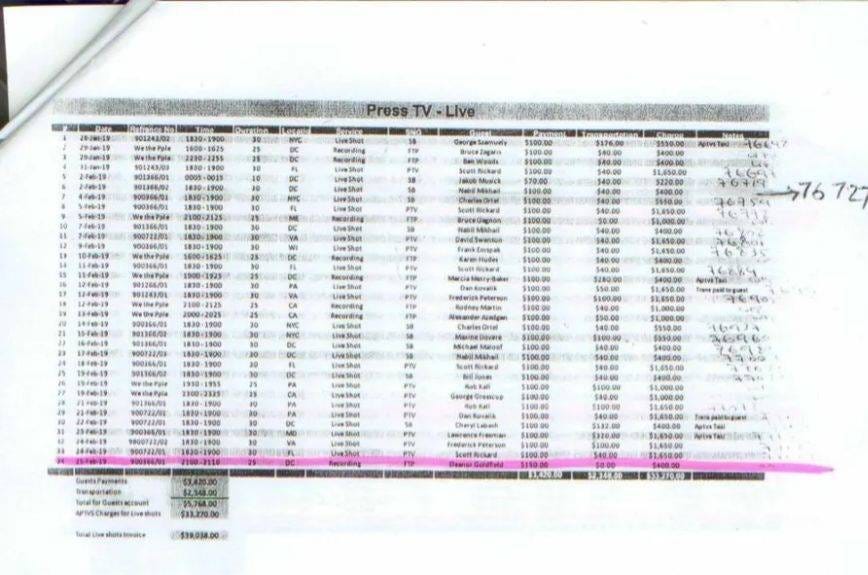
Take payment first. David Swanson is World Beyond War’s co-founder and executive director, a prolific author and broadcaster, a Nobel Peace Prize nominee, and the recipient of the US Peace Memorial Foundation’s prize in 2018. He is also a name on a PressTV ledger. The PressTV live-shots invoice for January and February 2019, among the documents released in the Black Reward hack, lists a guest payment of one hundred dollars to Swanson against a live shot dated 7 February 2019, on the same sheet whose guest payments total three thousand four hundred and twenty dollars and whose full live-shots billing comes to thirty-nine thousand. The sum is trivial and the triviality is not the point. The point is the existence of the relationship and the identity of the counterparty: in September 2023 the US Treasury designated PressTV, stating that it had been used by Iranian intelligence services to recruit assets, including US persons. The executive director of an organisation decorated twice for peace is, on the documentary record, a paid contributor to a broadcaster that a Western treasury has named as an intelligence recruitment platform. He is not alleged here to know what the broadcaster is for, or to have shaped a single word to its instruction. He is alleged to be on the books, because he is.
Now take attention, which is the subtler and in some ways the more damning mechanism. Edward Horgan is a member of the World Beyond War board of directors and a founding member of Shannonwatch, the Irish campaign group that has spent two decades opposing the United States military’s use of Shannon Airport, a cause he pursued all the way to the High Court in a constitutional challenge over Irish neutrality. He is, on the public record, a genuine and lifelong peace campaigner: a retired Irish Army commandant, a former United Nations peacekeeper in Cyprus and the Middle East, and an academic at the University of Limerick. None of that is in dispute, and none of it is discreditable. What is worth noticing is a single line in a 2003 Irish Times profile of him, published when he launched his Shannon challenge. After leaving the regular army in 1986, it records, he worked for about ten years as a safety and security manager, in various positions, including at Aughinish Alumina in County Limerick.
Aughinish is the refinery Part 6 examined: Russian-owned, through Rusal, and shown by the 2026 NAFO Alumina21 Campaign, the Irish Times and OCCRP investigation to ship alumina into the smelters that feed dozens of Russian arms manufacturers making the tanks, cruise missiles and bombers used in Ukraine. The dates do not line up into any allegation of wrongdoing, and none is made here: his employment ended in the mid-1990s, decades before the war and the export surge. The point is not agency. The point is salience. Here is a peace network exquisitely attuned to American military logistics passing through County Limerick, sustained over twenty years and a court case, and structurally silent on the Russian-owned heavy-industry plant in the same county that was quietly supplying Moscow’s war machine. The asymmetry of attention is the finding. The network notices American power with great sensitivity and Russian power with none, and the asymmetry runs, consistently and across the whole anti-war bench, in one direction.
That is the property that unites the two men and the organisation that carries them both. One is paid by a sanctioned Iranian broadcaster and the other spent his working life beside a Russian war-supplier he has never campaigned against, and between them they direct an organisation whose moral energy is aimed, with great sincerity and without exception, westward. None of it requires a handler or an order. It requires only that the network’s attention be structured so that American power is always the subject and the power that pays the invoices and owns the refinery is always the blind spot. That is the contaminated frame made concrete. It is not a slogan anyone recites. It is a pattern in what the network is built to see and what it is built to miss, and the two World Beyond War figures are the pattern in miniature: the payment and the blind spot, in the same boardroom, under two peace prizes.
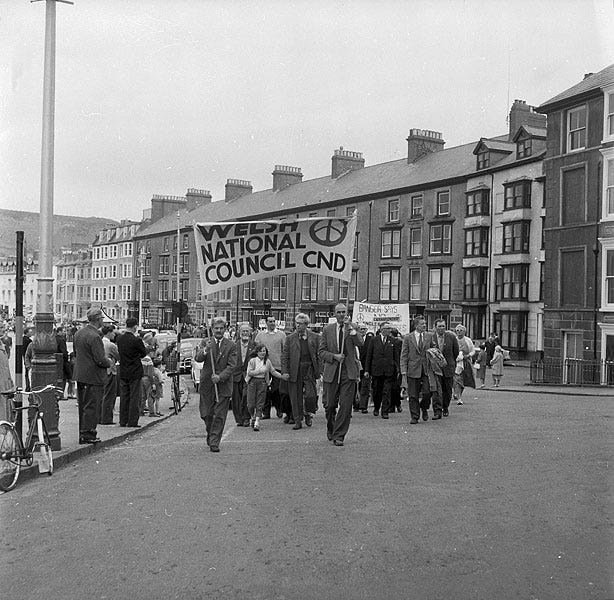
None of this is new. It is the most thoroughly documented influence technique of the entire Cold War, running now on different hardware. The Western peace movement of the 1980s, the campaign against the Pershing and cruise deployments, the nuclear-freeze marches, the women at Greenham Common, was overwhelmingly composed of sincere people who genuinely feared annihilation and were right to. It was also, at the organisational level, the target of what the historian Thomas Rid calls by far the largest, longest and most expensive disinformation campaign in intelligence history: a Soviet effort the KGB ran under the codename MARS and the Stasi called Friedenskampf, “peace-war.” The flagship vehicle was the World Peace Council, founded under Soviet auspices in 1949, funded chiefly by Moscow until the USSR collapsed, and identified as a Soviet front by a CIA report to Congress as early as 1978. The design principle was explicit and is the single most important sentence in this part. A United States State Department official estimated that the KGB had spent some six hundred million dollars on the peace offensive by 1983, channelled through the World Peace Council, in the official’s words, “to a host of new antiwar organizations that would, in many cases, reject the financial help if they knew the source.” The sincerity of the activists was not an obstacle to the operation. It was the operation. You do not capture a peace movement by recruiting its members. You capture it by funding and steering the structures through which sincere members act, and by ensuring that the movement’s moral attention is always pointed at your adversary and never at you.
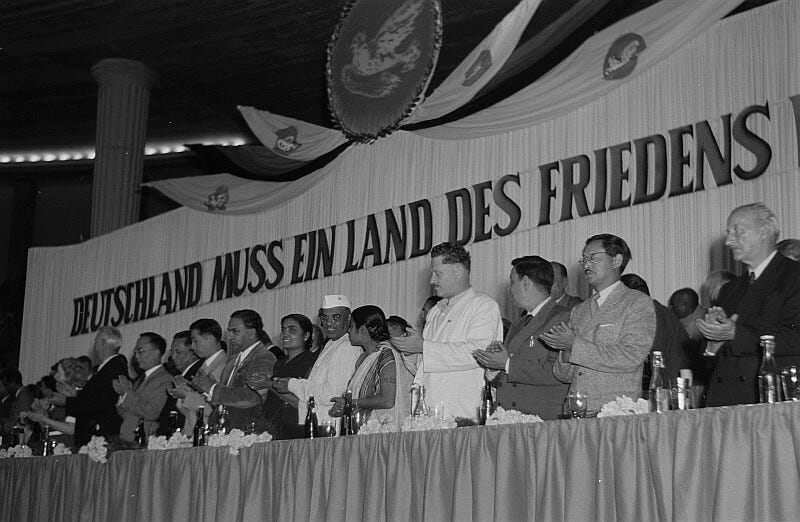
The structure did not dissolve when the Soviet Union did. It was inherited. Edward Horgan’s own World Beyond War biography lists him as a member of the World Peace Council, the same 1949 Soviet front, still operating, now headquartered in Athens. The vehicle that once carried Soviet messaging against NATO missiles now carries Russian and Iranian state-media product against Western support for Ukraine. But something has changed in the carrying, and it is the thing the 1980s frame can no longer account for. The Cold War operation worked at arm’s length: the money moved through cut-outs precisely so that sincere activists would not know the source, and most did not. That distance is gone. The figures in this part are not at arm’s length from anything. One is on a sanctioned broadcaster’s invoice. One sat on the board of a peace charity and, before it, at the plant now feeding Moscow’s war. The conference attendees flew to Tehran as guests of a body the United States Treasury sanctioned for running intelligence recruitment. These are not people kept ignorant of the source by a careful handler. They are people whose names are in the source’s own books.
What that proves, and what it does not, should be stated exactly. It does not prove that any of them takes instruction, holds a brief, or has betrayed a country. No document here shows a single one of them being told what to say. What the documents show is narrower and harder: that the moral prestige of the twentieth-century peace movement, the prestige of Greenham and the freeze and the march against the missiles, is now attached to people who are, by the plainest reading of the record, on the payroll, on the board, or on the guest list of the states whose wars they do not protest. Whether that is conviction, convenience, vanity, income, or something each of them has stopped examining, the documents do not say, and this series will not invent it. It will only put the two things side by side, the peace prizes and the invoices, the neutrality campaign and the refinery, the marches against one empire and the silence about the other, and decline to resolve them on the reader’s behalf. The fear that drove the ordinary marcher was real, and a teenager at Greenham who simply did not want to be incinerated was nobody’s asset. But the movement she marched in was not a pure thing later corrupted.
Its flagship body was a Soviet front from its founding in 1949, its funding ran from Moscow until Moscow ran out of money, and its moral attention pointed in one direction from the start. The capture was not a betrayal of the cause. In organisational terms it was the cause, or at least inseparable from it, and the people now on the invoices and the boards are not the heirs of something clean. They are the current operators of something that was built bent. Whether the late-twentieth-century peace movement was a genuine moral achievement or the most successful influence operation of the Cold War is a question the documents reopen rather than close. They are on the table.
VI. The Plan that did not survive contact with Ukraine
Everything described so far, the doctrine, the charter, the captured movement, was built on the premise that the physical event would arrive quickly and the apparatus would narrate it. The decade of preparation assumed a clean fact to describe. In the last week of February and the first week of March 2022, the apparatus got its test, and two images record what happened when the narrative met the ground.
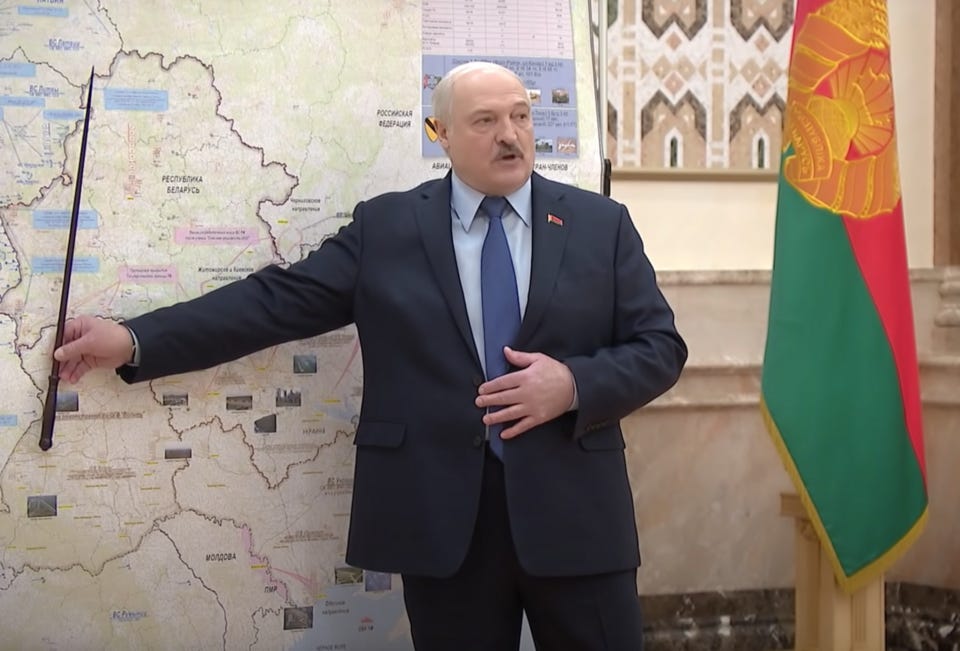
The first image is a map. On 1 March 2022, during a Security Council meeting in Minsk broadcast on Belarusian state television, Alexander Lukashenko stood at a podium and used a pointer to explain the war to his defence officials. Behind him was a large battle map of Ukraine, divided into four operational sectors, marked with the directions of attack. Most of the arrows matched events that had already happened. One did not. An arrow ran south from Odesa to link up with the Russian garrison in Transnistria, a planned thrust into Moldova that exposed a war aim far larger than the official framing admitted. The Belarusian journalist who first posted the image noted the detail that makes it unforgettable: everything on the map agreed with reality except the Odesa-Transnistria axis. Lukashenko had held up, on live television, a plan that included the one move the war never managed to make. It was the doctrine’s grand integrated advance, rendered as a visual aid, and it leaked the strategy in the act of projecting confidence.
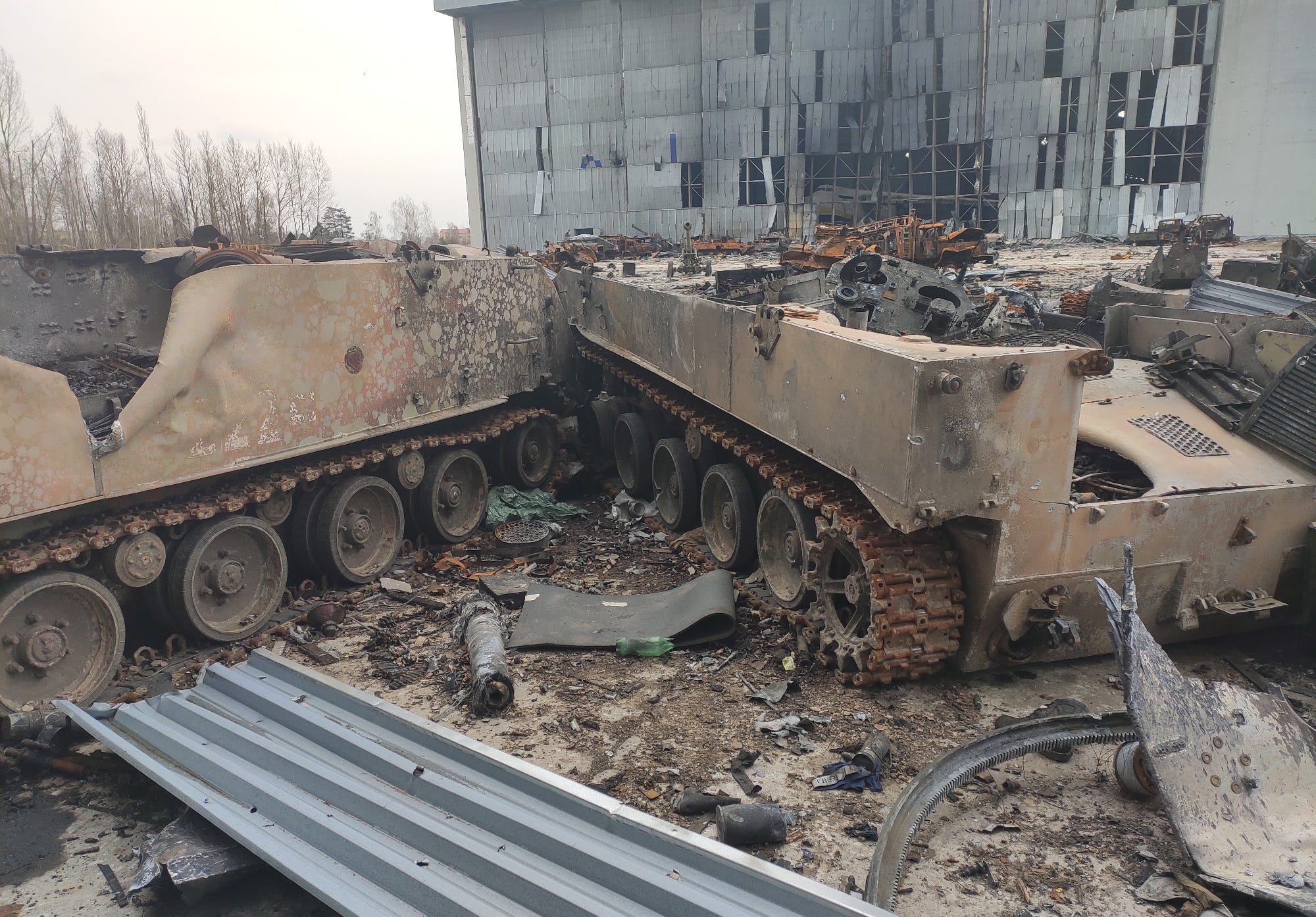
The second image is an airport. On 24 February, hours into the invasion, around two to three hundred elite VDV paratroopers, flown in on roughly thirty-four helicopters, assaulted Antonov Airport at Hostomel outside Kyiv. The plan was textbook vertical envelopment: seize the airfield, turn it into an air bridge, pour in reinforcements, and take the capital in days. As the Oryx investigation Destination Disaster documents in granular detail, it failed. Ukrainian forces destroyed the runway to deny the air bridge, kept the airfield under fire, and ambushed the armoured columns trying to break out toward Bucha and Irpin. The lightly armed paratroopers, deprived of their quick reinforcement, were left to be ground down; the VDV was tied down for weeks and finally withdrawn in early April. The airhead meant to open the road to Kyiv became, instead, a field of burned-out armour and wrecked airframes.
And here is the detail that makes Hostomel an information-operations story and not merely a military one. Russian state television produced video of the assault crafted to present it to the domestic audience as a triumph, while on the ground it was a catastrophe. The megaphone did not wait for the dust to settle. It narrated the defeat as a victory in real time, because narrating the accomplished fact was the entire plan and the apparatus did not know how to do anything else. The map projected the advance before it happened. The airport showed what the advance met. The state-TV triumph reel is the hinge between them: the moment the transmitter, confronted with a fact it could not use, simply broadcast the fact it had been built to expect.
This is where Transnistria, parked at the start, pays off. The enclave was meant to be the doctrine’s proof of concept, the place where the multipolar advance became permanent fact on the ground. The land bridge on Lukashenko’s map was the line that would have connected it to the rest of the project. A string of unexplained explosions inside Transnistria in the spring of 2022, widely read as attempts to manufacture a pretext for bringing the territory into the war, produced no casualties and went nowhere. The arrow stayed an arrow. The fact the apparatus had spent more than a decade preparing to describe never occurred, and a press office, however well funded, cannot broadcast a victory that did not happen.
The apparatus is still running. The doctrine still has its fifty-year vocabulary, its two architects in their state-funded club, its Tehran charter and five-state council, and a Western retail bench whose paymasters Part 8 will name from the leaked books. What it has never had is the one thing it kept promising: the redrawn map made real. Lukashenko held up the redrawn map on live television in March 2022, and years later it remains the only place that map exists.
Which is the question Part 8 has to answer. If the narrative cannot be made true by the army, it must be sold by the salesmen. Part 8 opens the leaked books and names that sales force from the bottom up: the bench of ostensibly independent commentators whose invoices and phone bills the hack laid bare, and above them a Western retail front far more powerful than any commentator, reaching into a cabinet. When an American administration tells the elected president of the invaded country that he does not hold the cards, that he should be more grateful, that he is the obstacle to a settlement everyone already knows the shape of, it is voicing the doctrine’s oldest assumption: that Ukraine is a transient nuisance delaying a deal that history has already written. The anger in that exchange is not really about gratitude. It is the frustration of a script that was supposed to be describing a finished fact by the spring of 2022, confronted by a man who will not read his assigned line. Hostomel is the reason he is still on the stage to refuse it. The retailers who would write him out are the subject of Part 8.