


There’s a particular kind of strategic failure that keeps repeating across history.
It looks irrational at first glance.
It produces enormous costs for very little gain.
And it’s usually explained away as madness, delusion, or ideology.
It isn’t any of those.
It’s what happens when leaders stop optimising outcomes and start optimising attention.
Once you see that shift, a lot of “nonsensical” decisions suddenly line up.
The Stuka Problem
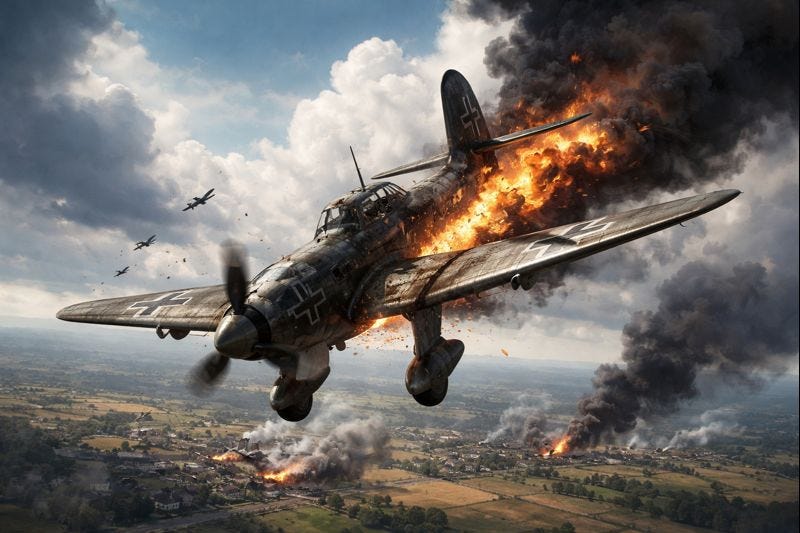
At the start of the Battle of Britain, Germany sent Ju-87 Stuka dive bombers against Britain with minimal fighter protection.
This is often taught as a simple technical mistake:
The Stuka was too slow
Too vulnerable
Unsuitable for contested airspace
All true but incomplete.
The purpose of the Stuka attacks wasn’t battlefield efficiency in the modern sense. It was system shock.
The Luftwaffe believed:
Precision attacks on airfields and radar
Would cripple RAF operations
Which would collapse morale
Which would force Britain to negotiate
The Stukas were meant to look decisive.
They screamed.
They dived.
They terrified civilians.
They created the impression of unstoppable power.
And then… the system absorbed the damage.
Radar stations were repaired in hours.
Airfields were patched overnight.
Fighter Command didn’t collapse: it adapted.
The Stuka wasn’t breaking Britain’s war machine.
It was performing power.
And performance, it turns out, is not the same thing as strategy.
The Same Mistake, Repeated
Fast-forward to Ukraine.
Russia has repeatedly targeted:
Power stations
Substations
Transmission infrastructure
Civilian energy supply
The logic is almost identical to 1940:
Disrupt daily life
Sap morale
Force political pressure
Induce capitulation
But once again, the system doesn’t behave the way the attacker expects.
Power grids are not glass ornaments.
They are repairable, modular, redundant systems.
Outages are patched.
Crews reroute.
Generators appear.
Life continues, grimly, but resolutely.
And critically: morale doesn’t collapse.
It often hardens.
Because once a population understands the war is existential, discomfort stops functioning as leverage.
This is the same error the Luftwaffe made:
Modelling society as a brittle machine
When it is actually a resilient ecosystem
The Wunderwaffe Fallacy
When system shock fails, authoritarian leaders tend to escalate symbolism.
In WWII it was the V-1 and V-2 rockets.
In Ukraine it’s hypersonic missiles, “unstoppable” weapons, theatrical strikes.
These weapons:
Are enormously expensive
Have limited military utility
Produce dramatic headlines
And very little strategic change
They don’t scale against large, dispersed, motivated populations.
But they do something else extremely well.
They generate attention.
Where Strategy Starts to Break
This is the inflection point.
In functioning systems, leaders optimise for:
Durable outcomes
Stability
Enforceable agreements
Long-term risk reduction
In personalist authoritarian systems, leaders increasingly optimise for:
Narrative dominance
Personal centrality
Visibility
Avoidance of perceived humiliation
At that point, being seen to act becomes more important than whether the action works.
The war stops being fought to win.
It starts being fought to sustain the leader’s relevance.
This is why failed strategies repeat.
Admitting failure is more dangerous than continuing to fail.
And Then We Get the Negotiations
This is where things start to look truly surreal.
Peace talks that go nowhere.
Ceasefires without enforcement.
Blame that seems wildly misallocated.
When Donald Trump complains that Ukraine is “holding up peace”, it sounds absurd if you assume everyone in the room is trying to end the war.
But they aren’t all optimising for the same thing.
Ukraine, Europe, and the UK are trying to:
Reduce violence
Preserve sovereignty
Create time-consistent security arrangements
Maintain institutional legitimacy
Putin, and Trump, are optimising individual attention.
For them:
Peace is not an outcome
It’s a performance
A solved war is a dead narrative
Institutions ending the conflict removes the protagonist
So negotiations become theatre:
Kept alive
Never resolved
Constantly reset
Rich in blame and drama
Everyone is “talking”.
No one is converging.
They are not even in the same building, let alone the same room.
Why This Keeps Fooling Us
We keep assuming:
Surely everyone wants peace.
But that only holds if peace is part of the optimisation function.
For leaders whose power rests on personal visibility, grievance, and spectacle, peace is an attention cliff.
Ending the war ends the story.
Ending the story ends the centrality.
Ending centrality is existentially risky.
So the war continues — even when it’s strategically useless.
The Pattern, Clearly Stated
Stukas failed because Britain had repair capacity and system resilience
Power grid attacks fail because Ukraine has the same
Wunderwaffe fail because spectacle doesn’t scale
Negotiations fail because some actors want resolution and others want relevance
This is not madness.
It’s misaligned incentives.
Once leaders start optimising personal attention rather than collective outcomes, strategy degrades into performance.
And performance is very hard to negotiate with.
The Uncomfortable Conclusion
If this diagnosis is right, then:
More talks won’t fix the problem
Better wording won’t fix the problem
Personal summits make it worse
Attention-rewarding formats actively prolong conflict
The only things that change behaviour are:
Costs that bypass attention
Institutional enforcement
Outcomes that reduce personal centrality
Which is precisely why attention-optimising leaders resist them so fiercely.
History doesn’t repeat itself because leaders don’t learn.
It repeats because the incentives haven’t changed.
And until they do, we’ll keep watching Stukas dive
long after everyone knows they don’t work.
Further reading:

Wunderwaffe Redux: From the Sonnengewehr to Putin’s Hypersonics

In World War I, it wasn’t a futuristic invention that changed warfare but the brutal economics of mass firepower: machine guns, barbed wire, shells. Today, on the battlefields of Ukraine, it’s the cheap FPV drone—a flying hand grenade with a GoPro—that’s grinding down tanks and logistics.