



“Trump & Brexit are not two different things. They are the same thing. Same companies. Same data. Same Facebook. Same Russians…”
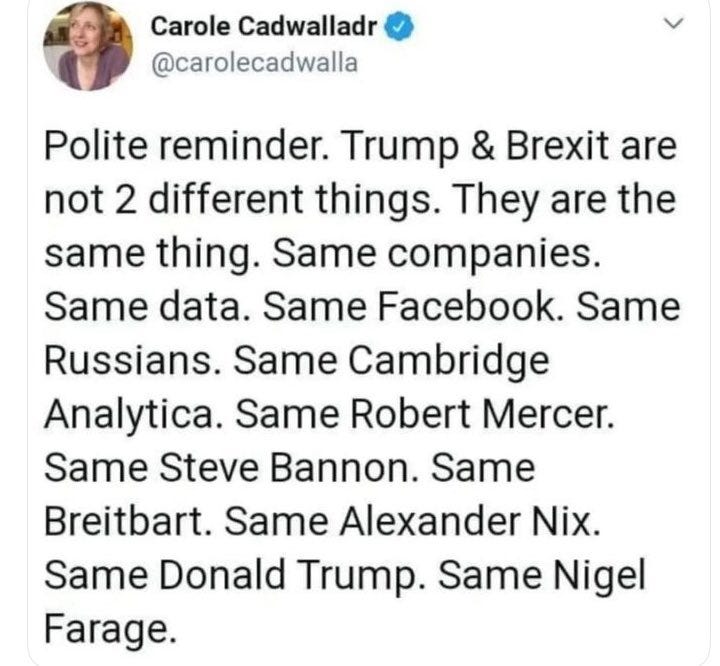
I’ve been circling this problem for some time.
In earlier writing, most explicitly in my RICU-RICO article, I argued that modern political conflict increasingly behaves like enterprise activity rather than persuasion or representation. That piece focused on enforcement: how coordinated misinformation, when combined with monetisation and foreign influence, should be treated as a networked economic phenomenon rather than a collection of individual bad actors.
This article steps back one layer.
It asks why a particular explanatory frame, one that is often factually correct, has stopped being analytically useful.
The tweet above is a useful starting point precisely because it is not wrong. Trump and Brexit did share platforms, techniques, intermediaries, and financiers. But the tweet also commits a category error: it treats those overlaps as the cause of what followed, rather than as the proof-of-concept phase of a deeper economic shift.
1. The implicit model behind the tweet
The tweet encodes a campaign-era model of politics. Implicitly, it assumes a structure that can be written as:
where
(O) is the political outcome (an election or referendum),
(A) is a set of actors,
(T) is a set of techniques, and
(D) is a distribution platform.
Within this model, causality is agentic and event-bounded. Outcomes occur because identifiable actors deploy specific tools through particular platforms. If those actors are exposed or removed, the outcome should weaken or reverse.
This model made sense when political operations were discrete, time-limited, and outcome-dependent.
It no longer describes the system we are observing.
2. The missing variable: monetisation
What changed after 2016 was not the existence of data targeting or identity-based messaging. Those techniques pre-dated Trump and Brexit.
What changed was the pricing of political attention.
Once political identity became directly monetisable, through subscriptions, donations, advertising, merchandise, events, and later crypto rails, political activity ceased to be merely instrumental to winning office. It became a revenue-generating process in its own right.
At that point, the objective function of many political actors changed.
Instead of maximising the probability of electoral victory, they began maximising expected cashflow.
The tweet does not model this shift. As a result, it continues to search for villains in a system that has already moved on to incentives.
3. A minimal return model for political activity
We can formalise this shift with a simple expected-return function:
where
(A) is attention volume (reach, engagement, watch-time),
(m) is monetisation per unit of attention,
(p) is the probability of winning or holding office,
(V) is the value of office,
(C) is operating cost, and
(L) is expected loss or penalty (legal, platform, reputational).
In a campaign-centric system, (pV) dominates. Political actors invest because winning office is the payoff.
In a retail political system, (mA) dominates. Attention itself becomes the payoff.
The significance of Trump and Brexit is that they empirically demonstrated:
for a large and growing class of political actors.
Once this inequality holds, electoral victory becomes optional. Loss, grievance, and ongoing conflict remain profitable states.
4. Attention production and the incentive to polarise
Attention is not exogenous. It is produced by strategy.
A simple functional form is:
where
(A_0) is baseline reach,
(P) is polarisation intensity,
(I) is identity clarity (ease of in-group signalling, e.g. MAGA, “Corbyn”, Reform),
(F) is frequency and responsiveness, and
(Q) is credibility or complexity drag.
Empirically,
Substituting into the return function:
Taking the partial derivative with respect to polarisation:
As long as penalties are weak, delayed, or uncertain; meaning
is small, escalation is the profit-maximising strategy.
NB By attacking the credibility and mocking the Vatnik, NAFO increases the credibility and complexity drag (Q) - thus reduces the return that the Vatnik receives. This explains the vitriol shown towards NAFO by all sides. NAFO unexpectedly hit their wallets in an unexpected way.
This is not ideological extremism.
It is yield optimisation.
5. Identity as capital and the emergence of sunk costs
Once audiences pay, financially, socially, or reputationally, political alignment acquires capital characteristics.
Let (N_t) be the committed supporter base:
where
is the conversion rate from attention to supporters, and
is churn.
Churn is not constant. It increases with deviation from the expected political stance:
where
(S) is stance deviation and
measures audience intolerance.
This captures the central phenomenon: changing position increases loss.
Narratives persist not because they are continuously reassessed as true, but because abandoning them requires writing off accumulated capital.
The tweet’s framing assumes belief revision is cheap.
In a monetised identity system, it is not.
6. Why actor-based explanations fail post-2016
If Trump and Brexit were sustained by a specific constellation of actors, their removal should have mattered.
Instead:
firms collapsed and techniques diffused,
platforms adjusted policies and behaviour persisted,
individuals exited and were replaced immediately.
This is precisely what economic theory predicts when expected returns remain positive.
Markets do not require conspirators.
They require incentives.
7. Foreign influence in an incentive-dominated system
Foreign states still participate in this environment, but their role has shifted.
They no longer need to direct movements or control organisations. They need only inject narratives into a system where:
Domestic actors then rationally perform the amplification, monetisation, and persistence.
The market completes the operation.
8. Updating the story
The Cadwalladr tweet treats Trump and Brexit as the same phenomenon because they share actors.
They are the same phenomenon for a different reason.
They validated a political business model with positive expected return independent of electoral success.
Once validated, that model became self-sustaining. It no longer required Cambridge Analytica, Mercer, Bannon, or any specific cast of characters.
The system did not need to conspire.
It needed to pay.
Conclusion: from actors to accounting
The persistence of polarisation is not a mystery of psychology or propaganda. It is an accounting identity.
So long as:
polarised political enterprises will exist, scale, and reproduce, regardless of who originally discovered the technique.
Trump and Brexit were not the culmination of a conspiracy.
They were the beginning of a market.
And until political analysis shifts from who did this to what behaviour the system rewards, it will continue to describe yesterday accurately while misunderstanding today completely.

Postscript: why enforcement has to change
If polarisation now persists because it is profitable, then exposure alone cannot resolve it. Naming actors, tracing origins, or correcting claims does not alter the underlying return structure. It simply supplies new content to an already-functioning market.
This is the context in which I previously argued for a RICU-RICO–style approach: not to police belief, but to intervene at the level of enterprise behaviour. When political activity functions as a coordinated revenue system, combining monetised amplification, concealment, and, in some cases, foreign alignment, the relevant unit of analysis is no longer the individual speaker but the economic network.
In accounting terms, the problem is not persuasion but yield. Any response that does not raise operating costs (C), increase expected penalties (L), or reduce monetisation (m) leaves the equilibrium unchanged. Regulation that targets speech will fail. Enforcement that targets organised, monetised political enterprises at the level of cashflow and coordination is the only intervention that addresses the system as it actually operates.
That is the shift this analysis points toward: from arguing with narratives to changing what the market makes viable.
An extremely relevant point on the benefit on crypto to Trump allies with the recent American invasion of Venezuela.
"To be very clear about this: Tether, which is the crypto company that Venezuela was using to evade sanctions, is run by Howard Lutnick, who is Trump’s Commerce Secretary.
Lutnick has been making money off Venezuela’s avoidance of U.S. sanctions. Tether has also been used to North Korea for its nuclear program, by terrorist organizations and terror states to buy weapons and fund their operations, and by criminal organizations - drug cartels and human trafficking organizations - to do business.
The entire point of “Decentralized” crypto is that people can create their own money, while they dismantle “the administrative state”
This is a not just a libertarian fantasy, it is a criminal swindle: it is people who want money to exist outside the law.
That means enforcement is also outside the law: you can’t go to court, so threats, theft, and violence are the alternative, which is fine for the criminals who want to use it.
One of the most effective ways to cut the legs out from under organized crime and bad actors would to criminalize currency.
Instead, credulous politicians are integrating it into government money-systems. The results are already a disaster."
https://substack.com/@dougaldlamont/note/c-194777556
https://substack.com/@cryptadamus/note/c-194720304
This has potential to be a model for the platform-real-world flow of influence and events. Interesting. Will follow closely. I’m focusing on the incentive cascades within the platform economy (under its current monetisation model), but we also need descriptions, in mathematical/logical terms, for the transfer mechanisms.