


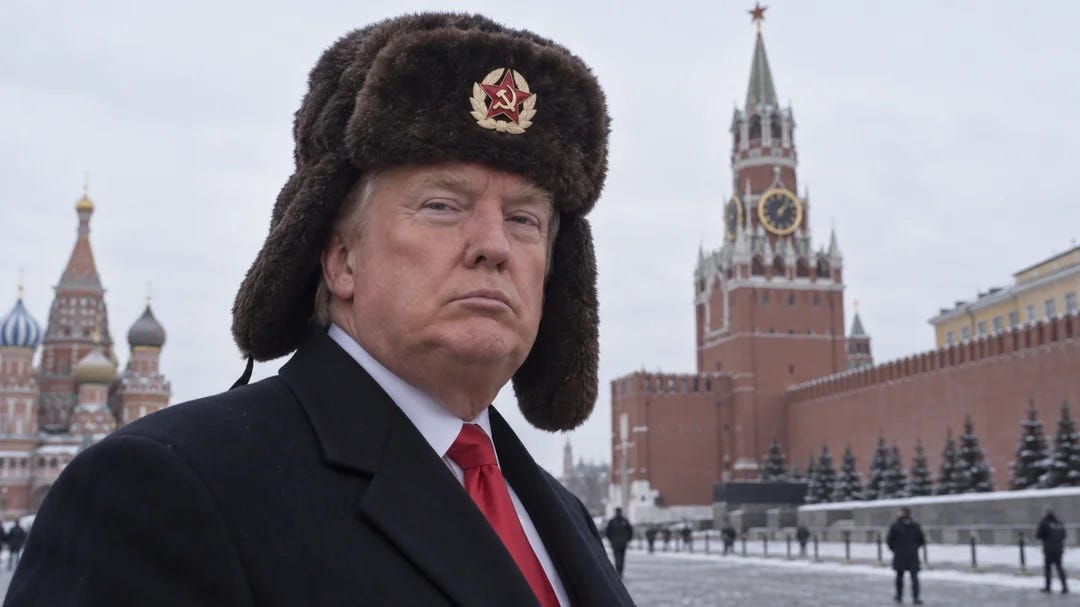
On Saturday 10 October, Donald Trump told reporters outside the White House that it was “time for Ukraine to get a new president”. Within a day, the number of English-language posts on X calling Ukrainians “Ukronazis” had more than doubled.
I was already counting. For this series I had been tracking who uses the Kremlin’s favourite slur against Ukraine, and how often. A normal day runs to about 70 posts. On 10 October it was 151. On 11 October it was 174.
The Russian-language version of the same slur did not move at all. The push did not come from Moscow. It came from Washington, and from the Americans who took their cue from it.
A word made in Moscow
“Ukronazi” is a straight translation of the Russian укронацист. The idea behind it has been a staple of Russian state messaging since 2014: Ukraine is run by Nazis, so Russia is fighting fascism again. In February 2022 Vladimir Putin made “denazification” an official war aim.
The word is useful to Moscow because it does two jobs at once. It borrows the moral weight of the Second World War, and it turns a country with a Jewish president into the villain of that war.
To see who repeats it in English, I searched X for the coinage itself (”Ukronazi” and its variants), the “Nazi regime in Kyiv” framing, and “Nazi Zelensky”. I ran the same searches in Russian. Each post was graded automatically:
Strong: the Kremlin coinage, or unmistakable framing such as “Nazi regime in Kyiv”. These are the numbers in this piece.
Ambiguous: “Banderites”, “Nazi Ukraine”, “denazification”.
Not counted: posts that report, quote or rebut the smear, and pro-Ukrainian mockery of it (”Year 5 of Putin’s 3-day operation to remove the Nazi regime in Kyiv”).
A normal week: about 70 a day
From Monday 5 to Friday 9 October, the strong form of the smear ran at between 59 and 80 English posts a day. That is the baseline: a steady international crowd of a few hundred accounts, posting drone footage, mocking Zelensky and replying to Western politicians.
The loudest of them are not British. Of 580 English-language accounts that used the strong form over the past month, X places 156 in the United States and 61 in the UK, about one in ten. The rest are spread across Canada, Europe, Australia and further afield.
The Russian-language version ran at a much lower 9 to 19 a day.
The trigger
The jump lands on the day Trump said Ukraine should replace Zelensky, not on the day before.
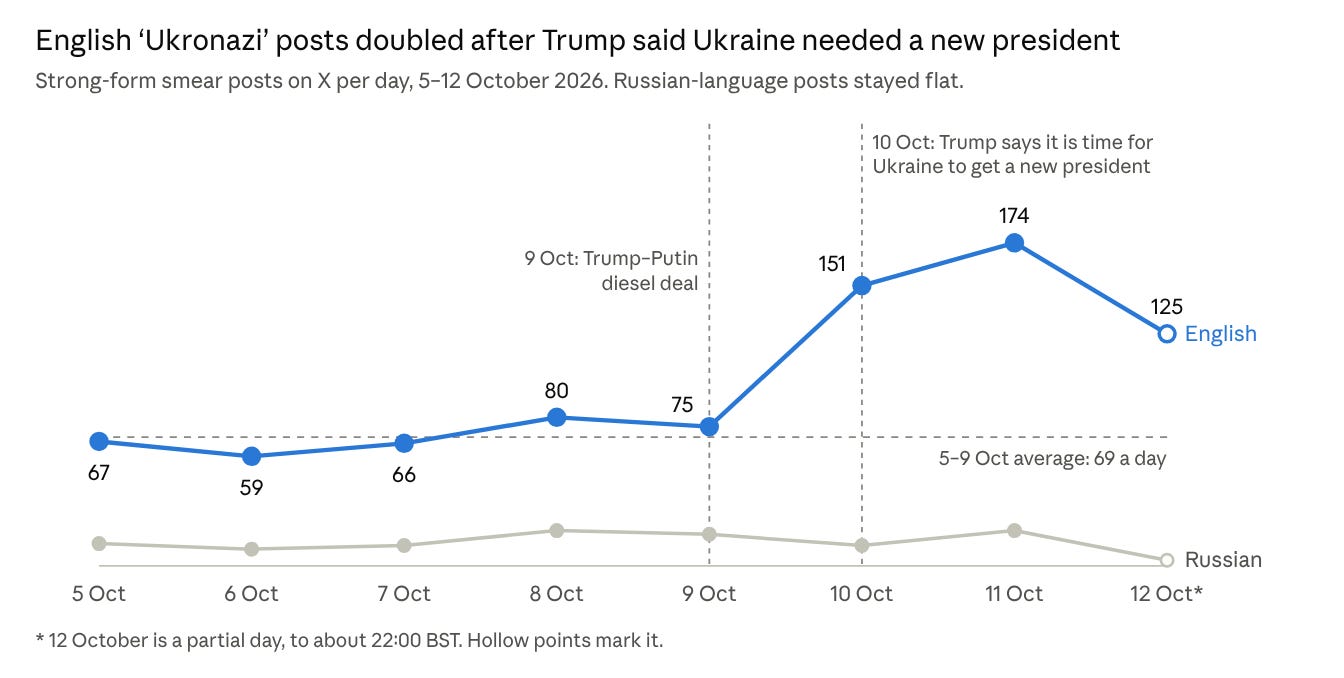
Friday 9 October: Trump announced a deal with Putin to ease sanctions by opening world markets to Russian diesel, to bring down fuel prices. Kyiv had been expecting talks on an energy ceasefire that week. The smear barely registered: 75 posts, a normal day.
Saturday 10 October: leaving the White House, Trump blamed Ukraine’s strikes on Russian refineries for the diesel shortage. “He better damn well stop,” he said of Zelensky, adding: “I think it’s time for Ukraine to get a new president.” The Kyiv Independent noted that the evidence points to the US war with Iran and the closure of the Strait of Hormuz instead. The smear doubled to 151 posts.
Sunday 11 October: Zelensky replied on X that Ukraine would stop hitting refineries if Russia stopped hitting Ukraine’s power grid. Elon Musk backed Trump in a post, which revived fears in Kyiv about losing Starlink. The smear peaked at 174 posts.
Trump had been pressing Zelensky over the refinery strikes for weeks, according to Al Jazeera. What changed on 10 October was the demand for a new president.
Who joined in
The surge was not the regulars shouting louder. It was new people turning up.
First-timers: 159 accounts used the strong form on 10–11 October but not earlier that week. Only 26 of them had used any of this vocabulary anywhere in my data, going back to mid-September.
Ordinary accounts: the newcomers have a median of 491 followers. Only 18 have fewer than 50. These are not freshly minted bot accounts.
American-led: X places 52 of them in the US, 12 in Canada and 11 in the UK. Among all authors, the American share rose from about a fifth to nearly a third, while the British share fell from 14% to 10%.
Short-lived: only 14 of the 159 were still using it by Monday evening, 12 October.
What they said tracked the news almost line by line. Posts complained about the diesel price and blamed Ukrainian strikes on refineries. They cheered Trump for “giving Zelensky the shaft”. One account told a pro-Ukrainian user that without “StarLink and American Intelligence”, the “UkroNazis” had only one option left. Another, replying to Laura Loomer, said Putin had always promised the war would end “if the buffoon in Kyiv were replaced”.
The replies went to American targets. Laura Loomer drew seven strong replies in two days, against none earlier in the week, and Elon Musk drew four.
Moscow stayed flat
If this were a Kremlin push, the Russian-language channels should have moved first or at the same time. They did not. Russian posts using укронацист ran at 11 on 10 October and 19 on 11 October, inside the same range as the week before.
Across the seven full days, English and Russian daily volumes barely move together. Their correlation is 0.35, too weak to mean anything over a week.
Russian state accounts were not driving the English traffic either. Of more than 1,200 strong English posts collected over the month, two replied to a Russian state account and two quoted RT.
None of this means the word is innocent. It is Moscow’s word, and 1,015 English posts used the translation directly. But this week the people who reached for it were reacting to an American president, not to a Russian broadcast.
The British fringe
Britain supplies a small, steady share of the people using this word, and an even smaller share of the surge.
The 61 accounts X places in the UK come from both ends. There is an anti-imperialist left: hammer-and-sickle bios, a self-described tankie, “Red Steve”. There is a religious and traditionalist right: “GOD HAS RIGHTS”, “God is King”, “Not far-right! Just right”. The largest is @blackrussiantv, with 144,000 followers and more than 220,000 views this month on its 35 posts using the word, most of them combat footage. One account with Russian, British and Serbian flags in its name told Andy Burnham to “stop sending billions to ukronazis”.
British party supporters barely touch it. I checked the accounts against the followers of all seven parties surveyed earlier in this series. The share who used the strong smear was between 0.00% and 0.03% for every party, with no party standing out. Restore Britain, which stood out on conspiracy-theory bios, does not stand out here.
There is some overlap with the “Russia is not my enemy” campaign that started this series: 39 of the 580 English-language authors also posted that slogan in September. That is about one in fifteen. The two crowds are neighbours, not the same crowd.
The loudest amplifier was in Washington
This series has spent weeks looking for Russian fingerprints on British social media, and finding some. This week’s data points somewhere less comfortable.
The Kremlin built the “Ukronazi” smear and has pushed it for a decade. But the biggest lift it got in the week I can measure properly came from the President of the United States telling Ukraine to change its leader. Some 159 ordinary, mostly American accounts that had not used the word before reached for it within a day. Russia did not need to do anything.
That is how a narrative works once it is planted. It does not need constant pushing from the people who made it. It sits in the vocabulary, waiting for someone with a bigger microphone to give it a reason.
The data cannot prove that Trump’s words caused the surge. It shows the timing, the topics and the people, and all three point the same way.
How this was measured
Data: posts collected from X through the Sorsa API, searching each phrase one day at a time from 12 September to 12 October 2026, in English and Russian.
The week that counts: X search only fully covers about the last seven days. Earlier days are undercounted, so every comparison here uses 5–12 October only. Days before 5 October are not shown.
Even effort: every day got the same number of search pages, and I checked that no day ran out of pages. The figure for 12 October stops at about 22:00 BST.
Grading: automatic, by the rules above. Posts that report or mock the smear are excluded. Automatic grading still makes mistakes, so quoted posts were read by hand.
Placement: country is X’s own “account based in” label, looked up for every English-language author who used the strong form.
Party comparison: the followers and self-declared supporters of seven British parties collected for the earlier parts of this series. Following an account shows attention, not membership.
What it does not show: that anyone directed anyone. It shows who repeated the word, and when.
Sources
Oval Office spat to public rebukes: a timeline of Trump–Zelenskyy ties, Al Jazeera, 11 October 2026
‘He better damn well stop’ — Trump slams Zelensky for attacking Russian refineries, says Ukraine should get ‘new president’, Kyiv Independent, 10 October 2026
Fears that Ukraine will lose Starlink are back after Musk backed Trump against Zelenskyy, Euromaidan Press, 11 October 2026
X data: the author’s own collection through the Sorsa API, 12 September to 12 October 2026