


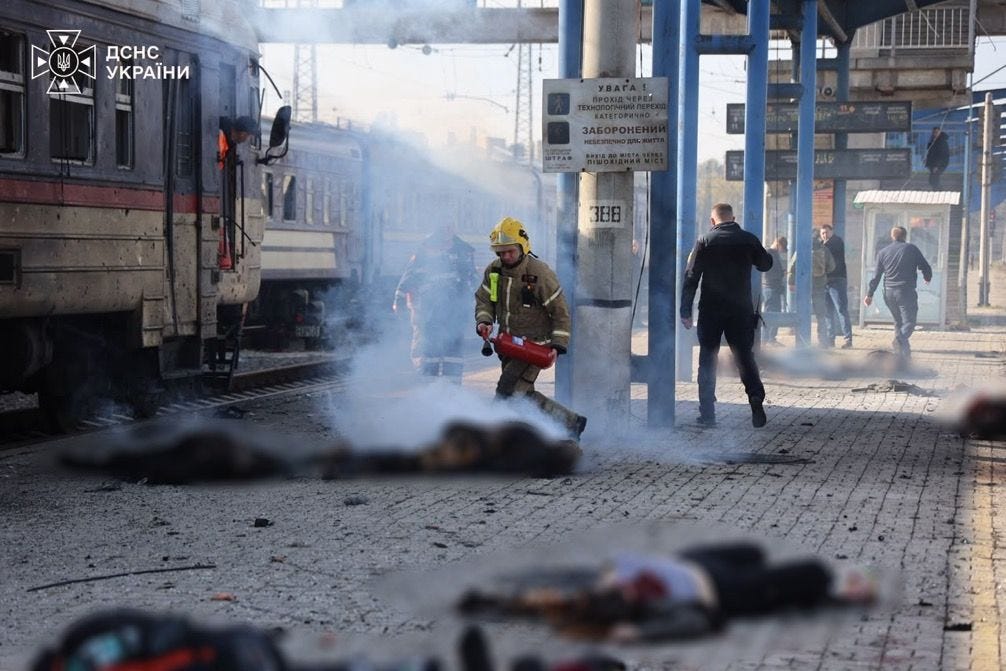

A train at a platform
On Thursday morning a Russian jet-powered drone hit train 866 as it stood at the platform of Dnipro railway station, waiting to leave for Zaporizhzhia. The air-raid alert was already sounding. Ukrzaliznytsia said people had stayed on the platform anyway, because people do. By late morning the regional governor had confirmed 13 dead and at least five injured, and the numbers were still moving. It is the worst strike on Ukrainian rail since Kramatorsk station in April 2022, when an Iskander with “for the children” painted on it killed 63 people waiting for evacuation trains.
Three weeks earlier a Kh-101 cruise missile took the middle out of a five-storey block of flats in Pryluky and killed 22 people, five of them children. The night before that, Russia had put 30 cruise missiles into Kremenchuk, Oleksandriia and Svitlovodsk alone. The week before, two merchant ships were sunk in Bulgaria’s exclusive economic zone, ten sailors lost, and the attacks moved from 70 nautical miles off the coast to 15 in seven days. None of this is new. All of it is accelerating.
I have spent the last fortnight trying to understand why Europe watches this and does not act, and I have ended up use Anthropic Fable 5.1 to construct the document nobody in a European defence ministry has been willing to write: a set of rules of engagement for a European air mission over western Ukraine. It exists because the standing objection from NATO’s Secretary General to the idea is “show me the rules of engagement”, and nobody has. This piece is the argument for it. It is also an attempt to be fair to Mark Rutte, because his objections are serious, and because the honest answer to them is not that the risk is zero but that we already know what Russia does when its aircraft are shot down, and it is not what he fears.
What Russia is doing
Start with the weapon, because it decides what can be done about it. The drone that hit Dnipro was jet-powered. The Institute for the Study of War’s assessment of 7 October is that Russia’s jet-powered Geran variants fly faster and lower than the propeller Shaheds, get through Ukrainian air defence more reliably at depth, and let Russia concentrate its cruise and ballistic missiles on fewer targets without firing more of them. Ukraine has said openly that it is struggling to catch them. That is the night of 6 to 7 October in one sentence: 130 drones and 48 cruise missiles, 161 of them intercepted, and still 18 impact sites and a Kh-101 through a block of flats in Pryluky.
Then the targets. Since the summer of 2025 Russia has run a deliberate campaign against the railway, the one piece of infrastructure Ukraine cannot do without: twice as many strikes in September 2025 as in August, concentrated on the junctions at Lozova, Synelnykove and Koziatyn, then the passenger trains themselves. A double-tap on a train at Shostka in October 2025. A passenger train at Lutsk on 12 September this year. The next day, the locomotive of the Kyiv to Warsaw service at Yahodyn, two kilometres from the Polish border, close enough that Poland sounded air-raid alerts in Chełm. Then Dnipro. Add the intercepted Russian target list, 60 energy sites including three nuclear plants and the water system, and the Black Sea, where the attacks on merchant ships in Bulgaria’s waters moved from 70 nautical miles offshore to 15 in a single week without ever touching a Bulgarian hull or a Bulgarian sailor.
That last detail is the whole method. Every strike is calibrated to sit just under the threshold that would oblige NATO to respond, and every time NATO responds with a statement, the threshold is confirmed and the next strike moves a little closer. Drones into Poland: Article 4 consultations and a mission with a name. Ships sunk in a NATO exclusive economic zone: an ambassador summoned. An Oreshnik near the EU border: “unacceptable escalation” from three capitals, and nothing else. Moscow is not testing whether the West will fight. It knows the answer. It is measuring, to the nautical mile, how much it can do without finding out.
The effect on Ukraine is arithmetic. Patriot interceptors delivered: 675 in 2023, 364 in 2025, 264 projected for 2026, because the one line that builds the PAC-3 round is in Camden, Arkansas, and the United States has been spending them on Iran. Europe’s own anti-ballistic interceptor, the Aster, is on a ramp that doubles this year from a base that took 40 months to build a missile. The EU has borrowed €90 billion and released €6.1 billion for air defence in August, and none of it can be turned into an interceptor this winter. Money is not the constraint. Time is, and Russia has built its target list for exactly the months in which Europe has the money and not the missiles.
The proposal
SkyShield is not new. It was drawn up by former RAF planners with the Ukrainian armed forces, published by the Center for European Policy Analysis, and backed by Philip Breedlove and Richard Shirreff, who between them have run NATO’s military side, along with Aleksander Kwaśniewski and Gabrielius Landsbergis. It has been sitting on European desks since March 2025. Chatham House said in July that Europe could stand it up in a few weeks.
In plain terms: around 120 European fighters, Typhoons, Rafales and Gripens, flying from Poland and Romania, patrolling western and central Ukraine at least 200 kilometres behind the front and outside the reach of Russian air defences. Their job is to shoot down cruise missiles and drones, which they can do with a cannon or a short-range heat-seeking missile; a Ukrainian Mirage did exactly that to a Russian cruise missile on 3 October. They do not fly east. They do not strike Russia or Belarus. They do not engage Russian aircraft except in self-defence, and a Russian pilot who locks them up gets a defensive manoeuvre and a report, not a missile. They cannot touch ballistic missiles, and nobody should pretend otherwise. The mission is outside NATO, run by whoever signs, with a declaration in advance that losing a jet over Lviv is not an attack on NATO territory and does not trigger Article 5.
What it buys is not that the Zone becomes safe. It is that every Ukrainian interceptor and every Ukrainian fighter that no longer has to sit over Lviv, Rivne and Khmelnytskyi can go to Dnipro, Kharkiv and Zaporizhzhia, which are where the drone that hit train 866 came from and where the next one will go. It also covers the three nuclear plants on the Russian target list, the rail corridor from Poland that Russia hit at Yahodyn, and Ukraine’s own missile and drone production in the west. The directive I have written sets out the rules in full: who commands, what a pilot does when an S-400 in Belarus locks him, what happens if a jet is lost, what the pre-agreed consequences are, and the ten problems the plan does not solve. It is published alongside this piece so that the argument can be had on the detail rather than on the slogan.
Rutte’s objections, fairly stated
Mark Rutte has not said these things in these words, but they are the case his office makes and I would rather state it at full strength than knock down a cartoon of it.
First, escalation. The alternative to managing escalation is not a protected Ukraine; it is a coin-flip with a nuclear power. Four and a half years in, Ukraine is still a sovereign state with a growing army and a ballistic missile of its own, and not one NATO soldier has died. Every red line was crossed one at a time, with months between and deliberate signalling, and the gradualism may be the reason the escalation never came. You cannot run the experiment the other way.
Second, the rules. SkyShield is a think-tank paper. Show me who commands it, what a Polish pilot does when a Russian radar locks him over Lviv, and what the Secretary General tells 32 allies the morning after a jet is lost. Backers say the risk to pilots is low. The treaty says Article 5, and a declaration that a Coalition jet is not NATO territory is a political promise no parliament can bind a successor to. Low is not zero, and nobody is permitted to gamble Tallinn to protect Pryluky.
Third, the military case. Fighters are an expensive way to catch cheap drones; Ukraine’s ground-based air defence intercepts more per euro than foreign jets would; the mission cannot touch the ballistic missiles that are doing the most damage; and it would burn the same European stocks of air-to-air missiles that every European air force needs for its own air policing. Ukraine may prefer the money.
Fourth, capability and dependence. The interceptor line is in Arkansas, the Iran war is Washington’s decision, and Europe has funded a fivefold Aster ramp and built PURL so that Europeans can buy American kit for Ukraine when the Americans stopped giving it away. Only six or seven allies carry the load, and the Secretary General says so in public. That is persistence under an American umbrella that has wobbled twice, not inaction.
Each of these gets a different answer. The second, the rules, is the easiest, because it is a request for a document and the document now exists (I wrote it with Fable). The third, the military case, is partly right and the proposal should concede what is right in it: jets are not the best drone-catchers, and the point of flying them is to free the things that are. The fourth is true and beside the point, because the money Europe has committed arrives as interceptors in 2027 and the target list is for this winter. The first is the one that holds everything else up. It assumes that Russia, having lost an aircraft to a European fighter, would answer with a wider war. That assumption has been tested, many times, and the next section is the record of what happened each time.
What Russia does when its aircraft are shot down
The fear underneath every objection is a single picture: a European fighter goes down over Lviv and the world is a day from nuclear war. The fear is understandable. It is also testable, because Russian and Soviet aircraft have been shot down by other states repeatedly, in circumstances that look a good deal more provocative than a defensive patrol 200 kilometres from the front, and we know what Moscow did each time.
Korea, 1950 to 1953. Soviet pilots flew MiG-15s against American aircraft over North Korea for most of the war, in Chinese or North Korean markings, with the Soviet Union insisting it had no pilots there. American figures credit several hundred MiG kills; Soviet records admit losing well over 300 aircraft and more than a hundred pilots, and the Americans lost heavily too. Both superpowers knew exactly who was in the cockpits. Both pretended not to, because the alternative to pretending was a war neither wanted. Nobody escalated. The lesson is the one the rest of this list repeats: a nuclear power that loses an aircraft has every incentive to say it didn’t.
Egypt, 30 July 1970. During the War of Attrition the Soviet Union sent an air-defence division and a fighter regiment to fly for Egypt, denied it, and let its pilots hunt Israeli aircraft. Israel’s answer was an ambush, Rimon 20: five Soviet-flown MiG-21s destroyed in under three minutes, four Soviet pilots killed, no Israeli losses. Moscow’s retaliation was to send another regiment, lay a missile trap that cost Israel an F-4 a few days later, and keep quiet; the Soviet Union never publicly acknowledged the losses. Eight days afterwards, with American pressure on all sides, a ceasefire ended the war. Israel had killed Soviet airmen in the air and the response was a truce.
Turkey, 24 November 2015. A Turkish F-16 shot down a Russian Su-24 on the Syrian border; the pilot was killed by rebels on the ground, a Russian marine died in the rescue. This is the nearest precedent, because it was a NATO member deliberately destroying a Russian military aircraft with Russian troops in a war zone. Putin called it a stab in the back. The response was a visa regime, a ban on charter flights and Turkish tomatoes, ten businessmen detained, a pipeline and a nuclear plant put on hold, and S-400s deployed to Latakia. No Turkish aircraft was touched. No Turkish soldier died. Seven months later Erdoğan wrote a letter of regret and the sanctions came off; within two years Turkey was buying the S-400 itself. The entire retaliation of a nuclear power for the loss of a strike aircraft to a NATO fighter was economic, and it was over by the summer.
Syria, 17 September 2018. A Syrian S-200 shot down a Russian Il-20 reconnaissance aircraft with 15 crew while Israeli F-16s were attacking nearby. Russia’s defence ministry blamed Israel for “hiding behind” the aircraft; Shoigu announced S-300s for Syria within two weeks; the Israeli ambassador was summoned. Putin himself called it “tragic chance events” and played the Israeli role down. There was no retaliation against Israel and Israeli strikes in Syria went on, with a deconfliction line that both sides kept using.
Ukraine, 2022 to now. The largest body of evidence, and the least cited. Ukraine has destroyed well over a hundred Russian combat aircraft, including the things Russia can least afford to lose: an A-50 radar aircraft over the Sea of Azov on 14 January 2024 with its whole crew, a second one weeks later, an Il-22 command aircraft shot up the same night, and a run of Su-34s and Su-35s in early 2024 that Ukraine put at ten in ten days, several to Patriot batteries pushed forward into ambush positions. The Kremlin’s spokesman said he had no information. Russia flew its remaining A-50s further from the front. Much of this was done with American and European missiles, fired by crews trained on NATO bases, at targets found with NATO intelligence. The thing Rutte fears has happened dozens of times with Western weapons in the loop, and Russia’s answer has been to lose the aircraft and move the rest.
And the one that matters most: the aircraft Russia hasn’t lost. Since February 2022 Russian combat aircraft have not crossed the front line into western Ukraine, not once, because the S-300s and Patriots there would kill them. NATO aircraft fly within range of Russian air defences every day over the Baltic and the Black Sea, and Russia has never fired. The Russian air force already behaves as if a European air-defence zone over western Ukraine exists. SkyShield would make it true for drones as well as jets.
What the record says about the fear
Read together, the cases say three things.
Russia retaliates for lost aircraft economically and diplomatically, and then stops. Tomatoes, visas, an ambassador summoned, an S-300 sale. The pattern holds for the Soviet Union and for Putin’s Russia, for a NATO member and for Israel, in 1970 and in 2018. There is no case in seventy-five years of a Russian or Soviet aircraft shot down by another state leading to a military attack on that state.
Russia’s first instinct when it loses aircraft is denial, not vengeance. Korea was denied for decades. Rimon 20 was never acknowledged. The A-50 was “no information” from the Kremlin and friendly fire on the Telegram channels. A nuclear power that has built its domestic story on invincibility cannot afford to admit that a Turkish F-16 or a Ukrainian Patriot beat it, and the thing it cannot admit it cannot avenge.
And Russia’s own aircraft already respect the line that SkyShield would draw. The Russian air force has not flown into western Ukraine since the first weeks of the war, because it cannot survive there. Its missiles and drones go where its pilots will not. A European patrol in that airspace is not a new front; it is a reinforcement of a line Moscow has already conceded.
None of this makes the risk zero. Russia could choose to shoot at a European jet, as it could choose to shoot at the NATO jets it sees over the Baltic every morning, and the directive is written on the assumption that one day it might. What the record does is move the question from “could Russia start a war over this?” to “has Russia ever done so, with far more provocation, under far more pressure?” It hasn’t. The fear is not irrational. It is unfalsifiable, and that is a different thing: an estimate that cannot be lowered by any amount of evidence is not an estimate any more, it is a policy, and Moscow knows which policy it is and feeds it on purpose. Every Oreshnik is aimed at that estimate as much as at Dnipro.
Answering Rutte
Show me the rules of engagement. They are published alongside this piece. The short version: unmanned threats are declared hostile and engaged on identification, no warning, no higher authority. Manned Russian aircraft are never engaged except in self-defence, and a radar lock alone is not grounds; a lock gets a manoeuvre, an egress and a report, precisely because Russian pilots will lock European jets to test the rules and the rules must give them nothing. A missile fired at a Coalition jet from Russia or Belarus is defended against and never answered on the ground: there is no suppression-of-air-defence element in the force, so there is no capability to misuse on the night. If a jet is lost, the consequences are already agreed and already published, so there is no emergency summit at which resolve can die.
What do I tell 32 allies the morning after? That the mission is not NATO’s, that the loss was declared in advance not to be an Article 5 matter, and that the bases in Poland and Romania, which are NATO territory, were not touched. Then you point at the published consequence ladder, which is deliberately non-kinetic towards Russia at every rung and ends in a fixed tranche of immobilised Russian reserves transferred to Ukraine for each aircraft lost. Moscow gets a price list for shooting at the mission, and European governments get a response they can announce within the hour.
Low isn’t zero, and I can’t gamble Tallinn. Nobody is asking you to. The Zone is drawn outside the assessed engagement envelope of Russian air defences, and if the council won’t accept the Belarus batteries’ reach over Kyiv, it doesn’t activate Phase 2. Phase 1 alone covers Lviv, two nuclear plants and the rail corridor Russia hit at Yahodyn, from bases on NATO soil, against an air force that has not crossed the line in four years. The record above is the answer to “low isn’t zero”: it is lower than the risk NATO already runs every day over the Baltic.
Jets are an expensive way to catch cheap drones, and Ukraine’s own air defence does it better per euro. True, and the directive says so. The point of SkyShield is not that a Typhoon is a better Shahed-catcher than a Gepard. It is that the Typhoon can be over Lviv so the Gepard can be at Dnipro station. The measure of success is Ukrainian batteries and fighters redeployed east, not Coalition kills. And the cheap-weapon answer is in the loadout: cannon, infrared missiles and guided rockets for drones, with Meteors held back.
It can’t touch ballistic missiles. Correct, and the honest version of the proposal never claims it can. It frees the Patriots that can.
Europe is already doing a lot. It is, and the money is real. But the interceptors arrive in 2027 and the target list is for this winter. SkyShield is the only thing on the menu that can be flying before the snow, and that is the whole reason to argue about it now.
What the readers said
On 13 October I asked on X why Europe and NATO do not help Ukraine more, and then pulled every reply through the Sorsa API: 411 of them, 394 genuine once X’s injected adverts were stripped out, plus 300 more in the threads underneath. I coded every one by hand. Roughly a third accepted the question and tried to answer it; a third were Kremlin-line; the rest pushed back without a Russian frame, or were abuse.
The sympathetic third is the part that matters for this piece, because it is the pro-Ukraine audience talking about NATO among themselves. Of 125 replies, 46 explained Europe’s inaction as cowardice or fear, and 27 used the word coward, spineless or something ruder. The most-liked reply in the whole thread, by a distance, was this: “They just want it contained. As long as the war is in Ukraine it won’t touch their lands.” The Ukrainians in the thread said the same from the other side: “as long as it’s just us dying, it’s all good.” NATO itself was named in only 12 of the 125, and where it was named it was with contempt: “No Action, Talking Only”; “they’ll stand with Ukraine until it’s time to actually stand against something, then they’ll draft a letter.” Not one sympathetic reply argued that Europe was doing enough.
That is the finding I did not expect. Among Ukraine’s own supporters, NATO has stopped being an alliance and become an audience. They do not think it can’t act. They think it won’t, and they have reached for the word the alliance least wants to hear. The thing Russia’s demoralisation campaign exists to produce, the belief that Europe will not help, is now held in nearly identical words by the Kremlin-line accounts and by the people who fly the Ukrainian flag in their bios. Nobody planted it in the second group. Europe’s behaviour did, and the propaganda only has to point.
The hostile third, incidentally, was not new. Thirty-eight of those accounts were already in my databases from the “Russia is not my enemy” campaign in September, the Ukrainians-are-Nazis sweep, and the Aughinish defence; ten of them had posted the slogan and every one of the ten was hostile. They are an audience, not a unit, and they say what they are told. The sympathetic side says what it sees.
The morning after
Here is what the directive cannot do, stated plainly because Moscow will state it for us. The Zone does not reach Dnipro. It does not reach Kharkiv, Zaporizhzhia, Sumy, Kremenchuk or Pryluky, which is where Russia is killing the most people. A European patrol over Lviv on Thursday morning would not have stopped the drone at Dnipro station, and the first time a jet drone hits a platform in the east while Typhoons are flying in the west, the mission’s opponents at home and in Moscow will say the same sentence on the same day. The answer, that the Zone protects the west so that Ukraine’s own interceptors can protect the east, is true, and it has to be said out loud before the next Dnipro, because it cannot be said afterwards.
That is the real question for the council, and it is not a military one. It is whether Europe’s leaders are prepared to own a decision in advance, with its risks and its limits written down and published, rather than discover each one on the night and convene a summit about it. Everything Russia has done this autumn, from the 15-mile ships off Bulgaria to the train at Dnipro, has been designed to make sure that question is never put. Every red line has been crossed without the sky falling; every aircraft Russia has lost, to Turkey, to Israel, to Ukraine, has been swallowed and denied. The fear that keeps Europe on the ground is not a prediction. It is a habit, and it is the one thing Moscow cannot afford us to break.
The rules are written. The aircraft exist. The bases are on NATO soil. The only thing missing is a government willing to say that it would rather be blamed for flying than for watching, and I would like to know which one it is going to be, before the next train.
Sources
SkyShield: An Integrated Air Protection Zone for Ukraine, CEPA: https://cepa.org/?p=38703
Ukraine needs help against Russian missiles now. What more can allies do?, Chatham House, July 2026: https://www.chathamhouse.org/2026/07/ukraine-needs-help-against-russian-missiles-now-what-more-can-allies-do
European-led Ukraine Sky Shield plan could halt Russian missile attacks, Ukrinform reporting The Guardian: https://www.ukrinform.net/amp/rubric-defense/3967626-europeanled-ukraine-sky-shield-plan-could-halt-russian-missile-attacks-media.html
Russia strikes train at Dnipro station with jet-powered drone, at least 13 dead, Kyiv Independent, 29 October 2026: https://kyivindependent.com/breaking-russia-strikes-train-at-dnipro-station-with-jet-powered-drone-at-least-13-dead/
Russian drone strike on Dnipro train platform kills 13, Kyiv Post, 29 October 2026: https://www.kyivpost.com/post/88526
Russia strikes passenger train near Polish border as drone swarms reach deeper into western Ukraine, Euromaidan Press, 13 September 2026: https://euromaidanpress.com/2026/09/13/russia-strikes-passenger-train-near-polish-border-as-drone-swarms-reach-deeper-into-western-ukraine/
Logistical terrorism: Russia steps up attacks on Ukrainian railways, Kyiv Independent: https://kyivindependent.com/logistical-terrorism-russia-steps-up-attacks-on-ukrainian-railways
Russian Offensive Campaign Assessment, 7 October 2026, ISW: https://www.criticalthreats.org/analysis/russian-offensive-campaign-assessment-october-7-2026
Ukraine honours the victims of the Russian attack, 8 October, Censor.NET: https://censor.net/en/news/4027275/ukraine-honors-the-victims-of-the-russian-attack-october-8-is-a-day-of-mourning
New drone attacks on ships in Bulgaria’s Black Sea EEZ, one sunk, Sofia Globe, 13 October 2026: https://sofiaglobe.com/2026/10/13/new-drone-attacks-on-ships-in-bulgarias-black-sea-eez-one-sunk/
Ukraine allies meet in Kyiv as interceptors run low, Kuwait Times/AFP: https://kuwaittimes.com/article/48608/world/ukraine-allies-meet-in-kyiv-as-interceptors-run-low/
The constraint is the production line, Großwald: https://www.grosswald.org/grosswald-curated-no-41-the-constraint-is-the-production-line/
Russia and Turkey: Two Friends Become Enemies, Jamestown Foundation, December 2015: https://jamestown.org/?p=10968
Putin signs sweeping economic sanctions against Turkey, AP, November 2015: https://www.columbian.com/news/2015/nov/28/putin-signs-sweeping-economic-sanctions-against-turkey/
Operation Rimon 20: https://en.wikipedia.org/wiki/Operation_Rimon_20
Syria missile strikes (September 2018) and the Il-20 shootdown: https://en.wikipedia.org/wiki/Syria_missile_strikes_(September_2018)
2024 Russian A-50 and Il-22 shootdowns: https://en.wikipedia.org/wiki/2024_Russia_Beriev_A-50_and_Ilyushin_Il-22_shootdowns
Ukrainian Armed Forces claim to have shot down ten Russian aircraft in ten days, Mind.ua: https://mind.ua/en/news/amp/20270252-ukrainian-armed-forces-claim-to-have-shot-down-ten-russian-aircraft-in-ten-days
Rutte: only six or seven allies doing the heavy lifting, Kyodo/Nordot, May 2026: https://nordot.app/1430711897167741172