


This morning Phillips P. O’Brien, one of the sharpest strategic analysts working today, published a piece called “The Two Wars.” His thesis: we are not seeing one war between the US/Israel and Iran. We are seeing two very different wars. Both sides can be winning and losing simultaneously.
He is right.
He is also wrong.
And the reason he is wrong tells you something important about why nobody can agree on what is happening in the world right now.
There is one war. America and Israel are fighting Iran. That is the event. One set of missiles, one set of targets, one set of consequences.
But the war sits inside two completely different stories at the same time.
For Netanyahu, the war is institutional with a conspiracy underneath. Iran is the hidden hand. The infiltrator. The puppet master pulling strings behind every proxy. The war makes sense as self-defence against a concealed existential threat. If you are inside that story, the war is coherent. You know what it is and why it is happening.
For Trump, the war is biblical. Iran is eschatological. The geography is holy. The conflict has a divine script. If you are inside that story, the war is also coherent. Completely different, but equally coherent.
Same bombs. Same ships. Same fire. Two completely different wars.
Not because the strategy differs. Because the story the war lives inside differs. The war has two identities simultaneously. It has not collapsed into one, and it will not, because both stories have millions of people invested in them.
Now here is where it gets interesting.
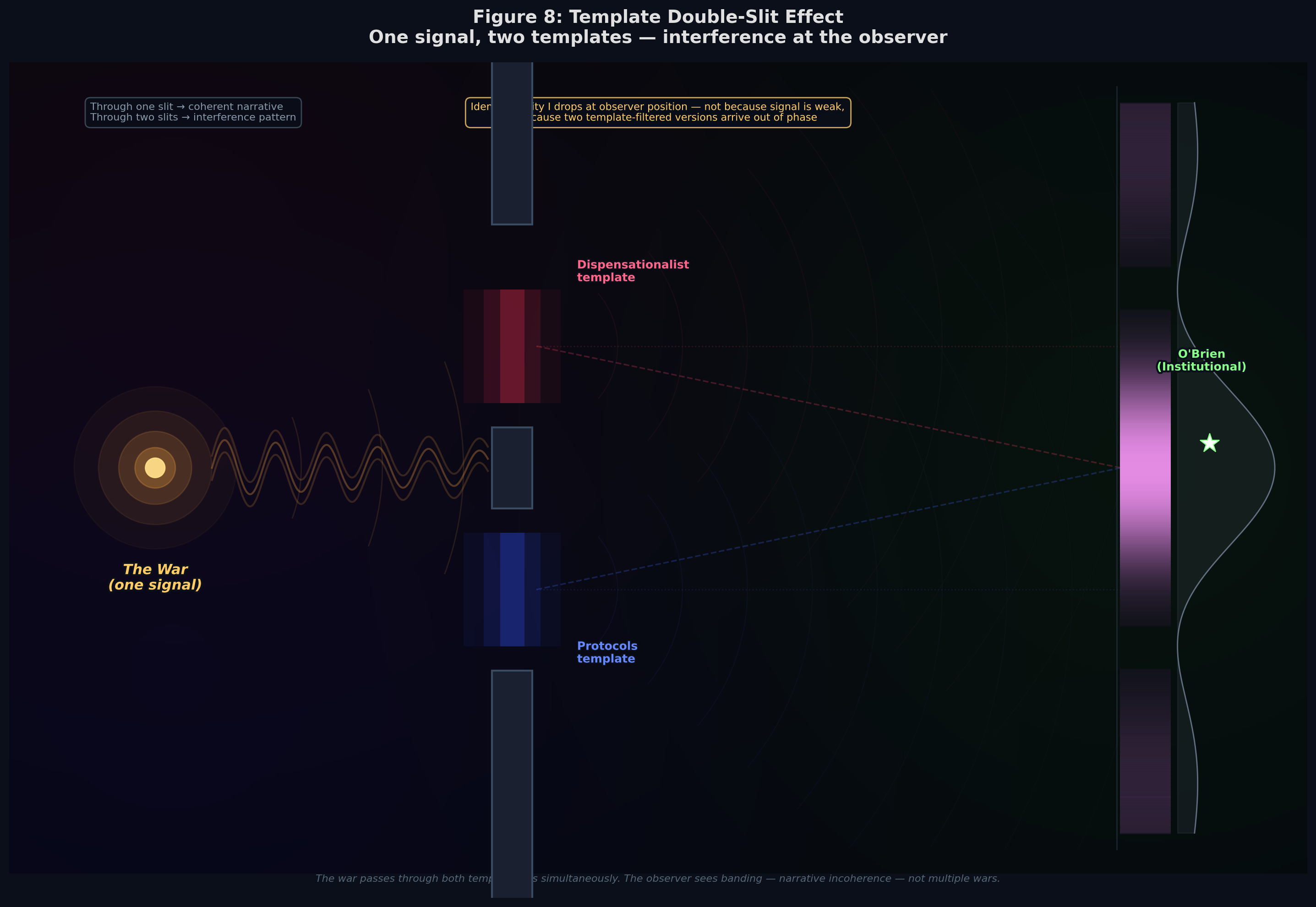
You probably remember the double-slit experiment from school physics. You fire a beam of light at a barrier with two narrow slits in it. On the other side, instead of two bright lines, you get an interference pattern. Bands of light and dark. The wave passes through both slits at the same time, and the two versions interfere with each other at the detector.
The war is the beam of light.
The two stories are the two slits.
O’Brien is standing at the detector screen.
He is inside neither story. He is an academic strategic analyst. His tools are procedural, institutional, evidence-based. He is looking at the war through the lens of strategic studies. And because that lens does not amplify either story over the other, he receives both versions at full strength.
Both versions arrive at his position. They interfere with each other. And what he sees on his detector screen is banding. Bright patches of coherent narrative alternating with dark patches of incoherence. He cannot make the picture resolve into one thing.
So he does the only honest thing available to him. He reports what he sees: two wars.
Here is the paradox.
If O’Brien were watching through a less rigorous lens, the picture would be clearer.
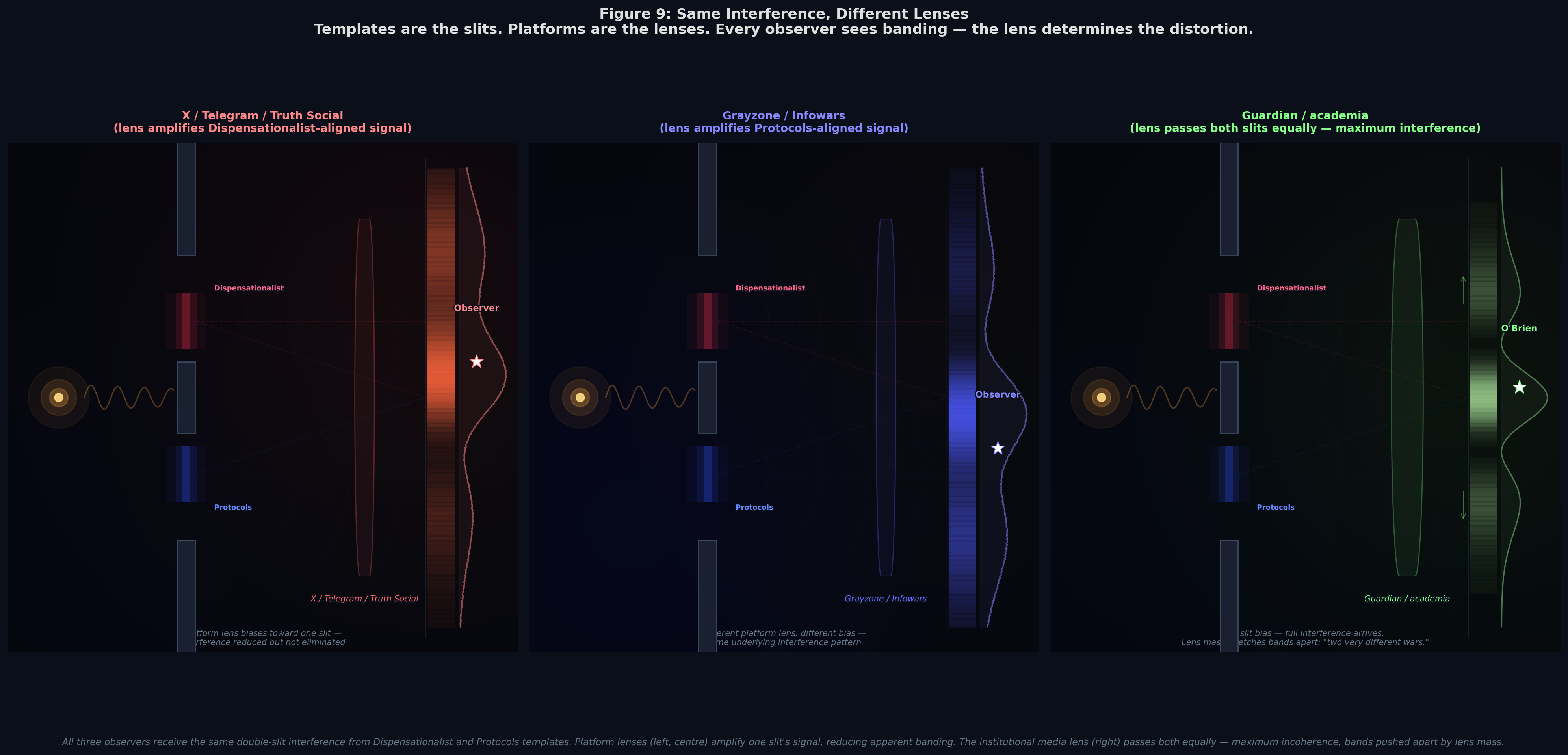
Someone watching through Truth Social or Telegram gets a lens that amplifies the biblical story and suppresses the other one. The interference is reduced. Not eliminated, but reduced. The picture is mostly coherent. One war. God’s plan.
Someone watching through the Grayzone or Infowars gets a lens that amplifies the hidden-hand story — but the hidden hand is Israel, not Iran. The template is the same. The target rotates. Mostly coherent. One war. Zionist puppet masters dragging America into someone else’s fight.
Both of those observers see a simpler, cleaner picture than O’Brien does. Not because they are smarter. Because their lens changes the interference. A “biased” lens suppresses one of the two slits. One slit, less interference, more coherence.
O’Brien’s lens is the Guardian. Radio 4. Academia. Strategic studies. It is the most even-handed lens available. It does not suppress either slit. And that is exactly why it produces the most confusing picture.
The more rigorous the analysis, the more incoherent the output.
That is the O’Brien Paradox.
This is not a criticism of Phillips O’Brien. The opposite. He is doing the best work possible within the constraints of his instrument. He is honestly reporting what his detector shows. And what it shows is real. The interference pattern exists. The narrative incoherence is not a failure of analysis. It is a structural feature of a war that sits inside two incompatible stories at the same time.
The problem is not O’Brien. The problem is that nobody has told him he is looking at a double-slit experiment. He thinks he is seeing two wars because there are two wars. He is actually seeing one war producing an interference pattern because it passes through two story-structures simultaneously.
The distinction matters. If there are two wars, you need two peace processes. If there is one war with an interference pattern, you need something else entirely. You need to understand the slits.
Every analyst, every journalist, every citizen is standing at a detector screen. Every one of them is seeing an interference pattern, because the war passes through both stories at once. Nobody is exempt (even me - and I wrote the framework)
The difference is the lens.
A “biased” lens gives you a coherent picture at the cost of accuracy. An “honest” lens gives you an accurate picture at the cost of coherence.
You can have clarity or you can have truth. In a world where the same event sits inside two incompatible stories, you cannot have both.
O’Brien chose truth. The paradox is his reward.
This is a companion piece to “The First Attention War” and “The Pekka Principle.” The formal framework behind this analysis is in peer review. If you are new here, the Angry Dogs are powered by righteous anger, ADHD and coffee. All subscription revenue goes to Ukrainian causes.
“Bright patches of coherent narrative alternating with dark patches of incoherence. He cannot make the picture resolve into one thing.”
Legit!
🔥👍🔥Brilliant!! imhNAFOo 🤩 Thank you!