


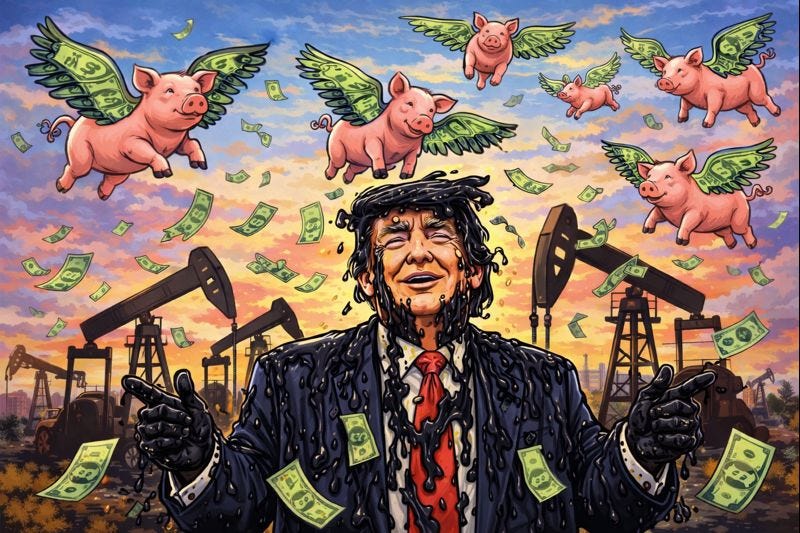
Oil is not priced by morality, or strength, or vibes.
It is priced by credible future barrels.
When governments turn oil into a stage prop, they don’t just “get it wrong”. They add a risk premium that shows up as higher prices, higher volatility, and lower investment.
The public pays.
The attention-economy operators collect.
This is the Nonsense Tax.
I. The Price Fantasy
The headline claim (from Trump): “$50 oil”
What it is: a price anchor, not a plan.
A consumer-pleasing number with meme efficiency
Implies the President can simply set the price of a globally traded commodity
Compresses a complex system into a single moral promise: I will make it cheap
Nonsense Tax mechanism:
The more a leader talks like a price controller, the more investors treat future supply as uncertain. Uncertainty is priced as risk. Risk raises prices.
“Use Venezuela’s reserves”
What it is: reserves-as-prop.
Reserves are geology.
Price is flow.
Flow requires:
infrastructure
skilled labour
diluent
upgraders
contracts
insurance
shipping
sanctions clarity
multi-year capex
Nonsense Tax mechanism:
When a state treats reserves like a valve, capital concludes: this government doesn’t understand the machine it’s threatening to operate. Capital hesitates. Output doesn’t rise. Prices don’t fall.
II. Capital Walks Away
The killer quote (capital says the quiet part out loud)
“No one wants to go in there when a random f*cking tweet can change the entire foreign policy of the country.”
— U.S. oil executive (via FT)
This is not opinion. It is a pricing signal.
It says:
policy is erratic
contracts are not credible
timelines cannot be trusted
political risk dominates project economics
Nonsense Tax mechanism:
If policy is stochastic, investment is optional.
If investment is optional, supply growth disappears.
If supply growth disappears, prices rise and volatility spikes.
That’s the invoice.
III. The Domestic Boomerang
$50 oil kills U.S. shale
$50 is not “cheap”.
It is supply destruction.
At ~$50:
marginal shale goes negative
rig counts fall
decline rates bite fast
banks tighten credit
production drops
prices rebound harder later
Nonsense Tax mechanism:
Trying to force low prices today guarantees higher prices tomorrow. Consumers get a brief sugar high, then a crash.
You can’t out-theatre OPEC+
If the U.S. somehow adds Venezuelan barrels:
OPEC+ cuts to defend price
exporters defend fiscal break evens
traders front-run the reversal
geopolitics adds premium
Nonsense Tax mechanism:
Your “victory” becomes everyone else’s stabilisation problem. The market prices retaliation and uncertainty, not your press release.
IV. Who Gets Paid?
Political Identity Rent
This is the part most analysis misses.
In the Rent Theory of Political Identity, the key variable is rent extracted from identity, not performance.
The identity product
“I’m the leader who makes energy cheap”
“I’m the movement that punishes enemies”
“I’m the realist who controls chaos”
“I’m the patriot who takes the oil back”
The monetisation channels
outrage subscriptions & donations
influencer content flywheels
fundraising off “sabotage”
scapegoat narratives (“cartels”, “traitors”, “deep state”, “foreigners”)
policy churn as attention fuel
volatility as content
Crucial point:
Failure is not disqualifying. Failure is convertible into loyalty.
That is why these claims persist even when they are mechanically impossible.
V. How the Public Pays (The Actual Tax)
The Nonsense Tax is not one number. It is a bundle.
Cost components
Risk premium
Higher expected volatility → higher prices todayUnderinvestment premium
Erratic policy → delayed capex → tighter future supplyTransition premium
Crush domestic producers → lose buffersInstitutional decay premium
Markets stop believing official statementsOpportunity cost
Diplomacy, regulation, and infrastructure replaced by theatre
Because oil is a foundational input, this propagates into:
food
logistics
heating
manufacturing
inflation expectations
interest rates
You don’t just pay at the pump. You pay everywhere.
VI. The Numbers (No Vibes Allowed)
Known inputs
1 barrel = 42 gallons
$1/bbl ≈ 2.4¢/gallon (rule of thumb)
U.S. gasoline use: 376M gallons/day
U.S. petroleum use: 7.39B barrels/year
U.S. households: 134.79M
Historical geopolitical risk premiums: ~$10/bbl (Goldman example)
Assumption
Policy chaos adds a sustained $5–$20/bbl credibility premium.
Pump-price channel (gasoline only)
Using the rule of thumb $1/bbl ≈ 2.4¢/gallon, and current U.S. gasoline consumption:
$5 per barrel risk premium
≈ +12¢ per gallon
≈ $16.5 billion per year in extra gasoline costs
≈ $122 per household per year (averaged)
$10 per barrel risk premium
≈ +24¢ per gallon
≈ $32.9 billion per year
≈ $244 per household per year
$20 per barrel risk premium
≈ +48¢ per gallon
≈ $65.9 billion per year
≈ $489 per household per year
Whole-economy petroleum channel
(everything that runs on oil)
Using total U.S. petroleum consumption (~7.39 billion barrels per year):
$5 per barrel risk premium
≈ $36.95 billion per year
≈ $274 per household per year
$10 per barrel risk premium
≈ $73.9 billion per year
≈ $548 per household per year
$20 per barrel risk premium
≈ $147.8 billion per year
≈ $1,097 per household per year
This is not just gasoline.
It’s trucking, food logistics, plastics, heating oil, jet fuel — everything.
VII. The Skim: Political Identity Rent
Let r be the take-rate captured by the attention ecosystem.
Identity Rent = r × Nonsense Tax
Using the $10/bbl case (~$73.9B/year):
0.1% → $73.9M/year
0.5% → $369.5M/year
1.0% → $739.0M/year
You only need a tiny take-rate to build a massive political-media business.
Failure doesn’t kill the product.
Failure is the product.
VIII. Is This “Rational”?
Rational for consumers / macro stability ❌
No. Chaos raises prices.
Rational for retail-politics rent extraction ✅
Yes.
Because the payoff isn’t the price level —
it’s what the price level lets you do.
Trump is optimising for control, narrative, and rent.
Oil prices are collateral.
IX. How to Falsify This New Model
If the true objective were lower prices, you’d expect:
boring, predictable policy
stable sanctions regimes
credible multi-year contracts
reduced rhetoric shocks
If the true objective is identity rent, you’d expect:
headline-grabbing moves
constant blame targets
policy reversals
fundraising spikes around each shock
Watch behaviour, not claims.
The Punchline
This is what economic insanity looks like in a commodity system:
Turn oil into theatre
Break policy credibility
Scare away capital
Trigger volatility
Blame enemies
Monetise the blame
Repeat
Oil is a medium.
Identity rent is the business model.