




Lyndon LaRouche died on the 12th of February 2019, in Leesburg, Virginia, aged 96. He had been a federal-fraud convict for thirty years, an eight-time presidential candidate, the author of a body of cosmological writing that ranged from the merely eccentric to the medically interesting, and the sort of figure that political obituarists reach for the word “fringe” to dispose of. The New York Times obituary ran to nine paragraphs. The Washington Post gave him eleven. Both treated the death as a footnote.
This was the most consequential editorial misjudgement of the decade.
The doctrine survived. More than survived: it has, in the six years since, become the operational vocabulary of the second Trump Treasury, the rhetorical framework of every BRICS finance ministers’ communiqué, and the explicit doctrinal cover for the largest sovereign reallocation away from dollar-denominated assets in the post-war period. It did not travel by accident. It travelled by employment record, and along one bridge in particular it travelled into the economic apparatus of the Russian state, where it found a host more powerful than its author ever was.
The vehicle
Helga Zepp-LaRouche, LaRouche’s German-born widow and the founder of the Schiller Institute in 1984, took the operational succession. The Schiller Institute had always been the more presentable of the LaRouche fronts, with its Friedrich Schiller drapery and its classical-aesthetics conferences and its chapters in fifty countries, and it absorbed the post-LaRouche workload with practised competence. The annual conference calendar in Berlin and Manhattan ran without interruption. The Executive Intelligence Review kept publishing. The LaRouchePAC livestreams kept going out. The vocabulary was preserved, the personnel chain was preserved, the doctrinaire’s death simply removed the inconvenient figure who had personally signed the cheques the federal prosecutors traced in 1989.
What the post-2019 Schiller Institute does, in operational practice, is host the doctrinal interface between Western policy elites and the diplomatic apparatus of Moscow, Beijing, and the wider BRICS+ bloc. It does this through three mechanisms.
The first is the conference. On the 12th and 13th of July 2025, the Schiller Institute convened “Man Is Not a Wolf to Man” in Berlin, with a standing-room-only audience of around 250 in person and thousands online. Panel One was titled “Cooperation between the BRICS and Europe to Implement the Oasis Plan and Agenda 2063 for Africa.” The keynote was delivered by Helga Zepp-LaRouche. The featured speaker, by video link, was Dr Naledi Pandor, the former South African Minister of International Relations and Cooperation (2019–2024) and current chairperson of the Nelson Mandela Foundation. Pandor used the platform to call for BRICS and European cooperation against “unipolar dominance,” to praise the Schiller Institute for “bringing the voice of freedom, justice, peace, and security to Berlin,” and to commend Zepp-LaRouche personally for providing “a clear basis for pursuing the [new paradigm].” The conference proceedings were published in Executive Intelligence Review, the LaRouche publication founded in 1974.
This is, by any reasonable measure, the chairperson of the Nelson Mandela Foundation endorsing a LaRouche front organisation from the stage of a LaRouche conference. It went unreported in the Anglophone press outside the LaRouche orbit itself.
The second mechanism is the publication chain. Asia Times, founded in Bangkok in 1995, came under the control of Uwe Parpart and David P. Goldman on the 14th of March 2015, when their investor group took over Asia Times HK Ltd. Both men were senior LaRouche operatives in the 1970s and 1980s: Parpart as Research Director of the Fusion Energy Foundation (1974–1986) and the man who accompanied the LaRouches to meet Indira Gandhi in New Delhi in May 1982, Goldman as head of LaRouche’s economic publications between 1976 and 1982. Goldman became Deputy Editor (Business) in 2020.
That the original Asia Times was a LaRouche reunion is not an inference. It is Goldman’s own account. In a 2009 First Things essay titled “Confessions of a Coward,” written when he stepped out from behind the “Spengler” pseudonym, Goldman described the founding desk: the chief science writer was Jonathan Tennenbaum, “a brilliant mathematician who had taught at the University of Copenhagen” and a fellow Fusion Energy Foundation alumnus. “We were all long-in-the-tooth student radicals,” Goldman wrote of the LaRouche cohort, “the flotsam washed up by the wave of the collective madness that had swept through the youth of the world in 1968.” The India desk was, and remains, staffed in the same tradition: Ramtanu Maitra, the Executive Intelligence Review New Delhi correspondent who convened the 1999 Triangular Association in New Delhi to promote the Eurasian Land-Bridge among India, China, and Russia, with LaRouche named honorary advisor, still files for both Asia Times and EIR and lists his employer, on his own LinkedIn, as EIR News Services in Leesburg, Virginia.
Honesty requires noting that the diaspora scattered. The original Asia Times European-economics man, Laurent Murawiec, went to the neoconservative Hudson Institute and became famous for a 2002 Pentagon briefing naming Saudi Arabia the enemy; the Middle East editor, Bob Dreyfuss, went to The Nation and the liberal press. The point is not that everyone who passed through the LaRouche organisation kept the faith. The point is that the network seeded operators across the entire ideological spectrum, from Hudson to The Nation to First Things to, eventually, the State Department, and that the Eurasianist strand running through Parpart, Goldman, Tennenbaum, and Maitra kept the doctrine intact while the others dispersed.
Under Parpart and Goldman, Asia Times relocated to Hong Kong, ran a Pepe Escobar column that was simultaneously syndicated across RT, Sputnik, and Strategic Culture Foundation, and became, in the period 2015–2024, the most reliable English-language amplifier of Beijing’s preferred diplomatic vocabulary. Parpart admitted to Splice Media in 2021 that Asia Times self-censors its Chinese-language editions to maintain mainland market access. The English editions do not require self-censorship because the editorial line arrives pre-aligned.
The third mechanism, and the most important, is the personnel pipeline. But before the pipeline, the bridge.
The bridge
The doctrine did not survive LaRouche’s death because the Schiller Institute kept the conference lights on. It survived because, two decades before he died, it had already crossed into the apparatus of the Russian state and acquired a host that would outlive him by an order of magnitude. The crossing point has a name: Sergey Glazyev.
Glazyev was Minister of External Economic Relations in Yeltsin’s first cabinet, the only member of the government to resign in protest at the dissolution of parliament in 1993. Through the 1990s, Executive Intelligence Review praised him as a leading economist of the anti-Yeltsin opposition and published his interviews and articles. In December 1999, EIR published the English translation of his book Genocide: Russia and the New World Order, with a preface by Lyndon LaRouche. The book’s thesis, that a “world oligarchy” had used economic shock therapy to depopulate Russia and strip it for international capital, is LaRouche doctrine in Russian dress, and the collaboration ran in both directions: representatives of the Schiller Institute presented LaRouche’s memorandum “Prospects for Russian Economic Revival” to the State Duma, and LaRouche himself appeared in the Russian parliament to deliver a report on the world financial system. Glazyev’s promotion of LaRouche inside Russia gave the American convict a standing as a serious economic thinker that he never achieved at home.
This was not a passing 1990s flirtation. Glazyev’s career since is the single most important fact in this series about why the doctrine matters. In July 2012, Vladimir Putin appointed him presidential aide for the coordination of the Customs Union of Belarus, Kazakhstan, and Russia, the structure that became the Eurasian Economic Union. From 2019 he served as the EAEU’s Minister in charge of Integration and Macroeconomics. In April 2025 he was appointed State Secretary of the Union State of Russia and Belarus, the most senior post of his career. He sits, alongside Aleksandr Dugin, on the Izborsky Club, the think tank that supplies the doctrinal substance of contemporary Russian authoritarian nationalism. He is sanctioned by the United Kingdom, the European Union, and Australia for, among other things, publicly calling for the annexation of Crimea.
And the vocabulary he deploys, from the most senior economic-integration offices of the Russian state, is the LaRouche vocabulary, unchanged. At the Eastern Economic Forum in 2023, Glazyev declared that “a new world economic paradigm needs a new monetary and financial architecture.” He speaks of the EAEU’s transition to settlement in national currencies (83% of intra-union trade by the end of 2022), of “coupling” the EAEU with China’s Belt and Road, of the imperfection of “the existing global monetary and financial system” as the cause of Global South underdevelopment. In September 2022, on the centenary of LaRouche’s birth, Glazyev sent a message of appreciation for LaRouche’s thought and impact to Helga Zepp-LaRouche directly. The pupil had become the most powerful living exponent of the doctrine, and he was still, forty-six years after EIR first published him, paying tribute to the master.
This is the bridge the series has been building toward. The New Bretton Woods vocabulary did not merely survive LaRouche’s death in the West, preserved by a widow and a conference circuit. It was, decades earlier, exported into the policy apparatus of the Russian state, where it became the operating doctrine of Eurasian economic integration and the rhetorical engine of the de-dollarisation programme. When Bessent speaks of a “Bretton Woods realignment” and Glazyev speaks of a “new monetary and financial architecture,” they are not converging by coincidence on a fashionable phrase. They are drawing, through different personnel chains, on the same fifty-year-old wellspring. One chain runs through Asia Times to the State Department. The other runs through the Eurasian Economic Commission to the Kremlin. The wellspring is the same Leesburg, Virginia mailing address.
The pipeline
Goldman kept the “Spengler” column and the Deputy Editor (Business) post through to his government appointment. In May 2025 he was appointed Senior Advisor to the Policy Planning Staff of the United States Department of State, the body established in 1947 to fuse, in Brzezinski’s phrase, thought with action. He is listed on the State Department website alongside Director Michael A. Needham (formerly Counselor of the Department) and Principal Deputy Director Arthur Milikh. His financial career between his LaRouche years and his State Department appointment ran: Credit Suisse 1999–2002, Global Head of Fixed Income Research at Bank of America 2002–2005, Global Head of Fixed Income Research at Cantor Fitzgerald 2005–2008, partner at Yunfeng Financial in Hong Kong (an investment bank later acquired by Jack Ma), Macrostrategy LLC president, Washington Fellow at the Claremont Institute’s Center for the American Way of Life.
The Cantor Fitzgerald entry is the one to remember. Cantor’s CEO during Goldman’s tenure as Global Head of Fixed Income Research was Howard Lutnick. Lutnick is now Commerce Secretary in the second Trump administration. Cantor Fitzgerald holds approximately 5% of Tether equity via convertible debt. Cantor Fitzgerald custodies the dollar reserves backing World Liberty Financial’s USD1 stablecoin, in which a Trump Organization-affiliated entity holds an approximately 38% beneficial position. The full architecture of the trade Parts 6 to 8 will excavate runs through Cantor Fitzgerald. The man who supplies the State Department’s doctrinal framework on China, the dollar system, and the Bretton Woods question worked at Cantor for three years under the man who now runs Commerce. They did not, presumably, lose each other’s phone numbers.
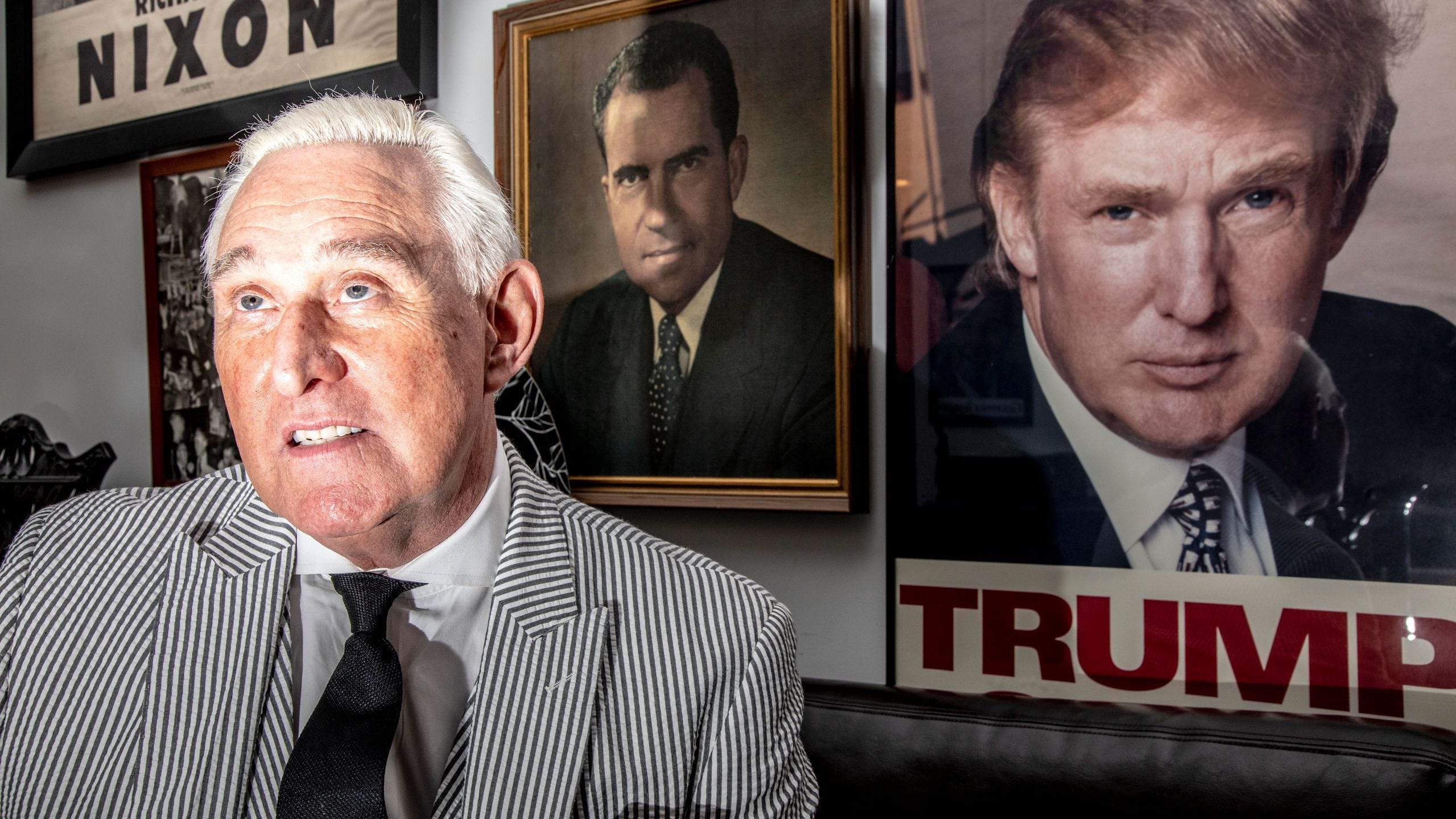
The personnel pipeline runs further. Harley Schlanger, LaRouche’s senior aide from the late 1970s onwards and the man described in Schiller Institute internal documents as “LaRouche spokesman for the Western region of the United States,” is now Vice Chair of the Schiller Institute Board, Vice President of Schiller Institute USA, National Spokesman for LaRouchePAC, and a contributor to the Russian International Affairs Council and Modern Diplomacy. He is also, since 2016, the operational interface between the LaRouche apparatus and Roger Stone.
The colleagues
Goldman is the laundered version. He writes for Tablet and First Things, he holds a Claremont fellowship, he advises the State Department, and the doctrine in his hands comes dressed in Spengler, Rosenzweig, and the decline of the West. To see what the same doctrine looks like when nobody launders it, look at the men he came up with at Executive Intelligence Review, because three of his old colleagues carried the unsanded version straight into the state-media apparatus of Russia, Iran, China, and Assad’s Syria.
F. William Engdahl was an economics editor at EIR and, like Goldman, wrote for Asia Times. His doctrinal signature is the conspiracist history: his first book attributed the 1979 fall of the Shah to a Brzezinski-and-Bernard-Lewis scheme to “Balkanise” the Islamic world, the standard LaRouche “British oligarchy” structure with the antisemitic furniture left in. He is now a fixture of New Eastern Outlook, the English-language journal of the Russian Academy of Sciences’ Institute of Oriental Studies that Facebook removed in 2019 as a Russian disinformation outlet, and of Veterans Today, which carries ties to Iran’s Press TV.
Webster Tarpley was a contributing editor at EIR and co-author, under the LaRouche imprint, of a 1992 conspiracist biography of George H. W. Bush. He became a fixture of the 9/11 “truth” circuit and the Thierry Meyssan Voltaire Network. The detail that matters: on the 21st of November 2011, Tarpley travelled to Syria and told the Assad regime’s state broadcaster, Addounia TV, that the civil war then beginning was a NATO and CIA plot to destabilise the country with mercenaries and death squads. That is an EIR alumnus performing on-camera narrative work for a government that was, at that moment, beginning to shell its own cities.
Lawrence Freeman has been an EIR spokesman, quoted as such in print. He now brands himself a “Political-Economic Analyst for Africa,” publishes in Xinhua, the Chinese state news agency, and recycles the doctrine in its purest contemporary form, the “rules-based international order created by the West has failed” and “humanity demands a new paradigm for global governance.” The vocabulary is identical to Glazyev’s, identical to Bessent’s, identical to the keynotes at the Berlin conference. It is the same doctrine, and Freeman delivers it through Beijing’s wire service into African readerships.
This is the half of the network that did not get cleaned up for cabinet consumption, and it is the half that runs directly into the post-Soviet and Iranian state-media ecosystem. That ecosystem, the charter binding the broadcasters together, the financing routed through nonprofits and diplomats, the recruitment cover, the recycled personnel rotating between Tehran, Moscow, and Beijing, is the subject of Part 7. For now it is enough to register the symmetry. The doctrine has a front door and a back door. Goldman walks through the front, into the State Department. Engdahl, Tarpley, and Freeman use the back, into the state broadcasters of the powers that the doctrine, from the beginning, was written to serve.
Stone
The Stone chain is where the doctrinal and operational layers are visibly stitched together, and the stitching is older than the LaRouche introduction suggests.
In 2004, Michael Caputo, then employed by a firm that the 2020 Senate Intelligence Committee Report on Russian Active Measures (Volume 5, page 48) describes as “run by Manafort and several others, including Roger Stone,” was hired by Paul Manafort onto a Deripaska-related project. Caputo testified that he was retained to “organise U.S. media coverage that would be positive towards Deripaska in response to Deripaska’s failed efforts to obtain a U.S. visa.” The same report notes that Manafort met Oleg Deripaska in 2003 through his business partner Rick Davis, who had met Deripaska that year through Nathaniel Rothschild, the British investment-fund manager and Rothschild dynasty scion. The Rothschild–Deripaska relationship is documented from at least 2003 and is reported to have provided the financing that consolidated Deripaska’s control of UC Rusal in the early-to-mid 2000s.
This is the operational chassis. Stone-orbit operators were doing paid foreign-influence work for a Russian aluminium oligarch, financed through a City of London banking channel, twelve years before the LaRouche network appears in the Stone story. What happens in 2016 is not the beginning of a Stone foreign-aligned political career. It is the moment the doctrinal layer is added to it.
In 2016, Roger Stone was introduced to Harley Schlanger. The exact circumstances of the introduction are disputed by the principals, but the chronology of Stone’s subsequent engagement with the LaRouche apparatus is dense enough to make coincidence implausible. In November 2016, two days after the election, Stone interviewed LaRouche himself on Stone Cold Truth. In September 2018, Stone delivered a keynote address at a Schiller Institute conference. In 2020, with LaRouche dead and Stone freshly commuted by Trump, Stone gave a series of interviews to LaRouchePAC, by then run by Schlanger.
In November 2024, on his WABC radio show The Roger Stone Show, Stone interviewed Scott Bessent as Bessent’s nomination to the Treasury Secretary position was being reported by Reuters. Bessent’s broader public articulation of the “Bretton Woods realignment” framework had been delivered shortly before on Ted Seides’s Capital Allocators podcast, in which Bessent said, of the realignment, “I’d like to be part of it, either on the inside or the out.” The Stone interview did not produce the vocabulary. The vocabulary was already in circulation. The Stone interview confirmed that the candidate for Treasury Secretary was happy to launder his confirmation hearings through the Stone media chain, which was, by then, the most consistent broadcast endorser of the LaRouche/Schiller Institute doctrinal package in American politics.
So: the 2004 Deripaska visa work. The 2016 Schlanger introduction. The 2018 Schiller keynote. The 2020 LaRouchePAC interviews. The 2024 Bessent appearance. Five dated nodes, one operator, twenty years of foreign-aligned political work. The man who ran media for a sanctioned Russian aluminium magnate in 2004 was, by 2024, conducting on air the job interview for the incoming US Treasury Secretary. The intervening years were not a career change. They were a career.
The doctrine, still antisemitic but disguised for public use.
The post-2019 public vocabulary is different from the antisemitic nonsense it always has been, including covering up the suspicious death in 2003 of Jeremiah Duggan. It is now the LaRouche doctrine with the personal liability and risk of arrest removed. The cosmological writing is gone. The antisemitic Rothschilds/British-monarchy conspiracy theorising is muted (for now). The references to Plato and Schiller and Cusa are retained because they read as European-classical seriousness rather than as the specific cult-formation device they functioned as inside the LaRouche organisation (although the language is still present in the grassroots). What survives, intact and operational, is the policy stack:
Sovereign credit creation against physical infrastructure (the “Hamiltonian American System”). Gold remonetisation as a moral correction to “British” financialisation. A Four Powers agreement among the United States, Russia, China, and India as the basis of a new international order. Dollar reserve status reframed as “weaponisation” to be replaced by a New Bretton Woods. Critical-infrastructure development in the Global South (the “Oasis Plan” for South-West Asia, the Schiller Institute’s variations on the African Union’s Agenda 2063, the “World Land-Bridge” rail and energy projects). And, threading through all of it, the framing of the existing dollar system as an “oligarchical” structure imposed on humanity, to be replaced by a sovereigntist confederation of nations conducting trade in their own currencies and in gold.
This is the vocabulary Bessent uses. This is the vocabulary Pandor uses. This is the vocabulary Pepe Escobar uses across the RT/Sputnik/Strategic Culture syndication network. This is the vocabulary that Goldman, in his Asia Times “Spengler” columns, has been refining for twenty-five years and now carries with him into State Department policy planning. The intellectual smuggling was completed long before the cabinet appointments. The cabinet appointments are the receipt.
Writers Note: The contaminated vocabulary and register described in this series, the weaponisation of the dollar and sanctions, the multipolar transition, the Global South and its pushback, is now so pervasive in the body of published commentary that it has become the default output of large language models asked to discuss the subject. The framing no longer needs an author to carry it; ask any general-purpose model about the dollar system and it will return the doctrine's vocabulary, unmarked and presented as neutral description, which is the clearest possible measure of how completely the smuggling has succeeded.
The convergence
Here is the part that is genuinely uncomfortable, and the temptation is to escape it with a tidy distinction that the evidence does not support. The tidy version goes: “a new Bretton Woods” is also a respectable phrase with a respectable lineage, and the respectable people who use it surely mean something safely distinct from what the LaRouche people mean, so the doctrine merely hides behind a harmless homonym. Robert Zoellick, as World Bank president, called for moving beyond Bretton Woods in the Financial Times in 2010. Benn Steil wrote the standard scholarly history under that title in 2013. Kevin Gallagher and the UNCTAD economist Richard Kozul-Wright published The Case for a New Bretton Woods in 2020. None of these people has heard of Leesburg, Virginia. The phrase, the comforting argument runs, is just common property, and the doctrine is a parasite on an innocent host.
That argument is wrong, and abandoning it is the whole point of this section. The “respectable” version and the doctrinal version are not opposites that happen to share a slogan. They are the same programme at different velocities.
Consider what the “respectable” version actually asks for. On the 13th of April 2022, Treasury Secretary Janet Yellen spoke at the Atlantic Council, the most establishment Atlanticist institution in Washington, and made more than a dozen references to Bretton Woods and the multilateral institutions. The Financial Times columnist Rana Foroohar, a centrist business writer of no conceivable LaRouche sympathy, asked her about the prospect of “new institutions” in global economic governance; Yellen replied that the existing ones “need to be modernized.” Foroohar headlined her column “It’s time for a new Bretton Woods.” A week later the Colombian finance minister called for “building a new Bretton Woods.” The Atlantic Council launched a “Bretton Woods 2.0 Project.” And the substance of what all of them wanted was this: reduce the structural dominance of the high-income bloc in the IMF and the World Bank, widen the voting share of the “Global South,” recycle capital into Southern infrastructure and global public goods, and dilute the unipolar character of the existing financial order in favour of a broader multilateralism.
Now read the LaRouche stack again. Reduce the reserve dominance of the dollar. Build out Global South infrastructure on a grand scale. Raise the standing of the non-Western bloc. Replace a unipolar financial order with a multilateral one. It is the same list. The Atlantic Council wants to get there by enlarging the franchise inside the existing institutions; the doctrine wants to get there by replacing those institutions with a gold-and-sovereign-currencies settlement among the Four Powers. The means differ and the velocity differs. The destination is identical: a diminished dollar, an elevated “South” (Russia and China), and a multipolar settlement in which American financial primacy is the thing being dismantled.
Two details make the convergence impossible to wave away. The first is that the Atlantic Council piece, arguing for Global South enfranchisement, illustrates its own case by laying the map of countries that declined to suspend Russia from the Human Rights Council over the map of China’s Belt and Road, and finding them nearly identical. The “Global South” whose voice the establishment wishes to amplify is, on the establishment’s own map, substantially the bloc that Beijing has financed and that declined to censure Moscow. The phrase “Global South”, which the methodology of this series treats with suspicion precisely because it flattens seventy contradictory states into one virtuous constituency, is here doing exactly that laundering work in a Washington think tank’s own prose. The second detail is that Yellen herself framed the goal as averting a “bipolar system” by accommodating China inside the institutions. Accommodation of China inside a diluted dollar order is not the opposite of the doctrine. It is the doctrine’s first chapter, conceded in advance by the people who think they are resisting it.
The convergence has a face, and it is worth dwelling on because it is where the respectable and the doctrinal stop being distinguishable by content at all. Richard Kozul-Wright, then director of the Division on Globalization and Development Strategies at UNCTAD, co-authored The Case for a New Bretton Woods in 2020, the book cited a moment ago as part of the phrase’s respectable lineage. In December 2022 he co-authored, for Progressive International, a manifesto calling for “a new New International Economic Order.” Set his programme beside LaRouche’s and run the ledger on outcomes, not on tone. Kozul-Wright wants capital controls, an end to footloose finance, sovereign-debt restructuring, the reversal of the Washington Consensus, and the channelling of development through the BRICS New Development Bank, the BRICS Contingent Reserve Arrangement, and China’s Belt and Road. LaRouche wanted sovereign credit against infrastructure, a debtors’ cartel against the City of London, grand Eurasian development corridors, and the supersession of the dollar order. The vocabularies come from different centuries and the conspiracy furniture is absent from the UNCTAD version. The named instruments, the New Development Bank, the BRI, are identical, and so is the effect on the one variable this series tracks: both drain dollar-reserve dominance into the same reservoir, to the benefit of the same bloc. Kozul-Wright is not a traditional LaRouchite, and the New International Economic Order he invokes is a real and respectable tradition, the 1974 UN programme, that LaRouche spent his life annexing rather than originating. That is exactly the point. The left-leaning developmental tradition and the parasite that fastened onto it have, after fifty years, become acoustically identical, and they now share a platform.
That platform matters, and it is the doorway into a larger structure this series takes up later. Progressive International, founded in 2020 out of a DiEM25 and Sanders Institute call, is where the doctrine’s left channel runs, the mirror of the right-hand chain from Goldman to Stone to Bessent. Its member organisations and its wire service overlap, at the level of named entities, with the apparatus that Part 7 will excavate: the post-Soviet and state-media ecosystem in which a respectable UN economist, a Stalinist-descended European workers’ party, and a sanctioned Iranian broadcaster are found, improbably, cheering the same de-dollarisation. For now the narrow point is enough. When a serving UNCTAD director and a dead American conspiracist are recommending the same banks, the contamination is no longer a matter of borrowed phrases. It is a matter of shared destination, and the destination is the one the doctrine has been walking toward since 1975.
This is why the phrase travels undetected, and it is not because anyone is fooled by a homonym. It is because the mainstream had already, in its own “respectable” register, talked itself into most of the doctrine’s destination. When Bessent says “Bretton Woods realignment,” the financial journalist who has read Yellen and Gallagher does not hear something alien and dismiss it. He hears a more forceful version of what the previous Treasury Secretary, the World Bank president, and the Atlantic Council were already saying, and he nods. The doctrine did not need to defeat the establishment consensus. It needed only to wait for the establishment consensus to arrive, with help from Russia and China, and for its own stated reasons, at the edge of the same cliff, and then to supply the final push and call it courage.
And here is the measure of how complete the work has been. The proposition that the dollar’s reserve status is a problem to be managed downward, rather than the single greatest strategic asset the United States and her allies in NATO possess, is now held across the aisle at the top of the United States Treasury.
Yellen, a Democrat, advanced it in the language of “reform and inclusion”. Bessent, a Republican, advances it in the language of crypto, realignment and gold. Two consecutive Treasury Secretaries, from opposed parties, both begin from the same unexamined assumption: that the reserve role is something to be diluted, shared, or modernised away. They start the analysis at the doctrine’s conclusion. That is what fifty years of patient vocabulary-building buys. Not an agent in the cabinet, but a premise in the air so familiar that the officials charged with defending the dollar and the reserve will argue for its diminishment or destruction and call it stewardship.
What neither appears to have war-gamed, in any account that has reached the public, is what the reserve role actually does, and therefore what its loss would actually cost. It is the reserve status that underwrites the sanctions architecture Yellen was deploying against Russia in the very same April 2022 speech. It is the reserve status that funds the federal deficit at a discount and makes the Treasury market the world’s risk-free asset. To wield financial statecraft against Moscow with one hand while conceding, with the other, the fifty-year Moscow-and-Beijing project to end the conditions that make that statecraft possible, is not treason. It is incoherence and incompetence, produced by a vocabulary that smuggled its conclusion in ahead of the argument. The full reckoning of what the dollar’s reserve role buys, and what the privatised dismantling of it will cost the public balance sheets of the West, is the subject this series closes on. For now it is enough to note that the gamekeepers have been persuaded, over half a century, that a healthier estate would have fewer pheasants.
What the personnel chain proves
There is an objection, and it should be addressed directly. People change jobs. People hold views without those views being traceable to a single ideological source. The fact that Goldman worked at Executive Intelligence Review in the late 1970s does not mean every word he writes in 2026 is LaRouche doctrine. The fact that Pandor spoke at a Schiller Institute conference does not mean she takes her foreign-policy line from Helga Zepp-LaRouche. The fact that Stone has interviewed everyone from LaRouche to Bessent does not mean Stone is the load-bearing element in a coherent operation.
All of this is correct, taken individually. Taken collectively, it is the structural answer the series is building toward.
The point is not that any one person in this chain were taking direct orders from a deceased convicted fraudster (I have no evidence of that - lack of evidence does not mean that they did not). The point is that an identifiable network, with continuous personnel, a continuous publication apparatus, and a continuous doctrinal vocabulary, has spent five decades producing the intellectual framework that is now the official rhetoric of cabinet-level positioning in the two largest powers contesting the dollar system.
In the West, the framework arrived on the CVs of the people who built it: Goldman from EIR to Asia Times to the State Department, Schlanger from LaRouche’s staff to the interface with Stone to the interface with Bessent. In the East, it arrived through Glazyev, from EIR contributor in the 1990s to State Secretary of the Union State of Russia and Belarus in 2025, and through the media tier, Engdahl, Tarpley, Freeman, that carries it into the state broadcasters of Moscow, Tehran, and Beijing.
And on the left, through Progressive International and the older Trotskyist lineage that Part 7 will trace, it arrived at the same destination from the opposite ideological direction. The CVs are matters of public record. The framework is a matter of public record. The convergence is not a coincidence because coincidences do not have shared employment histories.
This is the part that should trouble every reader, whatever their politics, because the doctrine respects none. It is in Bessent’s mouth and it was in Yellen’s. It is recited at the Schiller Institute and at the Atlantic Council, in Asia Times and at Progressive International, by a Republican Commerce Secretary’s old colleague and by a serving UNCTAD director, by Pepe Escobar on RT and by a centrist columnist in the Financial Times. The doctrine did not capture a party. It captured a vocabulary, and a vocabulary belongs to everyone who speaks it.
A man convicted of mail fraud in 1989 has had more sustained influence on twenty-first-century monetary policy than every Nobel laureate in economics combined. The vehicle was his employees. The doctrine outlived the doctrinaire because the doctrinaire was, all along, less important than the apparatus. Lyndon LaRouche was the most successful intellectual entrepreneur in modern American political history, and the measure of the success is that fifty years after he first proposed a New Bretton Woods, the phrase is in two successive Treasury Secretaries’ mouths, across both parties, and nobody is asking where it came from.
Nobody, that is, except this series and The Angry Dogs.
Next week: Part 6 - AI and crypto: data centres and natural resources. The physical-asset side of the new Bretton Woods trade, why Trump Jr visited Greenland and why Barrick Mining’s executive chairman has been on the China Investment Corporation’s International Advisory Council since 2009, whilst eating dinner with Bannon and Farage.
Writers Note:
I have amended Part 6 since the start of this series to explain the importance of the NAFO #Alumina21 campaign and why exactly does Ireland think it is ok to supply raw materials to Russia. I have done that because Aughinish, the online support for Rusal and the logistics around it form a key part of this whole enterprise (and it is a single enterprise). The campaign is far more important than the even the campaigners realise. Please support the NAFO campaign at: https://alumina21.com/
Previously: Part 3 (the development of crypto and stablecoins); Part 4 (Ross Ulbricht and Silk Road)
I do believe there is a difference between the left-channel and the right channel though.
I think they may differ on what they consider to be the downsides of the dollar-system, and the goals they have with de-dollarizarion. (For all: who should be its benificiaries. The actual 'people', societies? Or their (autocatic) leaders, oligarchs, (economic) elites and other superrich and powerful players?)
I understand also serious economists see downsides to the global dollar system. (e.g. Steve Keen on YT)
For America (more expensive currency/production/exports, a reason for industry to leave. Workers unemployed + basis for imperial status hollowed out on long run. Also , but not only, stressed by maga).
And also for other countries, altgough i dont remember exactly (e.g. strict IMF adherence? Markettheory-rules rule? Loans-Cuttings?)
Rich players and autocratic leaders probably see the control and oversight (on them) as the main downside? Not the downsides for the common people.
I can imagine the left-channel could prefer e.g. a return to the Keynes-idea at Bretton Woods (?)
The right-channel certainly will not mean to do that, i guess!
Whatever his other actions and ideas, and the conspirational background also to this one, Larouches ideas themselves about this subject still don't sound very bad to me.
But at the same time misused by certain players (incl. himselve? maybe not) to benefit quite different goals than advertized.
Esp. the left-channel leaders and adherents must often be confused by this, esp. nowadays.