


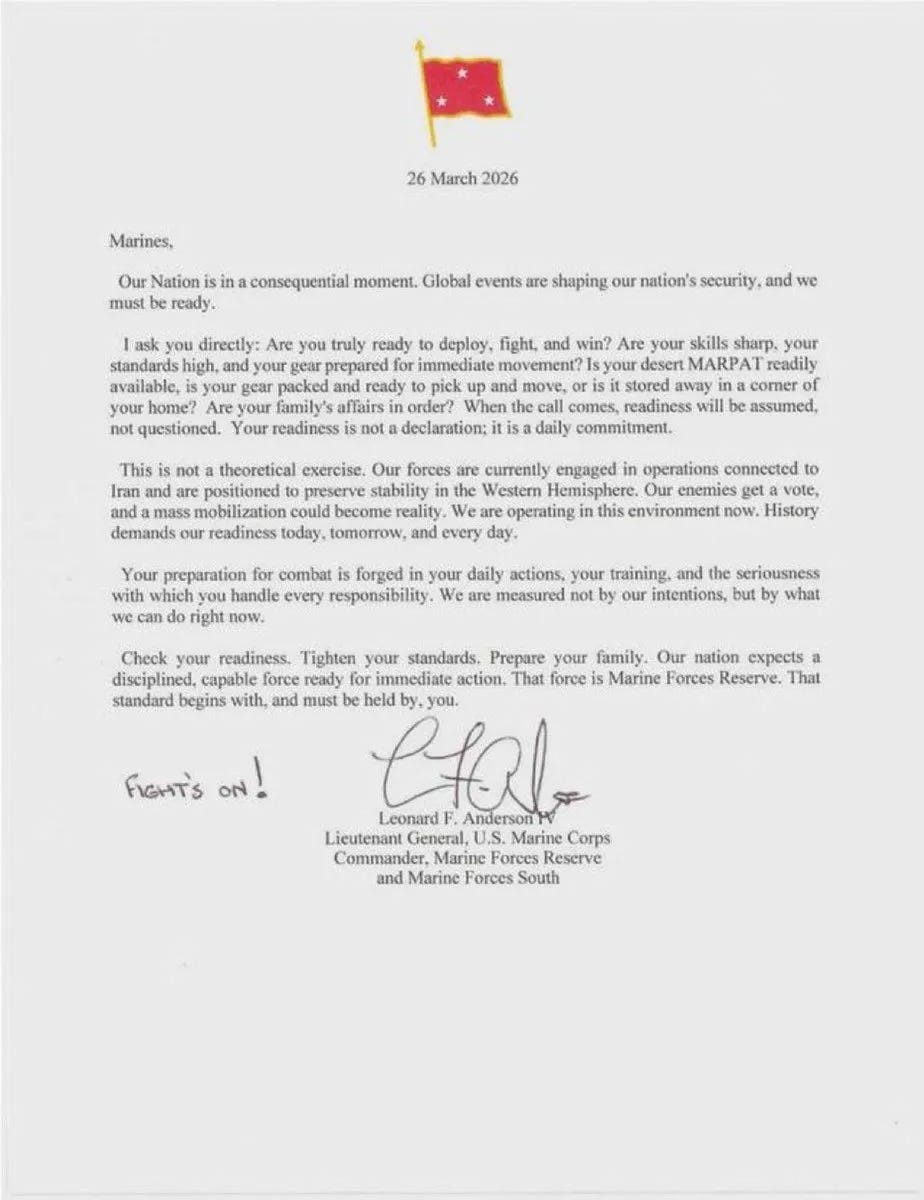
On March 26th, the off button wrote a letter.
The Letter
Lieutenant General Leonard F. Anderson IV, Commander of Marine Forces Reserve and Marine Forces South, sent a letter to 35,000 reservists. It asked them to check whether their desert camouflage was packed and ready to go or stored in a corner at home. It told them to get their family’s affairs in order. It said mass mobilisation could become reality.
The next day, USS Tripoli arrived in CENTCOM’s area of responsibility carrying 3,500 Marines, F-35Bs, attack helicopters, and amphibious assault assets.
Read the letter carefully. Not the content — the register.
“History demands our readiness today, tomorrow, and every day.” That is not operational language. Operational language says: report to your unit by 0600, confirm your SGLI beneficiary designations, verify your medical readiness. Operational language is boring because operations are procedural.
“Your readiness is not a declaration; it is a daily commitment.” That is a sermon.
“When the call comes, readiness will be assumed, not questioned.” That is prophecy.
And in the corner, handwritten: “Fight’s on!”
Leonard Anderson joined the United States Marine Corps because he watched Top Gun. I am not being cruel. His own biography says so. He was going to be a marine biologist. The film changed his life. He performed opera with Pavarotti as a child. He is, by all available evidence, a man who lives inside a story in which he is a character.
The dispensationalist template does not need everyone inside it to have read Revelation. It needs people who believe history has a script, the righteous have a role, and the decisive moment is always arriving. “History demands our readiness” is that template speaking through a three-star general’s letterhead.
The reservists on Reddit, confused, angry, asking each other what this means, are not inside the same template. They are reading the same letter from a completely different position in the field. From where they stand, it is a bizarre motivational speech attached to a real mobilisation warning. From where Anderson stands, it is the call.
Two information surfaces. One letter. No transmission mechanism between them.
The Analyst
The day Anderson sent his letter, Dean Blundell published a long piece on Substack about Kharg Island. The military analysis was anchored on Malcolm Nance — “former Navy cryptologist and MSNBC national security contributor” — who described the Persian Gulf as a shooting gallery and laid out why an amphibious assault would be catastrophic.
The piece quoted Lindsey Graham calling Kharg “seldom in warfare does an enemy provide you a single target like this.” It quoted retired Admiral Stavridis. It quoted McChrystal. And it quoted Nance, at length, as the primary military voice.
Here is what Blundell’s audience does not know.
In March 2023, the New York Times published “Stolen Valor: The U.S. Volunteers in Ukraine Who Lie, Waste and Bicker.” Nance was at the centre. He had joined the Ukrainian International Legion to much fanfare, leaving MSNBC, appearing on air with a gun, and then, according to the Times, became enmeshed in chaos. He accused a pro-Ukraine fundraising group of fraud without evidence. He labelled a fellow Legion official a potential Russian spy, offering no evidence. He wrote counterintelligence reports to get people fired. He partnered with a man who had lied about being a Marine and had actually been a server at LongHorn Steakhouse.
That was 2023. It got worse.
Nance was a regular featured guest on the Mriya Report, a 24/7 Twitter Spaces broadcast and associated charity run by Canadian Forces Captain Joseph Friedberg. The Mriya Report raised money for Ukraine. In September 2024, all 24 of its volunteers resigned simultaneously, citing “various ethical concerns.” In January 2026, co-founder Ryan Meyer went public with the financial records. Bank statements showed donations meant for Ukrainian frontline troops had been spent on pizza, Best Buy, Home Depot, car rentals in Toronto, and tens of thousands of dollars on storage units in Canada. Board officials had been paid over $50,000 from what was supposed to be a volunteer-only organisation. In 2023, $2,000 of Ukraine donations had been paid to Lev Parnas, a convicted felon, for a speaking segment, over the immediate objections of board members who resigned in protest. Only around 30 per cent of donations reached Ukraine.
A linked entity, KJA Digital Assets, had used its association with the Mriya Report to pitch investors on profiting from Ukraine’s reconstruction, explicitly noting that establishing the charity had helped them build government and military networks in the country.
The Ottawa Citizen investigated. The Canadian Forces investigated. The IRS complaint was filed. The Mriya Report and it’s radio station collapsed.
Every person in the NAFO ecosystem, the volunteer information community that actually supported Ukraine through the invasion, knows this story. It is not obscure. It is not contested. It is documented by the New York Times, the Ottawa Citizen, and the financial records themselves.
But Dean Blundell’s audience does not know it. And so Malcolm Nance appears in their feed as “former Navy cryptologist, MSNBC national security contributor,” and the credential does the work.
Information Is Local
This is not a media criticism point. This is the framework operating in real time.
The rent from a credential persists after the underlying credibility has collapsed. The institutional cost, the L in the payoff function, only arrives where observers have direct measurement capability. In NAFO circles, people have direct experience of Nance and the Mriya ecosystem. The credential has been measured against reality and found empty. In Blundell’s audience, nobody has that measurement surface. The credential is unexamined. It keeps paying rent.
Two completely different observable properties of the same person, depending entirely on the observer’s position in the field.
This is not a conspiracy. Nobody is hiding anything. The New York Times article is public. The Ottawa Citizen investigation is public. The bank statements are public. Information is not being suppressed. It is failing to propagate. Because information in this system is local and asymmetric. It depends on your position. It depends on which information surface you are standing on. And there is no arbitrage mechanism to close the gap.
The credential-as-rent-bearing-asset is one of the most important mechanisms in the framework. It explains why discredited experts keep being platformed, why institutional authority persists after institutional failure, why the same person can be simultaneously a fraud and a trusted voice. Not because anyone is stupid. Because the measurement has not arrived at the second observer’s position.
Nance may be right about Kharg Island. The geography is real. The fortifications are real. The kill zone is real. But his analysis arrives through a supply chain that has already been shown to be compromised, and that fact is invisible to the audience receiving it.
The Template Generates Orders
Two weeks ago I described a system with no off button. Two eschatological templates, dispensationalist and anti-Israel, facing each other with no institutional template between them. No mediating structure. No termination condition. An attention market rewarding both sides for escalation.
The Anderson letter is the update.
Previously, the template was generating content. Trump posts. Cable news segments. Substack analysis. Podcast appearances. The content was alarming but it was still content, words on screens, takes in feeds, identity capital appreciating in the attention market.
The letter crosses a threshold. A three-star general, operating inside the dispensationalist template’s register, has issued a preparatory mobilisation communication to 35,000 reservists. The template is no longer producing takes. It is producing orders.
Not formal mobilisation orders, not yet. But “check your desert gear, sort out your family’s affairs, mass mobilisation could become reality” is the institutional machinery being operated by a template-captured actor. The language is eschatological. The authority is real. The 35,000 people receiving it have actual desert camouflage in actual wardrobes and actual families who need to be told something.
And the information environment surrounding the mobilisation, the analysis, the expert commentary, the military assessment that reaches the public, is running through supply chains whose reliability cannot be verified from inside the audience receiving them. Nance is the worked example, but he is not the only one. The entire information surface is segmented. Each segment receives locally coherent analysis from locally credentialed sources, and no segment has the measurement capability to verify the other segments’ sources.
Graham says Kharg is a gift. Anderson says history demands readiness. Nance says the Gulf is a shooting gallery. Each statement is locally rational inside the template or information surface it originates from. None is visible from the others’ positions.
Meanwhile, the USS Tripoli is in the Gulf. The 82nd Airborne is deploying. Oil is above $100. The Strait is contested. And 35,000 reservists are checking their wardrobes.
The model said there was no off button. The update is simpler and worse.
The off button has been captured by the template. And it is being pressed, not to stop, but to accelerate.
The formal framework underlying this analysis is under peer review at Constitutional Political Economy. The book will be called The Outrage Dividend. All proceeds from The Angry Dogs are donated to Ukrainian causes — because information may be local, but solidarity doesn’t have to be.