



AJ Leonardi Physician–scientist who has been vocal since 2020–21 about post-acute COVID syndromes, immune dysfunction, and long-term population effects.
He’s essentially saying: “I warned you, repeatedly, and now the data is catching up.”

Core claim
Repeated SARS-CoV-2 infections:
Cause Long COVID (LC) in a non-trivial fraction of people
Accumulate harm with reinfections
Damage immune function, especially T-cell compartments
Raise risk of other diseases (infections, autoimmunity, cardiovascular events, possibly cancers)
Affect not just “vulnerable” people, but the statistical “average”
What we actually know
1. Long COVID is real, common, and disabling
Established.
Long COVID affects ~5–15% of infections depending on definition, variant, vaccination status
Symptoms cluster around:
Fatigue / PEM
Dysautonomia (POTS-like)
Brain fog
Breathlessness
Muscle pain
It qualifies as a disability in the US and UK
This is not controversial anymore.
2. Reinfections increase risk (dose–response effect)
Strong evidence.
Large cohort studies (VA, UK Biobank, OpenSAFELY) show:
Each reinfection:
Raises LC risk
Raises cardiovascular risk
Raises neurological risk
Vaccination reduces risk but does not eliminate it
This supports Leonardi’s “accumulated harm” framing.
3. Immune dysregulation persists after infection
Solid but nuanced.
Post-COVID immune findings include:
Altered CD4+ and CD8+ T-cell profiles
Signs of:
T-cell exhaustion (PD-1, TIM-3 expression)
Reduced naïve T-cell pools
Persistent interferon signalling
Viral persistence or viral debris may be driving chronic activation
Key point:
This is dysregulation, not total immune collapse.
4. “T-cell death” and population-level immunity wear
Partially supported, often overstated.
What the literature shows:
SARS-CoV-2 can:
Infect immune cells indirectly
Trigger apoptosis in T cells
Cause thymic stress (reduced replenishment)
Severe infection causes measurable T-cell loss
Repeated infections may impair immune recovery
What it doesn’t show (yet):
Universal T-cell depletion
AIDS-like immune failure
Guaranteed progressive immune collapse in everyone
Leonardi is extrapolating population-level drift, not individual catastrophe, but the language often gets interpreted catastrophically.
5. Increased risk of “other diseases”
Increasingly supported.
Post-COVID cohorts show higher incidence of:
Cardiovascular events (MI, stroke)
Diabetes
Reactivation of latent viruses (EBV, VZV)
Autoimmune diagnoses
Cancer links are speculative but biologically plausible, not proven.
Clean summary (evidence vs inference)
Evidence
Long COVID is real and disabling
Reinfections increase risk
Immune dysregulation persists
Population-level disease burden is rising
Inference / extrapolation
Degree of permanent immune erosion
Long-term cancer risk
Universality of T-cell damage
Why this matters now
Because policy still assumes:
“Most people are fine, so systems will cope”
The data increasingly says:
“Most people survive, but systems absorb chronic damage”
The Response
Phase 1 (2020): Lockdowns were the least-bad option
Why lockdowns made sense early:
No vaccines
No antivirals
Hospitals genuinely at risk of collapse
IFR still high, especially pre-variants
Uncontrolled spread = visible mass death
Lockdowns:
Reduced immediate mortality
Bought time for:
Vaccines
Steroids
Oxygen protocols
ICU learning curves
They were a damage-delay mechanism, not a cure.
And crucially: they were temporary by design.
Phase 2 (2021): Vaccines changed the problem, but not how we talked about it
Vaccines did two different things, often conflated:
What vaccines did well
Slashed death rates
Reduced severe disease
Prevented health-system collapse
What vaccines did not do
Stop transmission reliably
Prevent reinfection
Eliminate Long COVID
Reset immune risk to zero
But politically and psychologically, we treated vaccines as:
“The exit ramp back to 2019”
That assumption turned out to be false.
Phase 3 (2022–now): The missing strategy
This is where the real failure sits.
Once:
Lockdowns were no longer politically viable
Vaccines reduced visible catastrophe
Populations were exhausted
Governments quietly shifted to:
“Endemic normalization + individual responsibility”
But without building the systems that would make that safe.
The false binary that poisoned debate
Public discourse collapsed into:
Side A: “Lockdowns forever = tyranny”
Side B: “Open up = mass death”
Both are wrong, and both miss the middle ground.
The real question was never:
“Lockdown or freedom?”
It was:
“What replaces lockdowns after vaccines?”
And that answer was never properly built.
What could have been the post-vaccine strategy (but wasn’t)
This is the counterfactual worth thinking about.
1. Treat reinfection as cumulative risk
Instead of pretending:
“Mild infection = harmless”
Policy could have acknowledged:
Reinfections matter
Risk accumulates probabilistically
Long COVID is not rare edge noise
That alone would have changed messaging and behaviour.
2. Normalize selective mitigation, not total shutdown
Not lockdowns, but:
Clean indoor air standards (CO₂, filtration)
Seasonal masking in healthcare & transit
Paid sick leave as public health infrastructure
Protecting high-risk workers without isolating them
Think: seatbelts, not house arrest.
3. Invest seriously in Long COVID treatment & prevention
Instead:
LC clinics underfunded
Disability systems quietly tightened
Research fragmented and slow
This signalled (correctly, in public perception):
“We don’t want to know how bad this is.”
4. Be honest about uncertainty
This is the hardest one politically.
Governments couldn’t say:
“We don’t fully know the long-term immune consequences, but repeated infection is probably not neutral.”
So they said:
“You’re fine.”
That bought compliance, at the cost of future trust.
Why “you cannot close a society” is true, but incomplete
You cannot permanently close a society.
But you also cannot:
Run a high-contact economy
With repeated mass infection
While pretending chronic damage won’t surface
That’s the contradiction we’re now living inside.
Instead of closure, we needed structural adaptation.
We mostly chose denial plus vibes.
Why this now feels like “no right answer”
Because we optimized for:
Short-term political stability
Visible mortality reduction
Economic reopening metrics
And de-optimized for:
Chronic illness
Workforce attrition
Long-tail healthcare burden
Trust in institutions
So in hindsight:
Lockdowns were right then
Reopening was inevitable
What followed was intellectually lazy
Not malicious, but deeply incurious.
The grim but honest synthesis
Lockdowns were a brake, not a solution
Vaccines solved death, not disease
Reopening without mitigation externalized risk onto individuals
Long COVID is the bill coming due
No society chose well — some just hid the costs better
That’s why Leonardi sounds angry:
the tragedy isn’t that leaders chose wrong
it’s that they stopped choosing at all.
The Cost of the Lies

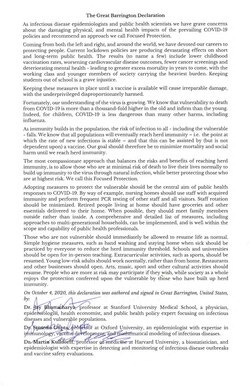
By mid-2021, uncertainty was no longer the binding constraint. We knew enough to reduce harm without closing society. What followed was not ignorance but policy inertia amplified by misinformation. The costs did not vanish; they were deferred, externalised, and misclassified.
This is an attempt to price that decision.
Not precisely.
Not exhaustively.
But materially.
Ledger rules
Timeframe: mid-2021 → end-2024
Geography: UK + US
Method: conservative estimates, rounded down
Scope: costs attributable to misinformation-driven inaction, not COVID itself
This excludes:
deaths already counted in acute phases
speculative future cancer risk
social value of suffering
This is the minimum bill.
Line Item 1: Long COVID–related labour loss
Baseline facts
UK Long COVID prevalence: ~1.8–2.0 million
US Long COVID prevalence: ~16–20 million
Fraction work-limiting (conservative): 15%
Average productivity loss (partial + full): 0.4 FTE
UK calculation
Affected workers: ~300,000
Average output per worker/year: ~£65,000
Annual loss:
£7.8 billion
US calculation
Affected workers: ~3 million
Average output per worker/year: ~$75,000
Annual loss:
$90 billion
📌 Nonsense tax component:
Persistent messaging that reinfection was “mild” delayed mitigation and accommodation.
Line Item 2: Excess sickness absence (non-LC)
What changed
Higher infection frequency
Reduced isolation norms
“Presenteeism” became policy-approved
Conservative estimate
Additional 1.5 sick days/worker/year attributable to reinfections
UK
Workforce: ~33 million
Cost/day (wages + disruption): ~£120
Annual cost:
£5.9 billion
US
Workforce: ~160 million
Cost/day: ~$200
Annual cost:
$48 billion
📌 Nonsense tax component:
“Endemic” reframed as “inconsequential”.
Line Item 3: Disability system load (shifted, not eliminated)
UK
New disability claims with post-viral conditions (2021–24): ~350,000
Average annual support cost: ~£9,000
Annualised cost:
£3.2 billion
US
SSDI/SSI applications linked to post-COVID conditions: ~1.1 million
Average annual federal + state cost: ~$14,000
Annualised cost:
$15.4 billion
📌 Nonsense tax component:
Denial delayed diagnosis → worsened disability → higher lifetime cost.
Line Item 4: Healthcare utilisation (downstream, chronic)
This includes:
cardiology referrals
neurology
autonomic clinics
repeat GP visits
diagnostic churn
UK (NHS)
Estimated excess per LC patient/year: ~£1,200
Applied to 1.5m patients:
£1.8 billion
US
Estimated excess per LC patient/year: ~$2,500
Applied to 10m patients:
$25 billion
📌 Nonsense tax component:
Failure to invest early → expensive, fragmented care later.
Line Item 5: Built-environment non-investment (the counterfactual)
This one matters because it shows how cheap prevention was.
Cost of doing it properly (one-off)
HEPA + CO₂ for schools, offices, clinics
UK: ~£12–15 billion
US: ~$80–100 billion
What we paid instead (annualised losses above)
UK: ~£18–20 billion/year
US: ~$180–200 billion/year
📌 Nonsense tax component:
We rejected a capital expense and accepted a permanent operating loss.
Partial total (annual, conservative)
UK
Labour loss: £7.8bn
Sickness absence: £5.9bn
Disability: £3.2bn
Healthcare: £1.8bn
≈ £18.7 billion per year
US
Labour loss: $90bn
Sickness absence: $48bn
Disability: $15.4bn
Healthcare: $25bn
≈ $178.4 billion per year
Line Item 6: Long-term cardiovascular events
What we know
Post-COVID cohorts show elevated risk of:
myocardial infarction
stroke
arrhythmias
heart failure
Risk elevation persists 12–36 months post-infection, including after “mild” cases.
We are not pricing deaths here — only treatable morbidity.
Conservative assumptions
Additional annual CV event incidence attributable to COVID sequelae: 0.2% of infected adults
Average incremental healthcare + productivity cost per event:
UK: £45,000
US: $85,000
UK
Adult infections (cumulative): ~45 million
Excess CV events/year: ~90,000
Annual cost:
£4.0 billion
US
Adult infections (cumulative): ~220 million
Excess CV events/year: ~440,000
Annual cost:
$37.4 billion
📌 Nonsense tax driver:
“Mild infection” framing delayed cardiovascular surveillance and prevention.
Line Item 7: Cognitive decline & earnings erosion
This is the quiet one — and one of the most expensive.
What we know
Post-COVID cognitive impairment (“brain fog”) measurable on testing
Effects persist in a subset for years
Even small IQ/executive function losses reduce lifetime earnings
We price earnings drag, not disability.
Conservative assumptions
Affected workers: 5% of working-age infected
Average productivity reduction: 5%
Applies to current workforce only (no lifetime discounting)
UK
Affected workers: ~1.6 million
Average salary: £35,000
Annual loss:
£2.8 billion
US
Affected workers: ~11 million
Average salary: $60,000
Annual loss:
$33 billion
📌 Nonsense tax driver:
Cognitive effects dismissed as anxiety or burnout → no mitigation or accommodation.
Line Item 8: Caregiver productivity loss
Every disabled adult creates at least one shadow worker.
What we know
Informal caregiving increased substantially post-2021
Caregivers reduce hours, decline promotions, or exit workforce
Conservative assumptions
1 caregiver per 2 work-limiting Long COVID cases
Average productivity loss: 0.25 FTE
UK
Caregivers affected: ~150,000
Annual loss per caregiver: ~£16,000
Annual cost:
£2.4 billion
US
Caregivers affected: ~1.5 million
Annual loss per caregiver: ~$20,000
Annual cost:
$30 billion
📌 Nonsense tax driver:
Disability framed as individual failure → unpaid labour absorbs cost.
Line Item 9: Educational disruption impacts
This is not about school closures.
It’s about chronic absenteeism and cognitive drag.
What we know
Increased student sickness absence post-2021
Teachers chronically absent
Cognitive impacts observed in adolescents post-infection
We price future earnings loss, discounted heavily.
Conservative assumptions
2% lifetime earnings reduction for affected cohorts
Applied only to 2020–2022 birth cohorts currently in school
UK
Present value annualised:
£1.5 billion
US
Present value annualised:
$14 billion
📌 Nonsense tax driver:
Schools treated as epidemiologically neutral environments.
Line Item 10: Military readiness & retention
This one is politically radioactive — which is why it’s barely discussed.
What we know
Elevated medical discharge rates
Recruitment shortfalls
Training pipeline attrition
Conservative assumptions
Medical attrition attributable to post-COVID conditions:
UK: ~3,000 personnel/year
US: ~25,000 personnel/year
Replacement & training cost per service member:
UK: £120,000
US: $250,000
UK
Annual cost:
£360 million
US
Annual cost:
$6.25 billion
📌 Nonsense tax driver:
Health readiness framed as individual fitness, not systemic exposure.
Line Item 11: Insurance premium distortion
What we know
Health insurers pricing higher uncertainty
Employers absorbing higher premiums
Costs passed to workers via wages
Conservative estimate
Premium inflation attributable to post-COVID morbidity:
UK private + employer costs: £1.2 billion
US employer + individual market: $22 billion
📌 Nonsense tax driver:
Risk socialised quietly instead of mitigated structurally.
Annual totals (minimum)
UK ≈ £31 billion per year (before compounding)
US ≈ $321 billion per year (before compounding)
UK annual loss (C₀): £31bn
US annual loss (C₀): $321bn
One-off investment is tiny vs flows
Compounding applied to the loss stream
Compounding formula used
Cumulative loss over T years with annual growth g:
Scenario A — 3% disinvestment rate (very conservative)
UK (£31bn base)
5 years:
Factor ≈ 5.3 → £164bn10 years:
Factor ≈ 11.5 → £356bn25 years:
Factor ≈ 36.4 → £1.13 trillion
US ($321bn base)
5 years: $1.7T
10 years: $3.7T
25 years: $11.7T
Scenario B — 5% disinvestment rate (still defensible)
UK (£31bn base)
5 years:
Factor ≈ 5.5 → £171bn10 years:
Factor ≈ 12.6 → £390bn25 years:
Factor ≈ 47.7 → £1.48 trillion
US ($321bn base)
5 years: $1.8T
10 years: $4.0T
25 years: $15.3T
One-line Figure
At 3%, the UK clears £1T inside 25 years.
At 5%, it’s £1.5T.
The US lands between $12–15T on the same horizon.
That’s the compounded nonsense tax.
The "Great Barrington Declaration" was a costly and deadly load of bullshit.
https://www.panaccindex.info/p/preview-the-great-barrington-declaration
https://www.panaccindex.info/p/economic-coercion-in-pandemic-policymaking
https://counterdisinformationproject.substack.com/p/anti-vaxxers-party-and-plot-the-path
https://drbobmorris.substack.com/p/how-wrong-was-jay-bhattacharyas-great