


I want to do something uncomfortable. I want to apply the same analytical framework I’ve been using on Trump, Iran, and the MAGA ecosystem to someone most of my readers probably agree with.
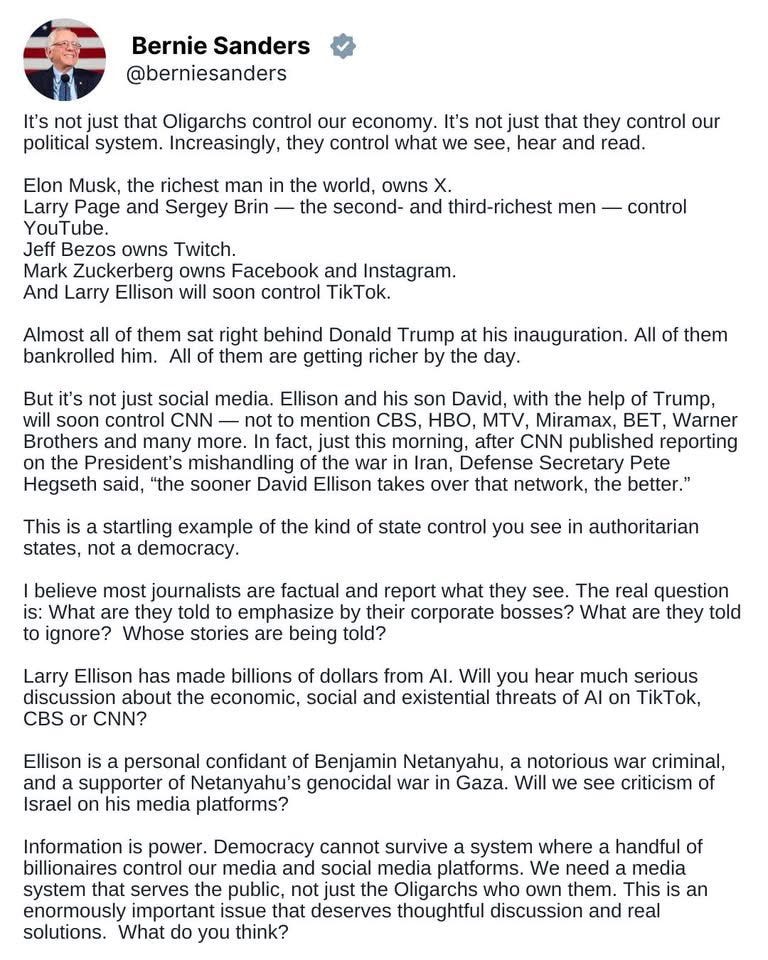
Bernie Sanders posted a thread this week about billionaire control of media and social platforms. Musk owns X. Page and Brin control YouTube. Bezos owns Twitch. Zuckerberg owns Facebook and Instagram. Ellison will soon control TikTok and CNN. All of them sat behind Trump at his inauguration. All of them bankrolled him. Hegseth said the sooner Ellison takes over CNN, the better.
I am not going to argue with any of that. The facts are accurate. Ellison is close to Netanyahu. The billionaires do own those platforms. The concentration of media ownership is real and worth discussing.
But I’m not interested in whether he’s right. I’m interested in the structure.
My framework identifies recurring template families in modern political communication. They are not ideologies. They are narrative structures — pre-built frameworks through which information is organised, transmitted, and received. The same template can carry left-wing or right-wing content. The template determines the shape of the message, not its direction. Intent is irrelevant to the analysis.
I have identified at least four families so far. There may be more.
The Institutional template. Procedural. Boring. Built on rules, processes, and legitimate authority. This is the template that produces legislation, regulation, diplomacy, and policy papers. Its termination conditions are built in — it contains its own off-ramps because the institutions need to keep operating.
The Protocols template. Named after the Protocols of the Elders of Zion (1903), the oldest and most successful open-source narrative template in modern politics. Its structure: a hidden elite controls society from behind the scenes. The threat is existential. The conspiracy is coordinated. The enemy is named. It can be forked to target any convenient out-group. QAnon is a Protocols fork. So is “the billionaires control everything.” Same template, different names in the slots.
The Dispensationalist template. Premillennialist, eschatological. The world is heading toward apocalyptic fulfilment. A particular 3rd party (mainly Israel) is the instrument of prophecy. The war is sacred. This is the template currently running the Iran conflict.
The Frankenstein template. The thing we created that turns on its creator. 207 years of conserved momentum since Shelley (1818). AI panic, nuclear fear, genetic engineering horror — all forks of the same template. The creation is the enemy.
Now read Sanders again.
“It’s not just that Oligarchs control our economy. It’s not just that they control our political system. Increasingly, they control what we see, hear and read.”
Hidden elite. Coordinated control. Named individuals. Existential scope — not a policy problem but a system-level takeover. This is the Protocols template.
“Elon Musk, the richest man in the world, owns X. Larry Page and Sergey Brin — the second- and third-richest men — control YouTube. Jeff Bezos owns Twitch. Mark Zuckerberg owns Facebook and Instagram.”
The named roster. The cabal identified. Classic Protocols structure — the enemy has names and addresses.
“Almost all of them sat right behind Donald Trump at his inauguration. All of them bankrolled him.”
Coordination. The hidden elite acting as a unit. Not independent billionaires making separate decisions. A group. Together. Behind him.
“This is a startling example of the kind of state control you see in authoritarian states, not a democracy.”
Civilisational framing. Not “this is a problem.” This is the end of democracy. The threat is existential. The template requires existential stakes.
“Democracy cannot survive a system where a handful of billionaires control our media and social media platforms.”
Cannot survive. Terminal. Eschatological endpoint — not “democracy is under strain” but “democracy cannot survive.” The Protocols template demands totality.
“Larry Ellison has made billions of dollars from AI. Will you hear much serious discussion about the economic, social and existential threats of AI?”
And there, nested inside the Protocols template, is a second template: Frankenstein. The thing we created that threatens to destroy us. And the hidden elite who created it are suppressing discussion of the threat. Two templates, layered. The hidden elite made the monster and are hiding it from you.
Then, right at the end: “We need a media system that serves the public, not just the Oligarchs who own them.”
One sentence. Institutional template. A procedural solution to a structural problem. It’s vestigial — bolted onto the end of a message whose entire structure is Protocols and Frankenstein. The institutional template is the delivery mechanism, not the content.
Three templates in one post. Protocols (hidden elite, coordinated control, named cabal, existential threat). Frankenstein (AI as the dangerous creation they won’t let you discuss). Institutional (one sentence of policy solution at the end).
Here is the part that makes this interesting rather than merely analytical.
Bernie Sanders is factually correct about the media ownership. He is factually correct about Ellison and Netanyahu. He is probably factually correct that AI coverage will be suppressed on platforms owned by AI billionaires. None of that changes the template analysis. Because the template is not about truth or falsehood. It is about structure. True information can be structured through the Protocols template just as easily as false information. The template determines how the message is received, how it propagates, who it mobilises, and what it excludes — regardless of whether the underlying claims are accurate.
And here is the part that is genuinely uncomfortable.
From a template perspective, Sanders is closer to the people he is fighting than to the people he is serving.
Sanders and the tech billionaires are running the same template family. Protocols. Hidden elite. Existential threat. Civilisational framing. They have filled in different names. Musk’s version: the deep state, the mainstream media, the woke establishment. Sanders’s version: the oligarchs, the billionaires, the corporate elite. Same structure. Different names in the slots. Opposite charge — Sanders points left, the tech-right points right — but the same template family.
His constituents — ordinary voters who want healthcare, lower costs, functioning infrastructure — are not in the Protocols template. They are in the institutional template. They want boring procedural outcomes. Policy. Legislation. They want their roads fixed. Sanders thinks he is serving them. But the structure of his message is closer to Musk’s “deep state” framing than it is to “I’d like my prescription costs reduced, please.”
He reaches his institutional-template constituents by broadcasting a Protocols-template signal through an institutional channel — his Senate platform, his verified account, his political authority. They receive it and hear “someone is fighting for us.” They don’t hear the template. They hear the charge. The direction. The left-ness of it. They can see the charge vector. They cannot see the template family. Because information is local, and from their position in the institutional well, the template is invisible. They see a senator fighting oligarchs. The framework sees a Protocols-template actor with negative charge pointed at Protocols-template actors with positive charge, while institutional-template constituents observe from a different well entirely and cheer because they can only see the charge, not the structure.
I want to be very clear about what I am not saying.
I am not saying Sanders is wrong. I am not saying his concerns about media ownership are invalid. I am not saying he is equivalent to Musk or Trump or QAnon. Charge matters. Direction matters. Content matters. The framework does not collapse these distinctions — it operates on a different axis entirely. Template analysis identifies structure. It does not evaluate content, assign moral weight, or rank actors. Two actors can occupy the same template family and differ on every other dimension that matters in the real world.
But the framework is content-neutral by design. It has to be. A model that only works on one side of the political spectrum is not a model. It is commentary. The same incentive structure generates the same dynamics regardless of which positions, movements, or political poles are involved. If I only applied this to Trump and MAGA, I would be doing template analysis with a template of my own — and I wouldn’t be able to see it. Just like Sanders can’t.
Information is local. Even for senators. Even for me.
Postscript: A challenge from a friend
A friend challenged me to apply the template analysis to AOC, i extended the challenge to five American political figures. I took recent public statements on the Iran war from AOC, Bernie Sanders, Kamala Harris, Jake Sullivan (speaking for the Biden framework), and Donald Trump. No political information was used. Just the template structure of what they said.
Jake Sullivan. Pure institutional template. “A war of choice.” “No clear objectives and no clear endgame.” Objectives, endgame, choice — the vocabulary of the institutional well. He is a former National Security Advisor. The institutional template is his professional identity.
Kamala Harris. Institutional template dominant. “Recklessness dressed up as resolve.” “Under the Constitution, the President must receive authorization from Congress.” “Congress must use all available power.” Institutional vocabulary throughout, layered with personal-brand attention extraction — the book tour, the cheese curds, “Doug and I will be praying.” She is framing opposition through institutional process while extracting mA from the war through her personal narrative.
Alexandria Ocasio-Cortez. Institutional template with Protocols threading. “Unlawful. Unnecessary. Catastrophic.” Constitutional war powers. Congressional authorisation. Impeachable offence. That is institutional. But: “dragged into a war they did not want by a president who does not care” — one man, acting alone, against the will of the people. And the Epstein connection: “if the Epstein files have such a hold on President Trump that they are willing to plunge us and risk world war” — that is full Protocols. Hidden leverage. “They” have a concealed motive. The real reason is hidden from view.
Bernie Sanders. Protocols template dominant. Hidden elite controlling everything. Named cabal of billionaires. Existential threat to democracy. Frankenstein template nested inside — AI as the dangerous creation they will not let you discuss. Vestigial institutional template bolted on at the end — one sentence of policy solution. As analysed in the main piece.
Donald Trump. “When I feel it in my bones.” “We’ve already won in many ways, but we haven’t won enough.” “We go forward more determined than ever to achieve ultimate victory that will end this long running danger once and for all.” Scalar attention production with dispensationalist template undertow. No objectives. No termination conditions. “Ultimate victory” and “once and for all” — eschatological language. Four different timelines to four different outlets. The contradictions are the product.
Now look at what the template analysis produced without using any political information.
Sullivan and Harris share the institutional template. They are allied. AOC and Sanders share the institutional-plus-Protocols blend. They are allied. Trump is alone — scalar actor, dispensationalist template, no institutional vocabulary at all. No one else in the American political landscape is producing the same template signal.
The template analysis mapped the actual alliance structure of American politics from the structure of their language alone.
And here is the uncomfortable finding. The voters of all four Democratic-aligned figures overwhelmingly want the same thing: healthcare, lower costs, functioning infrastructure. Boring procedural outcomes. Those voters are in the institutional well. But their representatives are not all in the same template. Sullivan and Harris are institutional. Sanders and AOC are running Protocols-threaded messaging through institutional channels. The representatives are further apart from each other in template space than their voters are.
The alliance structure follows the template structure. Not the voter structure. The model mapped it without knowing it.
The framework described here is developed formally in The Rent Theory of Political Identity, currently under peer review, and in working papers on field-theoretic models for political identity capital. The book will be called The Outrage Dividend.
All proceeds from The Angry Dogs are donated to Ukrainian causes.
Woah. Are you into narrative analysis? I am too. This is cool. NAFO forever.