


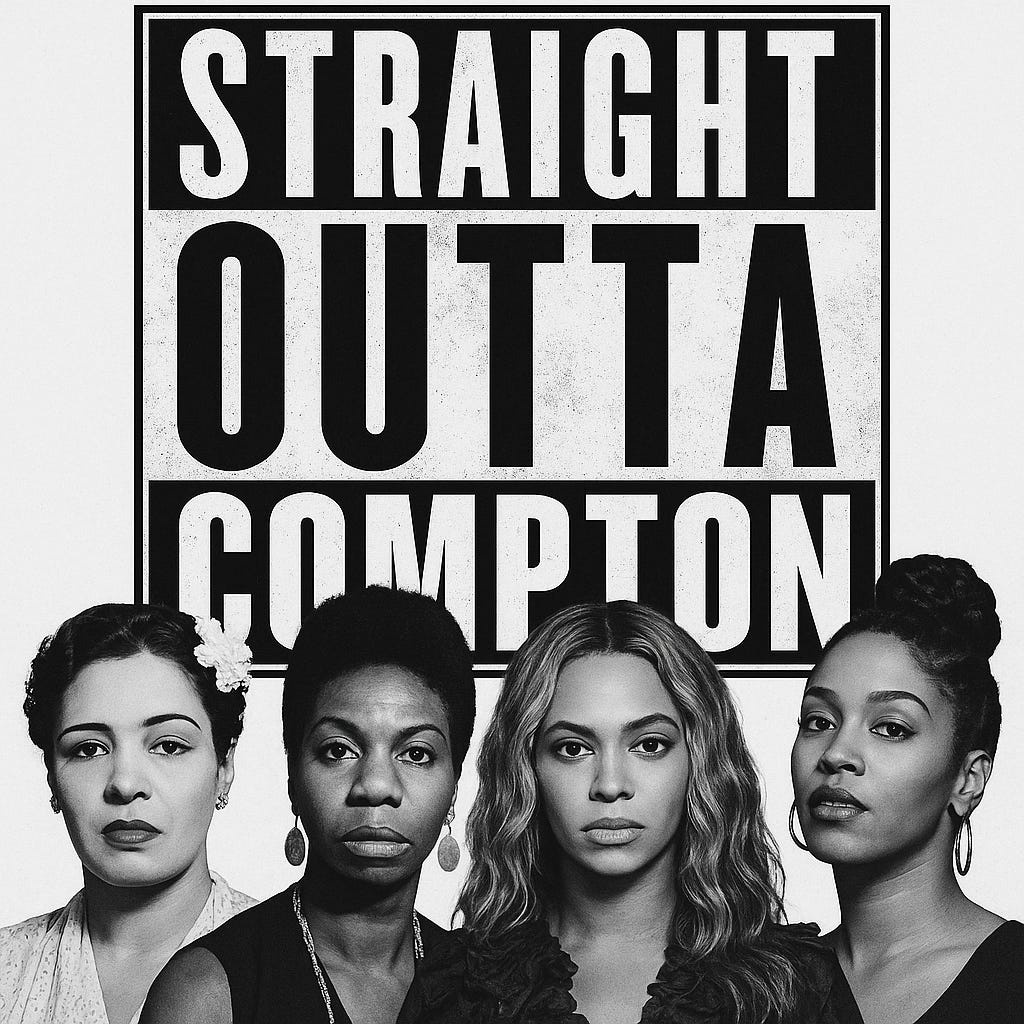
There are centuries that pass quietly.
Then there are centuries that fold themselves into a single line of music.
This one begins with a woman forced to sing perfectly in order to be allowed to speak.
It travels through women who refused that bargain.
It climbs into queer rooms shining under a mirror ball.
It breaks into the open air when kids with nothing built a media system out of turntables and hunger.
It reaches the present moment where protest has become survival rather than persuasion.
And it ends with three voices standing at the edge of a fractured civilisation.
Kendrick Lamar.
Beyoncé Knowles Carter.
Janelle Monáe.
The American protest song did not move in a straight line.
It twisted.
It adapted.
It survived.
It changed its own rules every time the country invented new ways to ignore it.
BILLIE HOLIDAY
THE WOMAN WHO HAD TO SING PERFECTLY TO BE HEARD
Billie Holiday walked into a room that did not want the truth.
She opened her mouth and described a lynching.
She sang in perfect phrasing because any imperfection would be used against her.
The audience would call the song flawed instead of the country flawed.
Her voice was both evidence and shield.
Strange Fruit is the beginning of this arc.
Horror set to beauty.
Truth smuggled in through technique.
A wound disguised as art.
NINA SIMONE
THE MOMENT THE TRUTH STOOD UP AND STOPPED APOLOGISING
Nina Simone shattered the bargain Holiday lived under.
Her talent was too large for any room to contain.
Her rage was precise.
Her music became indictment rather than testimony.
Mississippi Goddam was not an artistic choice.
It was an emergency.
She took the truth and threw it like a brick through the window of American society.
She told the country that she would not sing gently about murder.
She forced the audience to face the truth.
DISCO
THE SANCTUARY THE COUNTRY TRIED TO BURN
After Simone, the culture machine worked hard to make protest quieter.
Radio softened soul.
Labels co opted dissent.
Television wrapped despair in safe packaging.
The truth moved underground.
Disco became the hiding place for Black people, queer people and anyone who lived outside the borders of white American comfort.
It was not just a genre.
It was a liberated zone, sustained by sound and sweat and chosen family.
Then came Disco Demolition Night.
A white crowd burned the records on a baseball field and told themselves it was a joke.
Everyone who lived in the sanctuary understood exactly what it meant.
It was not about taste.
It was about erasure.
Disco was joy and visibility for the people the country wanted to forget.
The bonfire made the truth unmistakable.
EARLY RAP & HIP-HOP
THE MOMENT BLACK AMERICA BUILT ITS OWN MEDIA SYSTEM
When you burn someone’s music, they do not stop creating.
They build their own system instead.
Rap grew out of the parts of America that no one covered.
It was not a genre at first.
It was news.
It was testimony.
It was economic analysis.
It was the first time the American protest song no longer needed gatekeepers or permission.
Grandmaster Flash and Melle Mel mapped the cocaine economy in real time.
NWA described policing from inside the communities that were routinely targeted.
Early rap did not speak truth to power.
It created its own tower of power in the form of studios, labels, distribution channels and business empires.
Rap became parallel media.
A sovereign narrative system that spoke directly to its own people.
No room could silence it.
No critic could grade it.
The mic was finally in the hands of the people who needed it most.
KENDRICK LAMAR
THE SOUND OF A BROKEN NATION SINGING TO ITSELF
Kendrick Lamar’s arrival marks a new phase.
The bridge is broken.
The country is split into incompatible realities.
Kendrick does not write to change the mind of the state.
He writes to hold together a community living on the edge
Alright became the chant of the Black Lives Matter era.
It was not a plea for equality.
It was a survival code.
It was people using music as armour in a country that had placed them directly in harm’s way.
Kendrick is the point where the protest song stops speaking to America and starts speaking only to those who walk the same streets and carry the same grief.
It is the moment protest becomes internal rather than national.
Not persuasion.
Protection.
BEYONCÉ KNOWLES CARTER
THE WOMAN WHO BUILT HER OWN EMPIRE FROM THE ASHES OF THE INDUSTRY
Riot Women established the truth clearly.
Women, especially Black women, had to be perfect to be heard.
Their quality was policed.
Their bodies were policed.
Their anger was policed.
Beyoncé is the generation that broke that system.
She did not ask the industry for space.
She built her own.
She turned her art into structure.
She turned structure into business.
She turned business into sovereignty.
She is not a protest singer in the traditional sense.
She is what happens when protest becomes ownership.
She is the descendant of Simone’s defiance and Holiday’s grief and disco’s survival and early rap’s empires.
She stands on a stage she owns and sings Freedom with Kendrick Lamar beside her.
Two arcs.
One word.
A century of struggle converging in a single moment.
Freedom is no longer a request directed at the country.
It is a declaration of independence inside a fractured world.
It is a statement of unity for people whom the country refuses to protect.
JANELLE MONÁE
THE FUTURE. THE FLIP. THE TURNING OF THE TABLES.
This American arc will not end with Kendrick and Beyoncé.
There is one more voice.
One more chapter.
One more rotation.
Janelle Monáe.
Monáe is the artist who stands outside every box the American establishment uses to categorise dissent.
Black.
Queer.
Non binary.
Afrofuturist.
Technologist.
Storyteller.
Political witness.
Worldbuilder
Turntables belongs at the end of this arc
because it is not a plea or a cry for justice.
It is the sound of the machine reversing.
The people who were supposed to be silent will not wait.
They are announcing the reversal of power.
They are naming the injustices.
They are flipping the script.
Monáe sings Turntables as a person who sees clearly.
They know the country is still divided.
They know the institutions are still broken.
They know the truth does not travel freely across the trenches that divide America
Turntables is the sound of a political and cultural shift in a nation that still insists it is one people while behaving like warring tribes.
Monáe does not ask the country to listen.
They speak to the people who live inside the trenches and tells them the future is theirs.
The struggle is not over.
The unity is not coming.
But the rotation is real and irreversible.
They are the final voice because they contain everything that came before them.
The witness.
The rage.
The sanctuary.
The street report.
The warning.
The declaration.
And now the future.
MY ARC ENDS BUT THE DIVIDES REMAIN
Holiday sang to a room that wanted her silent.
Simone tore the mask off the country.
Disco gave people sanctuary when the world outside was unsafe.
Rap built its own towers when no one else told the truth.
Kendrick held together a community inside a split nation.
Beyoncé built power instead of asking for it.
Monáe flipped the table and told the truth about the fracture that defines this century.
This is the end of my American protest arc.
Not triumph.
Not closure.
A warning.
The American protest song has reached its final form.
Not a plea for unity.
A message to the future.
We are still here.
We are still fighting.
The table is turning.
The old world is fading.
The new world is being written by the people who refused to disappear.
This is my last American chapter.
And the next rotation has already begun.
Truth. America needs to change. Its flaws hold it back so much, and cause so much suffering.
That’s fire 🔥 as always!!!!!