


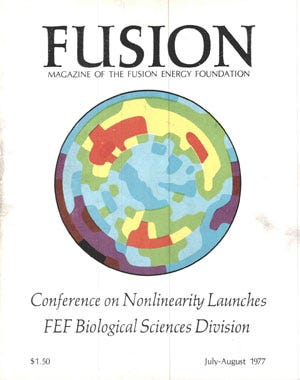
The airport, 1979
For most of the 1970s and 1980s, if you passed through a large American airport you were likely to be approached by someone selling a magazine called Fusion.
The magazine was real. It was well produced, technically literate, and by 1980 it claimed eighty thousand subscribers, which made it one of the more widely read popular science publications in the United States. It ran alongside a companion technical publication, the International Journal of Fusion Energy, which looked and read like a peer-reviewed journal. Both were published by the Fusion Energy Foundation, a non-profit body founded in 1974, with working scientists on its boards, seminars in its programme, and members who gave evidence at legislative hearings. One senior figure in the American fusion establishment said publicly that the field owed it a debt of gratitude. It was described, without obvious irony, as the largest private supporter fusion had.
It was also a LaRouche organisation, founded on Lyndon LaRouche’s initiative, run day to day by movement insiders, and operating from 231 West 29th Street in New York until 1984, when it moved to 20 South King Street in Leesburg, Virginia. Readers of Part 5 will recognise that address.
The end came in stages. The Internal Revenue Service revoked its tax exemption in September 1985. In July 1986 the New York Attorney General announced fines totalling seventeen million dollars against the Foundation and two affiliated publishing entities for misleading donors about how funds were used, and in October filed to dissolve the corporation and bar its directors from soliciting in the state. That same month several hundred federal and state officers raided the movement’s offices. In April 1987 prosecutors obtained an involuntary bankruptcy against the Foundation and its sister companies to settle contempt fines that had reached $21.4 million. LaRouche was convicted of mail fraud in 1988. The magazine was succeeded by another, under a different name, which is still published.
What matters for this part is not the collapse. It is the thirteen years before it, and specifically the fact that the science was not fake.
That is the thing most accounts of the Fusion Energy Foundation get wrong, and getting it wrong destroys the lesson. The Foundation was not selling a hoax. Fusion research was and is a serious field. The scientists it put on platforms were real scientists doing real work, and some of them were glad of the attention. The technical journal was technical. Nothing in the enterprise required a single false statement about physics.
It required only that fusion be the subject.
Why fusion pays forever
Fusion has three properties. Each is unremarkable alone. Together, and only together, they make it the most efficient instrument yet devised for converting enthusiasm into money on a permanent basis.
It is genuinely serious. This is the load-bearing property and it is the one that fraudulent schemes cannot borrow. Association with fusion confers real credibility, not counterfeit credibility, because the underlying work is real. A body that convenes fusion physicists is convening physicists. A company that publishes confinement results has published results. The legitimacy transfers, and it transfers to whoever stands nearest, because there is no mechanism by which a field can decline to legitimise its own advocates.
It cannot be falsified on any horizon that matters. Commercial fusion has been described as roughly thirty years away for roughly seventy years. That is usually told as a joke. It should be read as a specification. Thirty years is longer than a fund’s life, longer than an executive’s tenure, longer than an electoral cycle, and longer than the memory of the financial press. Within any period in which a backer could hold you accountable, no outcome can arrive that proves you wrong. Failure to deliver commercial power is not evidence of failure. It is the expected condition, indefinitely, and it is indistinguishable from being on schedule.
It is morally unimpeachable. The product is limitless clean energy. Opposing it is not a policy disagreement, it is a position against abundance, against the climate, against the future and against the poor. This forecloses the ordinary social mechanism by which unpromising ventures get talked about honestly in public, because the sceptic is required to sound like a scold.
Now combine them. The first property means the credibility is real, so scrutiny finds real substance and stops. The second means no result within the accountability window can end the story, so the story never ends. The third means nobody wants to be the person who ends it anyway.
The consequence is a funding instrument that does not have a natural terminus. Ordinary ventures conclude: they ship, or they fail, or they are found out. A fusion venture does neither. It produces milestones. Each milestone is genuine and each is incremental, and the function of a genuine incremental milestone is to license the next raise. Record confinement duration, first plasma in a new machine, a scaling result, a materials advance: all real, all publishable, none terminal. The pattern is not deception. It is that a field with a long horizon and continuous partial progress generates an unlimited supply of honest reasons to ask for more money.
The failure mode is therefore not exposure. It is exhaustion, and exhaustion is slow and quiet and can be deferred by finding the next backer, which is easier than it sounds because each raise validates the last.
The valuation point, which is the one this series needs
There is a fourth property, and it is the one that makes fusion matter to an argument about intermediaries rather than an argument about science.
A pre-revenue asset with a commercial horizon in the 2030s has no cash flows to discount. It has no earnings, no comparable multiples, and no market price. Its value is therefore established by exactly one thing: the price at which someone last transacted in it.
Consider what that means for the different parties around such an asset.
For the scientists it means very little, because they are doing the work either way.
For the holders it means that value is created by transactions rather than by results. A new round at a higher price raises the carrying value of every existing holding without anything having been built. This is not fraud and it is not even unusual. It is simply how private marks work when there is nothing else to mark against.
And for the intermediary it means the asset is perfect, because the intermediary is paid on transactions. A venture that has no natural terminus, whose value can only be set by the next round, and whose story cannot be falsified inside the accountability window, is an asset that generates fee events indefinitely. Not because anyone intends it to. Because that is the shape of the thing.
That is the whole argument, and it should be stated as flatly as possible so it can be tested. Fusion is an unusually efficient instrument for converting money into standing and standing back into money, and it is efficient because of its structural properties, not because of who is using it. The Fusion Energy Foundation exploited those properties from 1974 until the courts closed it. That does not make it the ancestor of anything that came later. Nobody had to learn the technique. The technique is a property of the subject, available to anyone who arrives at it, and it will be rediscovered by every party that arrives at it, forever, for as long as fusion remains thirty years away.
Which brings us to a merger announced in December 2025.
Part 9 ended with a claim that was, by design, difficult to falsify from a single document. The claim was that the intermediaries are paid at signing, the controlling shareholder holds at zero cost, the losses sit with the cash investors, and the position is indifferent to which gambler wins. It was assembled from nine parts of separate evidence: donation registers, cap tables, leaked beneficial-ownership files, a dinner in Brussels, a Lords Register entry, a switchboard in Tehran. Each line item was documented. The total was an argument.
This part is an audit of that argument against a single company, over fourteen months, using nothing but filings the company made itself.
The company is Trump Media and Technology Group Corp, Nasdaq ticker DJT, Central Index Key 1849635. Between May 2025 and December 2025 it did two things. It raised two and a half billion dollars and spent it on digital assets. Then it agreed to hand roughly half its equity to the shareholders of a private fusion company. Both transactions are fully disclosed. Neither has been read against the other in public.
The finding, stated at the front so the reader can test everything that follows against it: every element of the Part 9 thesis appears in the primary record of this one issuer, and appears there without requiring anybody to have coordinated anything. The intermediaries took roughly eighty million dollars at closing on a raise that has since lost more than half its value. The controlling shareholder holds thirty-six million shares acquired for nothing. The cash investors are down. And the transaction that follows brings a Gulf sovereign fund, an oil major with a Venezuela exposure, a brokerage dynasty with a documented Oval Office meeting, and a fund position that may still trace to a Russian state vehicle, onto the register of the sitting president’s flagship listed company.
Negative findings, stated first
The methodology of this series requires that what was looked for and not found is stated before what was found. Five things.
There is no evidence of coordination between the two transactions. No document reviewed suggests that the parties to the May 2025 raise knew of, planned for, or benefited by design from the December 2025 merger. The argument of this part does not require it and does not assert it.
Scott Bessent has no documented relationship to either transaction. The Treasury Secretary appears in this material once, in a White House photograph of an April 2025 Oval Office meeting with the President, Commerce Secretary Howard Lutnick and Charles Schwab. That is co-presence and nothing more. Under the tiering used throughout this series it is tier (c), and tier (c) is not a finding. It is recorded here because it is a genuine node in the wider network and because omitting it would be selective, not because it carries weight.
The 2017 supercomputer allocation was not a political award. TAE Technologies was admitted in November 2017 to the Department of Energy’s Innovative and Novel Computational Impact on Theory and Experiment programme, which gave it time on a Cray XC40 at Argonne. INCITE allocations are made annually by peer review on scientific merit and computational readiness by the Office of Science, through the Argonne and Oak Ridge leadership computing facilities. No White House sits in that process. Any account of this material that describes a president granting a supercomputer to a fusion company is wrong, and would be dismantled within a paragraph by anyone who works in the field.
The residue worth recording, and worth recording as a question rather than a finding, is one of sequence. Ernest Moniz, Energy Secretary until January 2017, joined the TAE board in May 2017. The INCITE admission followed in November. Peer review is a real filter and the sequence is very probably nothing. The 2018 INCITE award list is public and the question is therefore cheaply answerable by anyone who wants to answer it.
TAE Technologies is not a doctrinal descendant of anything in Parts 2 or 5. It is a company of roughly four hundred people, founded in 1998 out of the plasma physics group of Norman Rostoker at the University of California, Irvine, with peer-reviewed published results, a decade-long research collaboration with Google, and a board that has included a former US Energy Secretary, a former chief executive of General Electric and a former chief executive of Morgan Stanley. There is no lineage claim available here and none is made. The argument in this part about fusion is structural, is set out in the opening section, and the distinction matters enough that it is restated where the transaction is discussed.
No current direct Russian state holding in TAE has been established. What has been established is set out in its place. The company’s own denial is the interesting document, and the denial is not a finding of absence.
One further caution, on the weakest link, named here as the method requires rather than buried at the end. The connection between the capital structure of the May 2025 raise and the composition of the December 2025 cap table is thematic, not evidential. They are two transactions by one issuer. A hostile reader will say that placing them side by side is the analysis rather than a finding of it, and that reader is entitled to say so. What is offered here is that each transaction, separately and on its own documents, exhibits the same distribution of risk and reward, and that a pattern appearing twice in fourteen months at one issuer is worth naming even where the mechanism joining them is the incentive structure rather than a contract.
The operating business
Take the trading company first, because everything after it depends on understanding how small it is.
For the quarter ended 31 March 2026, net sales were $871,200. Cost of revenue was $1,501,000. The company spent more delivering its revenue than the revenue was worth. Against that sat general and administration of $37.9 million and research and development of $8.4 million. The net loss for the quarter was $405.9 million.
Two details make the revenue figure weaker than it appears.
The first is concentration. One advertising platform accounted for 66.5 per cent of total revenue. A single counterparty therefore supplied something near $580,000, and the commercial existence of the operating business rests on that one relationship.
The second is that some of the revenue is not cash. The filing carries a non-cash barter expense of $1,035,000, and the unearned revenue accounting policy expressly contemplates services provided in a barter transaction. Unearned revenue moved from $30,400 to $1,066,700 during the quarter.
The consolidated variable interest entity, which houses the Truth.Fi and Yorkville America fund vehicles, held total assets of $3,723,700. The entire asset-management business is three and a half million dollars.
This is the entity that raised two and a half billion dollars.
The first raise
In May 2025 the company raised approximately $2.44 billion gross, in two parts: about $1.44 billion of common stock sold to roughly fifty institutional investors at $25.72 per share, and $1 billion of zero-coupon convertible senior secured notes. Net proceeds were about $2.32 billion.
The difference is roughly $120 million. Forty million of that is the four per cent original issue discount on the notes. The remainder, on the order of eighty million dollars, is fees.
Those fees went to a defined set of intermediaries. Yorkville Securities and Clear Street were co-lead placement agents. BTIG and Cohen and Company were co-placement agents. Cantor Fitzgerald and Co acted as financial adviser. All of it was payable at closing.
The proceeds bought 11,542 bitcoin at an average of about $118,522 per coin.
By 31 March 2026 the company held 9,542.16 bitcoin at a cost basis of $1,131,024,300 and a fair value of $647,121,800. It also held 756,079,523 Cronos tokens at a cost of $113,949,300 and a fair value of $52,953,500. The bitcoin was 42.8 per cent below cost. The Cronos was 53.5 per cent below cost. The combined unrealised deficit against cost was $544.9 million.
The Cronos position is worse than that figure suggests, because it cannot be sold. The company is restricted from disposing of 615,984,303.6 tokens, roughly 81.5 per cent of the holding, with staged releases of fifteen to twenty-five per cent at intervals and full release no earlier than 26 February 2029. The issuer is a captive holder of another exchange’s token, marked at half of cost, locked for three years.
The shares sold at $25.72 closed at $21.88 on 4 June 2025. The equity was below issue price within days of closing. The registered resale shares represented 52.8 per cent of the public float and 30.55 per cent of shares outstanding.
Here is the distribution, in one paragraph. The intermediaries received approximately eighty million dollars at signing and retain all of it. The cash investors are down more than half. The Donald J. Trump Revocable Trust, holding about 41.1 per cent of voting power as at 25 February with Donald Trump Jr as sole trustee and the President as sole beneficiary, includes thirty-six million shares received as earnout consideration in April 2024 at no cost. A holding acquired at zero basis cannot register a loss. It can only be diluted, and dilution is not a payment.
That is the Part 9 formulation, in a single issuer’s own numbers, without an inference anywhere in it.
The circle
The structure of the notes is where the document stops being a story about a bad trade and becomes a story about who bears risk.
The notes carry a zero coupon, a four per cent original issue discount, an effective rate of 4.80 per cent, and a nominal maturity of 29 May 2028. The conversion rate is 28.8 shares per $1,000, giving a conversion price of $34.72. The share price implied by the filing’s own restricted stock unit disclosure, aggregate intrinsic value of $26,995,500 across 2,908,997 units, is $9.28. The conversion option is worthless and no rational holder will exercise it.
What remains is the repurchase right. Each holder may individually require the company to buy its notes back for cash at par on 30 November 2026. There is no consent threshold and no majority vote. That is why $953.3 million sits in current liabilities against total current assets of $1,051.6 million. The balance sheet turns on one date.
Now read Note 10. The company received $1 billion from noteholders. It delivered $1 billion to a collateral agent. It then used the cash delivered to the collateral agent to purchase bitcoin and bitcoin-related assets in order to satisfy the required loan-to-collateral ratio. The collateral securing the loan was bought with the loan.
The haircut factor applied is 0.5263157895, which is one divided by 1.9, so bitcoin counts at about 52.6 cents in the dollar. As at 31 March the collateral comprised $30.5 million of restricted cash, $268.9 million of equity securities and $289.0 million of bitcoin, being 4,260.73 coins. Apply the haircut and something in the region of $451 million of counted collateral stands against $1 billion of principal.
And then the company says, in its own June 2025 prospectus risk factors, that the collateral held by the collateral agent may not be available to it to repurchase or repay the notes, because release is governed by the indenture, and the release triggers are mechanical: a portion when principal outstanding falls to $500 million, a further portion at $250 million.
Follow that to its conclusion. A billion dollars was raised. A billion dollars was spent on assets. Those assets are held by a collateral agent and are contractually unavailable to repay the debt they secure until the debt is already mostly gone. To satisfy a par put on 30 November 2026 the company must find the money somewhere else. The prospectus says as much, noting that it may need to refinance or obtain a waiver from holders, and that a failure to purchase validly tendered notes would be an event of default.
This is not an inference drawn by a journalist. It is the issuer’s description of its own capital structure.
The redaction
Exhibit 4.1 to the Form 8-K of 30 May 2025 is the indenture governing the notes. The trustee and collateral agent is U.S. Bank Trust Company, National Association. The filing was signed by Scott Glabe as General Counsel.
The indenture is filed redacted, under Regulation S-K Item 601(b)(10)(iv), with the registrant undertaking to furnish an unredacted copy to the Commission on request. That provision permits redaction of information the registrant treats as both immaterial and likely to cause competitive harm if disclosed.
Two things sit inside the redaction that matter.
The first is the collateral coverage covenant. The narrative description in the 8-K confirms that the 1.0 to 1 loan-to-collateral ratio was a test to be satisfied within forty-five days of closing, which is to say a one-time test rather than a maintenance covenant. But the covenant list separately includes an obligation to adhere to collateral coverage requirements. An ongoing coverage covenant therefore exists. Its terms appear in no public document. That is precisely the gap in which the roughly $451 million of haircut-adjusted collateral against $1 billion of principal would have to be reconciled.
The second is the definition of Fundamental Change. The 8-K states that the definition includes certain business combination transactions involving the company and certain delisting events, and that on a Fundamental Change holders receive a par put on a date forty to seventy business days after notice. A Make-Whole Fundamental Change would additionally ratchet the conversion rate.
The TAE merger is a business combination. Whether it falls within the definition determines whether closing it hands every holder a cash put at par, potentially earlier than 30 November and potentially while the merger is in flight. The wording that answers the question is in the redacted text.
A billion dollars of secured notes at a company whose controlling shareholder is the revocable trust of a sitting president, governed by a document withheld from the public on grounds of competitive harm. Whatever else it is, it is not a small thing to have gone unremarked.
What the company says the rules do not cover
One paragraph of the June 2025 prospectus is worth more to this series than any characterisation could be, because it is written by the issuer’s own counsel.
The company states that it is not subject to, and does not voluntarily comply with, the Investment Company Act and the Investment Advisers Act regimes, and that in consequence its use of leverage, its custody arrangements, its ability to transact with affiliated parties and its investment activities are not subject to the requirements those regimes impose. Strategy is set at board discretion, with no shareholder or regulatory approval required to change it.
Set that beside what the company actually does. It holds roughly two-thirds of its assets in digital assets and correlated securities. It writes a covered-call options book. It pledges collateral to counterparties with relending rights. It manages third-party fund products through a consolidated entity.
Every one of those activities is the activity the two Acts were written to regulate. The issuer states on the record that neither applies to it.
This is the enforcement gap of Part 9 in its purest form, and it is not a gap in the sense of a rule broken and unpunished. It is a gap in the sense that compliance and impunity have become the same act. The company is entirely correct about its regulatory position. That is the problem.
The footnote
In Note 4, one sentence:
We hold covered-call options on 4,000.00 bitcoin with a counterparty to hedge our exposure to bitcoin’s volatility, which requires us to maintain 2,000.00 bitcoin as collateral that the counterparty can rehypothecate at their sole discretion.
The company of the sitting President of the United States has granted an unnamed counterparty the unilateral right to relend two thousand bitcoin. Sole discretion. Counterparty unidentified. Disclosed in a footnote.
The accounting consequence is that the coins leave the balance sheet, because control has gone. Emmett Gallic of Arkham Intelligence made this point publicly in March 2026, off the annual report, and the crypto trade press has repeated it since as a custody and accounting matter.
Nobody has framed it as what it also is. The pledged collateral of a politically controlled issuer sitting in the hands of a party the public cannot name, available to be lent on at that party’s discretion. The argument of Part 3 was that whoever holds the payment infrastructure holds the prize. This is the same proposition one layer down, at the level of the asset itself, and it is in a primary filing.
The second-quarter filing extends it. The company disclosed for the first time that it has placed bitcoin with third parties through lending, placement and other yield arrangements, that these create counterparty credit, insolvency, liquidation and custody risks, that some counterparties may relend the assets, and that the deployed assets carry no deposit-style insurance protection. No numerical limits were published.
The second raise, which is not a purchase
In December 2025 the company announced a merger with TAE Technologies, valued above six billion dollars.
The structure is widely misdescribed and the misdescription flatters the buyer. This is not a six billion dollar company being acquired for two hundred million. It is an all-stock merger in which TAE shareholders are expected to hold approximately half the combined entity on a fully diluted basis. The $200 million advanced at signing is an unsecured convertible note, payable within five business days, with a further $100 million due on the initial filing of the Form S-4. It is interim working capital, not consideration. A termination fee of $90 million runs both ways, with up to $30 million of expense reimbursement.
So the correct sentence is that the existing investors in a private, pre-revenue fusion company are to receive approximately half of the sitting president’s flagship listed company, in exchange for an asset whose first commercial machine is not expected before 2031 at the earliest.
The $200 million note is carried at $200 million. The company’s own Level 3 fair value measurement put it at $149,420,400 as at 31 December 2025 and $185,590,000 as at 31 March 2026. The issuer marked its own newly advanced loan at roughly seventy-five cents in the dollar at inception. Interest is entirely paid in kind, with interest receivable moving from $498,600 to $3,950,700.
That is unsecured paper on a private company, and it is among the assets that would need to be liquid on 30 November 2026.
Governance: a nine-member board, two designees from each side, five jointly selected independent directors, chaired by Michael B. Schwab. The Donald J. Trump Revocable Trust holds about 42 per cent of the company and has committed to vote in favour. TAE holders representing about 26 per cent have signed support agreements.
The register
Forbes published the cap table on 23 December 2025, five days after the announcement, in a piece by Christopher Helman. It is the single best source on this transaction and it has not been meaningfully followed anywhere. TAE declined to confirm which investors still hold, or in what size, citing confidentiality agreements.
The names, and what each one already touches in this series.
Kuwait Investment Authority. Invested in 2021 and again in 2025. The Kuwaiti government bought an apartment in Trump World Tower in 2012. The Kuwaiti embassy moved a gala for six hundred people to Trump International in Washington in 2017. The Emir received the Legion of Merit in 2020. The Gulf-capital leg of Part 9 has, in this transaction, an actual equity line into the president’s company rather than proximity.
Chevron, through Chevron Technology Ventures, in 2021 and 2025. Chevron is the only remaining American oil company in Venezuela and its chief executive has met the President to discuss it. Venezuela sits inside the contested-legitimacy tier of the coercive-measures taxonomy this series uses. That makes it a live thread rather than colour.
Google, with a decade of DeepMind collaboration on plasma containment simulation and an investment in the June 2025 round of more than $150 million alongside Chevron and New Enterprise Associates.
Michael Schwab, incoming chairman of the combined company. First invested $50,000 in 2002 and has said he joined every round since. Runs Big Sky Partners. His father Charles Schwab gave $1 million to the 2017 inaugural committee and met the President, the Treasury Secretary and the Commerce Secretary in the Oval Office in April 2025.
That last one requires care, and it is worth being explicit about what is and is not being said. The Schwab name now touches three separate things in this material: the original Truth.Fi custody arrangement, the incoming chairmanship of the merged entity, and a documented White House meeting with two figures who appear elsewhere in this series. Three appearances of a surname is a convergence worth recording and it is not, on its own, a relationship. What would convert it is a document. None has been found.
Rusnano. The Russian state corporation led a $150 million round into what was then Tri Alpha Energy in October 2012, reported at the time by Reuters. Anatoly Chubais, then its chief executive, took a board seat and appears on TAE materials as a director until at least 2019. Chubais left Russia after February 2022. Under Sergei Kulikov, Rusnano has sold a substantial part of its portfolio.
Asked about the current position, TAE said it has no Russian-based shareholder who will own one per cent or more of the combined company after the merger. A source told Forbes that the Rusnano exposure is probably not direct but a limited partner position in a fund.
Read the construction of that statement. It is bounded three separate ways in a single sentence: by residence, so Russian-based rather than Russian-owned or Russian state-controlled; by threshold, at one per cent; and by timing, post-merger rather than now. It does not say Rusnano exited. It does not address indirect holdings through a fund, which is precisely what the source describes.
This series has seen that drafting before. In December 2025 the House of Lords Commissioner for Standards dismissed a complaint against Lord Bletso on the basis that a shareholding fell below the £100,000 registration threshold, without addressing the paragraph 19 declaration duty, which is broader than registration and carries no threshold. Both answers are accurate. Both answer a question that was not the one asked. The threshold-bounded reply to an unbounded question is not a lie and is not an evasion in any actionable sense. It is the standard instrument, and it works because the reader supplies the missing generality.
The document that would settle it is the Form S-4, which must disclose principal stockholders.
Also on the register: Goldman Sachs, Venrock, Cercano Management as successor to Paul Allen’s Vulcan, New Enterprise Associates, the Wellcome Trust, the Samberg family, and directors including Jeff Immelt, John J. Mack and Ernest Moniz.
One item circulating in connection with this cap table should be named and discarded. There is internet folklore associating one TAE investor with the identity of the pseudonymous creator of bitcoin. It has no evidentiary basis of any kind and it appears here only so that its absence from the analysis is deliberate rather than accidental.
Why fusion, restated against this transaction
The opening of this part set out why fusion functions as a permanent funding instrument. It is worth restating the boundary of that argument here, at the point where it touches a named company, because the temptation to overreach is strongest exactly here.
There is no lineage claim. TAE Technologies has no connection to the Fusion Energy Foundation, to LaRouche, or to anything traced in Parts 2 and 5. Asserting one would be false and the argument does not need it.
What the argument says is that the three properties are properties of the subject. They were available in 1974 to a movement that needed respectability and money, and they are available in 2025 to a listed company facing a put date with a dead conversion option and a media business earning less than it costs to run. Neither party learned the technique from the other. Both arrived at the same asset and found the same characteristics waiting there.
Apply the fourth property, the valuation point, to the transaction directly. The target has no revenue and no commercial machine expected before 2031. Its value is therefore established by transactions, and the transaction being conducted values it above six billion dollars against an acquirer whose entire quarterly revenue is $871,200 and whose market capitalisation implies a share price of $9.28. There is no cash flow on either side of that exchange to anchor it. What is being exchanged is one narrative asset for another, at a price that exists because the parties agreed it exists.
And the intermediary on the transaction is paid six million shares on closing, whatever the reactor does.
The vocabulary in and around the merger announcement belongs in the contamination file rather than the analytical voice, quoted as framings under analysis: “energy dominance”, the race with China for artificial intelligence. Note where those phrases sit. They are the 2025 equivalent of what the Foundation’s magazine was selling in the airports, which was never fusion. It was national purpose, technological optimism and a future worth paying for now.
Who noticed
The distribution of attention is itself evidence, and it is worth setting out because it explains how a structure this legible stays unwritten.
Wendy Siegelman flagged the Rusnano and Chubais history within hours of the merger announcement. Christopher Helman at Forbes published the full cap table five days later and obtained the company’s bounded denial. Emmett Gallic at Arkham identified the relending arrangement in March 2026 and explained its accounting consequence correctly. A credit analyst writing at junkbondinvestor.com published a note on 16 May 2026 pricing the notes to the November put and identifying that the pledged collateral does not cover the claim. Lookonchain and Arkham track the wallet movements continuously and the crypto trade press reports each one.
Congress is engaged, and engaged elsewhere. Representative Ritchie Torres wrote to the Chair of the Securities and Exchange Commission on 20 July 2026 regarding the sale of low-latency access to the President’s social media posts. Senators Warren and Schiff followed on 28 July on the same subject. Senators Warren and Blumenthal wrote separately regarding the memecoin. None of the letters addresses the notes, the collateral structure, the relending rights or the merger cap table. None had received a substantive answer as at the second week of August.
So the pieces are all in public and each sits in a different silo. The crypto trade press owns the wallet movements and reads them as a market story. Credit analysts own the capital structure and read it as a trade. Forbes owned the cap table for one week in December and read it as a conflicts story. The political press owns the memecoin and the data feed and reads everything as an ethics story.
No one’s brief is that the capital structure and the cap table are the same story, so no one has written that story.
That is not suppression and it should not be described as suppression. It is what happens when disclosure functions as inoculation. Once the relending right is in a footnote, the footnote is simultaneously the evidence and the defence. A reporter who raises it is told, accurately, that it was disclosed. An editor asks what the story is if it was in the filing. The honest answer, that a thing being disclosed does not make it unremarkable, is true and does not survive a news conference. The material sits there, entirely public, permanently unwritten.
Two open questions and one unverified lead
Does the merger trigger a Fundamental Change? This is the most consequential unanswered question in the structure and no one appears to have asked it. If the answer is yes, closing the merger hands every noteholder a cash put at par, possibly before 30 November, possibly during the transaction. A Fundamental Change Company Notice or an issuer tender offer filing would answer it definitively.
What does the ongoing collateral coverage covenant require? It exists, it is not the forty-five-day test, and its terms are inside the redacted exhibit. Staff correspondence on EDGAR is the cheapest route to any pushback on the scope of that redaction.
Unverified. A secondary source indicates that the March 2026 annual report discloses a plan involving TAE and a further special purpose acquisition vehicle to separate Truth Social into its own listed entity. This has not been checked against the filing and should not be repeated until it has. If it holds, the transaction is not a media company acquiring a fusion company. It is a media company becoming a fusion company while the media asset is sold off through a different vehicle, and that changes the reading of everything upstream of it.
The rake, in one issuer
Part 9 argued that the house is indifferent to which gambler wins because the rake is collected on the playing rather than the winning. Here is that proposition reduced to a single company’s own filings over fourteen months.
Approximately eighty million dollars was paid to intermediaries at closing on a raise whose proceeds have since lost more than half their value. Yorkville Securities appears three times in one quarterly report: as co-lead placement agent on the raise, as merger and acquisition adviser on the TAE transaction with a fee of six million shares, and, through Yorkville America, as the registered investment adviser managing the consolidated fund entity. Cantor Fitzgerald advised. The fees are unconditional. They do not come back.
The controlling shareholder holds thirty-six million shares at zero basis, cannot record a loss on them, and saw the paper value of his position rise by a reported $450 million on the merger announcement alone, in respect of an asset whose first machine is not expected for five years.
The cash investors bought at $25.72 into a stock that closed below issue price within days and now implies $9.28, or lent a billion dollars at zero coupon against collateral their own borrower says may not be available to repay them.
And around the whole of it, arriving through a merger nobody in the first transaction planned for, comes a register containing a Gulf sovereign wealth fund, an oil major with a Venezuela exposure, a technology company with a decade of research inside the target, a brokerage dynasty whose name touches the custody arrangement and the incoming chairmanship and an Oval Office meeting, and a fund position that may still trace to a Russian state vehicle and about which the target has issued a denial bounded three ways in a single sentence.
Not one of those parties needed to speak to another. Each acted rationally inside its own position. The bitcoin was rational for a company that wanted a story. The fees were rational for the banks. The fusion merger was rational for a company facing a put date with a dead conversion option and a media business earning less than it costs to run. The Kuwaiti fund and the oil major and the search company were in the target for years before any of this and are simply still there.
What assembles itself out of those separate rationalities is a position in which the people who put in cash are down more than half a billion dollars, the people who put in nothing are up, and the people who put in nothing but advice were paid at signing and kept it.
The house did not need to rig the table. It only needed to be the one taking the rake while everybody else played.
To summarise: A company with under a million dollars of quarterly revenue, two-thirds of it from one advertiser and some of it paid in barter, raised two and a half billion dollars, spent it on an asset that halved, pledged the remains to counterparties it will not name, and then agreed to hand half its equity to the shareholders of a fusion company that will not switch on a reactor before 2031. Every element of that sentence is in a filing the company made itself. The indenture that governs the debt is redacted for competitive harm. The regulations written for exactly this activity do not apply, and the company says so in writing. On 30 November 2026 each noteholder may demand its money back in cash, and the collateral cannot be used to pay them. The house has filed its accounts. Nobody has added them up.
Back to Part 3, on stablecoin float as a private claim on public yield; Part 5, on the personnel chain from Leesburg to the cabinet; Part 6, on the gold leg; and Part 9, on the bill, the enforcement gap, and the rake on everyone’s defeat.
Wow. Great investigative writing. Chapeau!