


🕵️♀️ Introduction: When the Info War Goes Kinetic
Britain is under attack—not just from drones or saboteurs, but from memes, fake NGOs, and suspect think tank reports.
The front line isn’t just the Baltic Sea or a power station in Yorkshire—it’s also a Telegram channel run out of Serbia, a protest in Westminster backed by anonymous crypto wallets, and a podcast laundering Kremlin narratives with a Union Jack in the logo.
In a world where the weapon is often narrative—and the enemy doesn’t wear a uniform—the law needs an upgrade.
🧷 A Modern RICO for a Modern Threat
In the United States, the Racketeer Influenced and Corrupt Organizations Act (RICO) was designed to tackle the Mafia—groups structured like corporations but built for crime.
Britain doesn’t need a carbon copy.
It needs a version designed for Russian hybrid warfare—for the post-truth, post-Twitter, post-Rogue-State world.
Enter: The Racketeering and Influence for Covert Undermining Act
(AKA RICU-RICO)
🔍 How It Works: Breaking the Network, Not Just the Node
This law wouldn’t target just disinformation. That’s too narrow.
It would target the entire ecosystem of coordinated foreign influence operations—from the funders to the narrative laundromats.
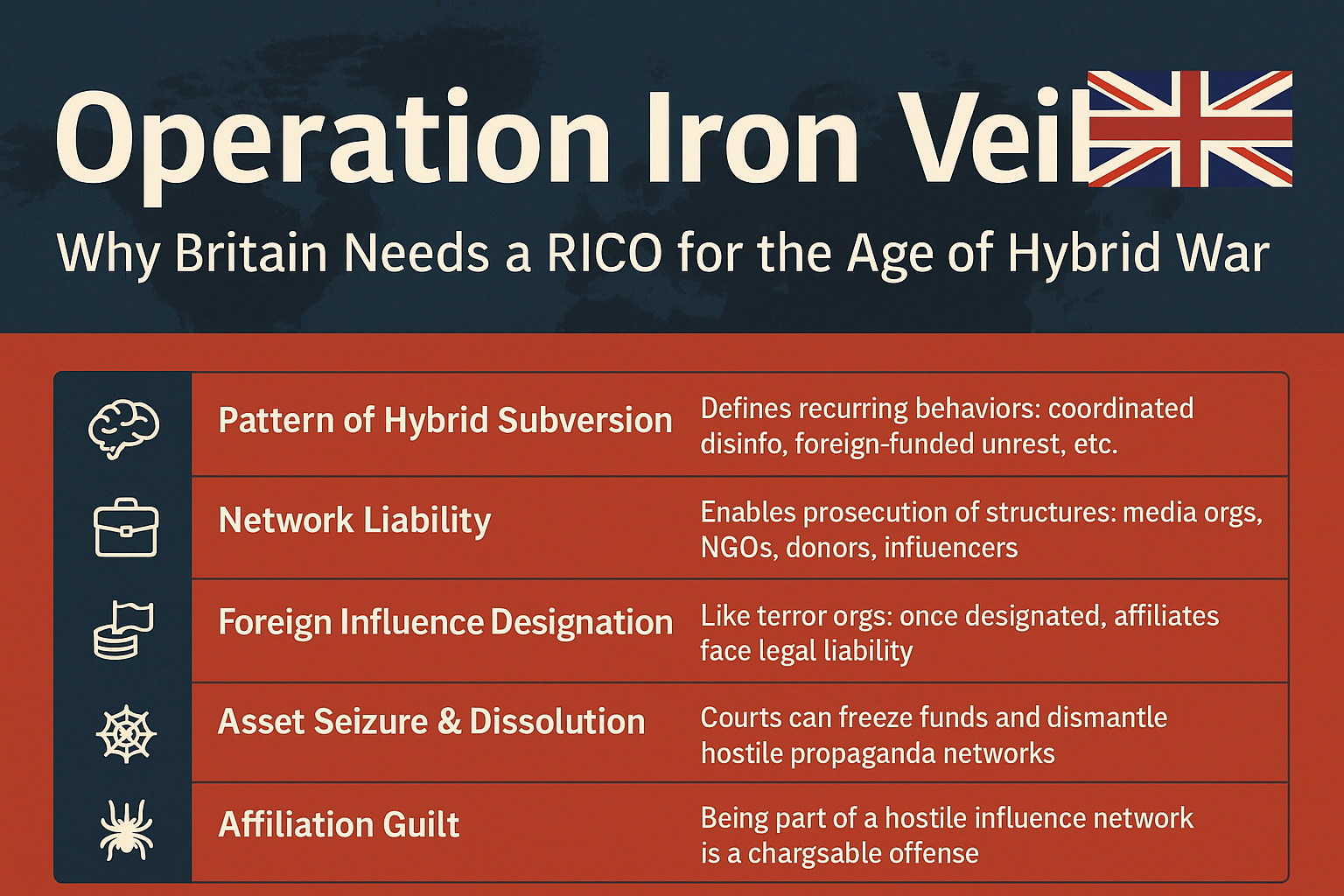
Key Features:
🔧 Built on Solid British Precedent
This isn’t some fantasy from a cyberpunk spy-cop movie. It builds directly on existing UK laws:
National Security Act 2023 – For espionage, sabotage, and foreign agents
Serious Crime Act 2007 – Already criminalizes “participation in criminal enterprise”
Terrorism Act 2000 – For designation mechanisms and asset freezing
Public Order Acts – To manage disinformation-driven protest and incitement
RICU-RICO is the convergence doctrine for all of the above.
🎭 What Would It Tackle?
“Independent” media laundering RT/PressTV narratives
“Anti-imperialist” orgs taking money from GRU-linked front groups
Crypto-funded protests coordinating with pro-Kremlin propaganda
Academics amplifying narratives tied to known Russian foreign policy lines
Podcasts, influencers, and Substacks “just asking questions” with suspicious synchrony
This is not a tool for censoring dissent. It’s a tool for dismantling hostile narrative militias pretending to be grassroots movements.
📎 The Real-World Model: RICU Already Exists
Yes, you read that right.
Britain already has a “RICU” — the Research, Information and Communications Unit in the Home Office. It coordinates counter-radicalisation messaging.
But under Iron Veil conditions?
RICU becomes the core of a new civil-legal fusion center. Intelligence feeds legal prosecution. Platforms are compelled to comply. Sanctions become structural.
Think:
AI-assisted narrative pattern detection
Real-time digital RICU-RICO graphs of influence webs
Shared legal templates across NATO partners
⚖️ Civil Liberties? Still Crucial.
RICU-RICO would include:
A designation appeals process
Whistleblower protections for journalists acting in good faith
An independent legal oversight board
Annual reports to Parliament on use and scope
The goal isn’t to chill speech—it’s to cool the fever swamp where propaganda becomes violence.
🛡️ Final Thought: A Law for a War We’re Already In
Russian warfare is asymmetric by design.
They don't send tanks through Dover.
They send funding through shell orgs in Cyprus and Turkey.
They target belief systems, not bunkers.
And they are already here.
Britain doesn’t need to wait for “boots on the ground” to fight back.
What it needs is a legal scalpel, not just a sledgehammer.
That’s what RICU-RICO would be.
Let’s make the law as modern as the threat.