
Part 6 followed the physical trade from one end to the other: free seized gas in a Moldovan breakaway turned into anonymous coin, cheap Siberian hydropower turned into metal, gold convoys leaving the Sahel and settling outside the dollar. In the middle of that argument sat a single sentence about a loop that should not exist, bauxite mined in Guinea, refined into alumina on the Shannon estuary, shipped to Siberia, smelted into aluminium, and sold through a Moscow trader into the supply chains of sanctioned Russian weapons makers, with almost every node owned by the same group. This part opens that node. It is worth a chapter of its own, because the refinery on the Shannon is where the whole series argument becomes physical and local at once, and because the story of how it has stayed open, and stayed legal, is a clean miniature of everything the series describes.
Start where Part 6 started, with power.
I. The base layer, again
A data centre converts electricity into a model output. A crypto mine converts electricity into a freshly minted coin. An alumina refinery converts electricity, and a great deal of natural gas, into a white powder that is the only economically significant feedstock for aluminium. The machine is the same machine Part 6 described: a device for turning continuous baseload energy into a tradable asset, sited where the energy is available and the oversight is tolerant. Aughinish is the largest such device in Europe.
The numbers make the point on their own. Aughinish runs entirely on natural gas. It operates the largest combined heat and power plant in Ireland and Britain put together, around 150 to 160 megawatts, and after meeting its own demand it exports the surplus to the national grid, enough on the plant’s own account to power roughly 200,000 Irish households. Even with that on-site generation, the refinery draws up to 15 per cent of Ireland’s total daily gas demand to make its product, a figure established by the March 2026 Irish Times, IStories and OCCRP investigation. In a briefing the plant supplied to the Irish government in late May 2026, seen by RTÉ, Aughinish stated that it contributes up to 25 million euro a year towards the upkeep of the national gas grid, and warned that any move to sanction its sales of alumina to Russia would carry consequences for Ireland’s gas and electricity networks.
Read that warning twice, because it is the architecture of the whole case in a single document. A Russian-owned refinery, feeding Russian smelters, has made itself load-bearing for the energy security of the European state that hosts it, and is now citing that dependence as the reason it should not be sanctioned. The plant did not need to plan this as leverage for it to function as leverage. It simply grew until switching it off meant switching off part of the grid. That is the same logic Part 6 found at the bottom of the crypto trade, energy converted into an asset that the surrounding institutions then cannot easily unwind, run here not in a frozen conflict zone but on a Special Area of Conservation in County Limerick, beside a designated bird sanctuary the company itself manages.
II. The plant two states cannot afford to lose
The leverage is not only the grid. It is also the mess.
Aughinish has operated on the estuary since 1983, and across four decades it has accumulated a bauxite residue disposal area, the red mud, that is now a permanent feature of the Shannon shoreline and a permanent liability. In 2018 the plant entered an agreement with Ireland’s Environmental Protection Agency to fund the closure, restoration and aftercare of the site, with figures reported up to 28 million euro committed over a 35-year horizon should the refinery shut. Whether that sum would cover the actual cost is not established, and the honest reading is that nobody knows. What is established is the shape of the bind it creates. If Ireland sanctioned or seized the plant and it closed, the state would inherit both a hole in its energy supply and a clean-up on its most sensitive estuary, and the company’s own briefings are careful to remind it of both. The refinery is too useful to lose and too dirty to abandon, and those two facts are not in tension. They are the same retention mechanism viewed from two sides.
This is why the Irish position has been consistent across two governments and one full-scale invasion. Dublin lobbied to keep the plant outside the 2018 United States designation, and lobbied again to keep it outside the European measures that followed February 2022, on the stated grounds that it is a rare European processing asset and a major regional employer, with more than 400 people directly on the books and many hundreds more dependent on it. The framing offered in public is that Aughinish is a “strategic asset,” and on the narrow industrial logic the description is fair: Europe has almost no large-scale alumina refining of its own, and is trying, at exactly this moment, to rebuild domestic processing capacity it spent thirty years offshoring. The difficulty is only that the strategic asset is owned by the country the rest of the policy is built to constrain.
That difficulty has now become a scheduling problem. Ireland takes over the rotating presidency of the Council of the European Union in July 2026, which puts a member state hosting one of the largest Russian-owned industrial assets in the bloc in the chair for the bloc’s business on sanctions, Ukraine and hybrid threats. In early June 2026 the European Union’s High Representative Kaja Kallas visited Dublin as scrutiny of the refinery sharpened, and Ireland’s Department of Enterprise acknowledged it had identified a discrepancy in the volume figures in Aughinish’s export data and had asked the company to reconcile it with the relevant state bodies. The plant says it operates in “strict compliance with all applicable European Union laws, including sanctions, export control measures and trade regulations.” That claim is almost certainly true, and it is the point, not the rebuttal. The materials reach the sanctioned end of the chain through a sequence of individually lawful steps. Compliance and the outcome the campaigners describe are not alternatives. They coexist.
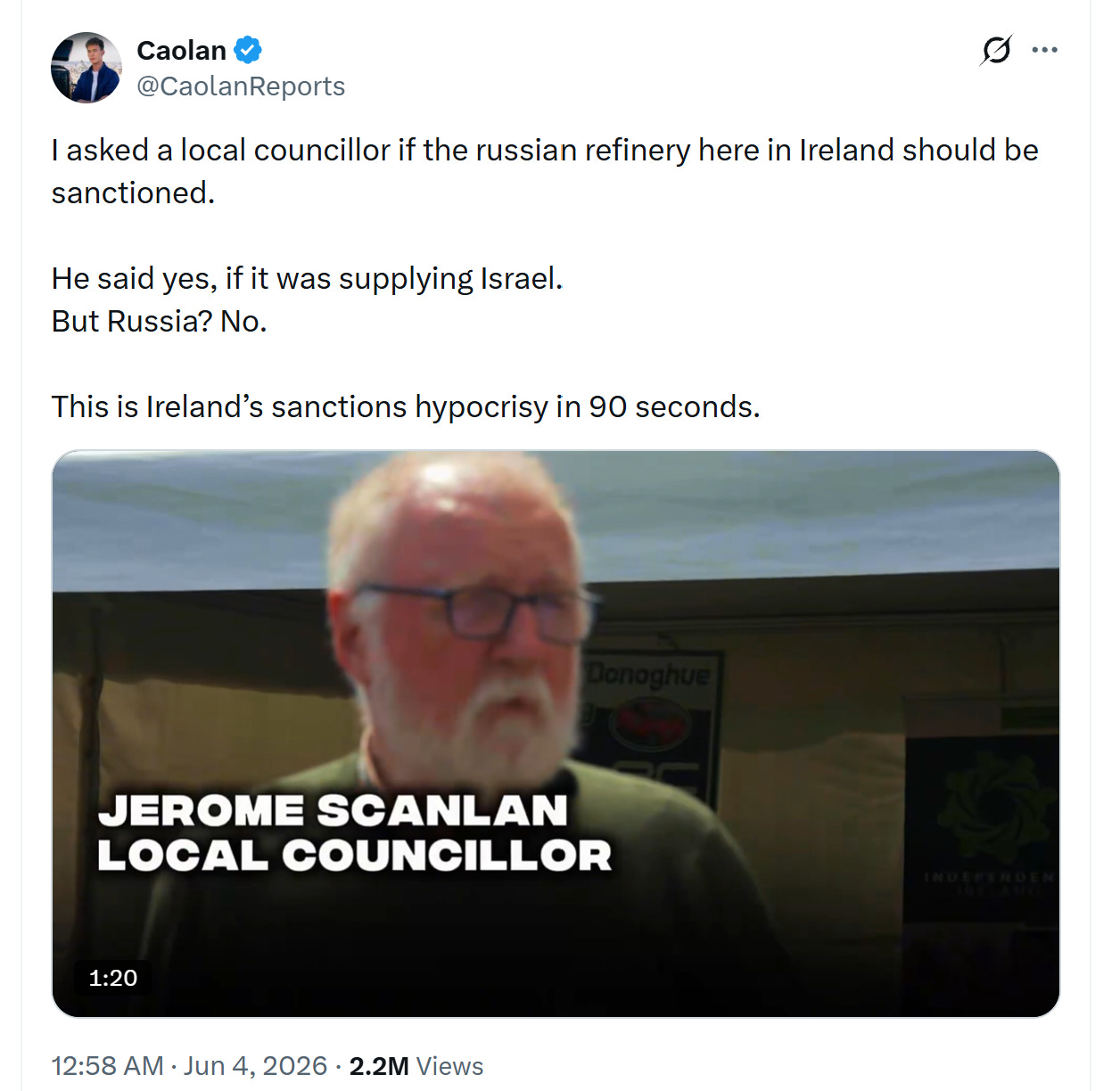
There is a popular layer beneath the official one, and it runs in the direction Part 7 documented. In early June 2026 a clip travelled widely showing an Irish local councillor asked, on camera, whether the refinery should be sanctioned; by the questioner’s account he answered that it should, if it were supplying Israel, but not for supplying Russia. It is an edited piece from an advocacy account and should be weighed as such: a single councillor is not a county, and the framing is the poster’s. But the asymmetry it caught is not an artefact of the edit, because Part 7 found the same direction across the whole anti-war bench in the same county, tuned then to American military logistics through Shannon and structurally silent on the Russian-owned plant on the same estuary. The clip simply moves Israel into the slot American power occupied and leaves the direction unchanged. What it added was reach. It passed two million views in days, which is the Part 8 argument arriving early: the framing that lets a Russian war-input refinery sit unsanctioned is not supplied only from above, by a lobbying peer and a cautious cabinet, it is also popular from below, and it travels. The attention that would close the plant tomorrow if its alumina went to Israel cannot be roused for the same plant when its alumina goes to Russia. That is not an Irish peculiarity. It is the contaminated frame the we have seen throughout the series, working as designed, in a council chamber in Limerick.
III. The company that needs the Shannon
To see why one Irish refinery carries this much weight, you have to look at the shape of the company that owns it, because the dependence runs the other way too.
United Company Rusal was assembled in March 2007 out of three sets of assets: Deripaska’s Rusal, the Siberian-Urals group SUAL, and the alumina refineries of the Swiss commodity house Glencore. At formation the holding company En+ took 66 per cent, SUAL’s shareholders 22 per cent, and Glencore 12 per cent, and the refineries Glencore brought to the table included Aughinish, which it had bought from Alcan in 1999 and which Alcan had built on the Shannon between 1978 and 1983. The new group accounted then, as it does roughly now, for something like 9 per cent of the world’s primary aluminium and 9 per cent of its alumina. From the first day it had a structural problem that the merger was partly designed to solve, and never did solve: it was short of alumina. The European Commission’s own clearance decision in 2007 recorded a group alumina deficit measured in the millions of tonnes. Rusal’s smelters, drawing on cheap Siberian hydropower, can turn out roughly four million tonnes of metal a year, and that requires close to eight million tonnes of alumina to feed them. The refineries inside Russia have never supplied much more than a third of it. The rest has always had to be imported, and the import map is the company’s central vulnerability.
That map is what broke in 2022, and the break is the reason the Shannon node moved from important to critical.
IV. The year the map broke
Two things happened within three weeks of each other in early 2022, and together they removed most of Rusal’s imported alumina.
On 1 March 2022 the company shut its Nikolaev refinery in southern Ukraine, citing transport conditions on and around the Black Sea. Nikolaev was no minor site. It produced something like 1.75 to 1.8 million tonnes of alumina a year, on the order of a fifth of Rusal’s total alumina output, and it was the single largest source of the imported alumina feeding the Russian smelters, fed in turn by bauxite from Rusal’s Kindia operations in Guinea. Then on 20 March 2022 Australia banned the export of alumina and bauxite to Russia, on Canberra’s own statement that Russia depended on Australia for close to a fifth of its alumina needs. Rusal held a 20 per cent stake in the Queensland Alumina refinery; its partner Rio Tinto took sole control of the plant, sidelined the Russian stake, and suspended a tolling arrangement it ran through Aughinish itself. By the analysts’ arithmetic at the time, the combined loss of the Ukrainian refinery and the Australian feed put around 3.2 million tonnes of alumina at risk, somewhere near 42 per cent of what the smelters needed to keep running.
A company that loses two-thirds of its imported feedstock in three weeks does not have many large refineries left that it actually controls inside friendly logistics. It had Aughinish. Within days of the Nikolaev shutdown, shipping data showed Rusal diverting the Guinea bauxite that had fed the Ukrainian plant to the Shannon instead, and the alumina Aughinish produced began moving east. Part 6 gave the downstream figure: more than 400 million dollars of Aughinish alumina shipped to the Krasnoyarsk and Sayanogorsk smelters in 2024, on the order of 40 per cent of those smelters’ intake. The Irish Times investigation traced the route out to a Russian port near St Petersburg. The plain description is that when the war removed Rusal’s other options, an Irish refinery became one of the load-bearing supports of Russian aluminium production, and the bauxite corridor from West Africa was rerouted to keep it fed.
The rest of Rusal’s response is the part that tells you this was treated inside the company as a permanent reordering, not a wartime improvisation. It turned to China for replacement alumina, and in 2023 it bought a 30 per cent stake in a Chinese refinery, the Hebei plant, to lock in feedstock. In 2025 it announced it would take up to a 50 per cent stake in an alumina plant in India. It set out plans for an entirely new 4.8-million-tonne refinery in Russia’s Leningrad region for the end of the decade. And in 2024 it lost its Australian court case to restore the Queensland stake, then sued Rio Tinto for 1.32 billion dollars in a Russian court, naming among the defendants Rio subsidiaries holding the Oyu Tolgoi copper and gold project in Mongolia, a country Moscow calls friendly and which has not sanctioned Russia. Read together, those moves describe a company rebuilding its alumina supply around China, India and a domestic build-out, while litigating in a captured home court to claw back what the war cost it. Through all of it, the one large refinery it kept in the European Union, on the Shannon, went on running.
V. The peerage that kept it legal
There is one more reason Rusal could keep all of this inside the Western system rather than wholly outside it, and it returns us to the theme Part 6 named the legitimacy layer: the British peerage as the cheapest available source of respectability on a Russian resource structure.
On 6 April 2018 the United States Treasury’s Office of Foreign Assets Control designated Oleg Deripaska and the principal companies he controlled, En+, Rusal and EuroSibEnergo, under the executive order covering those acting for the Russian state, citing his closeness to Putin and a list of allegations including money laundering and racketeering. The aluminium market convulsed; the London price spiked as the second-largest producer in the world was abruptly cut out of the dollar system. What followed is the instructive part. The petition to get the companies delisted was led, across roughly eight months of negotiation with OFAC, by the chairman of En+, the Right Honourable Lord Barker of Battle, Gregory Barker, formerly the United Kingdom’s Minister of State for Energy and Climate Change. His effort was supported by Washington lobbying that the public record shows was disseminated by Mercury LLC as a registered foreign agent acting on his behalf.
The deal he assembled, generally called the Barker Plan, is a precise piece of engineering. Deripaska cut his direct and indirect stake in En+ from around 70 per cent to about 44.95 per cent, below the threshold at which OFAC automatically treats a company as itself sanctioned. He was capped at voting roughly 35 per cent, with the voting rights attached to the remaining shares vested in independent United States trustees. The boards of En+ and Rusal were rebuilt with a majority of independent directors including American and European nationals; Deripaska was barred from receiving dividends while he personally remained sanctioned; and the companies submitted to ongoing auditing, certification and reporting to OFAC of a kind the sanctions specialists who reviewed it could not recall the office using before. Treasury notified Congress in December 2018, a Senate resolution to keep the sanctions in place failed to reach the sixty votes it needed on 16 January 2019, and on 27 January 2019 OFAC delisted En+, Rusal and EuroSibEnergo. Deripaska himself stayed on the list. Glencore swapped its direct Rusal holding into En+ shares in the reshuffle.
I want to be careful about what this is and is not, because the discipline this series tries to keep matters most exactly here. The Barker Plan was lawful. It was defended at the time by serious sanctions analysts as technically sound, a genuine severing of one oligarch’s control rather than a favour dressed as one, and the reporting and audit obligations it imposed were real. The point is not that Lord Barker did something improper. The point is structural, and it is the same structure Part 6 found around Lord St John of Bletso and the Guinea bauxite protocol and the London uranium vehicle: a British peer, with a ministerial past and the instinctive trust that a title still buys in a counterparty or a regulator, sitting at the head of the arrangement that keeps a Russian resource asset inside the Western system rather than outside it. Bletso supplied the masthead that made the bauxite and uranium structures read as respectable. Barker supplied the chairmanship that got Rusal off the American sanctions list. The commodities differ, the mechanisms differ, the conduct of the individuals differs, and there is no shared conspiracy to allege. What recurs is the role. The legitimacy layer is not a metaphor and it is not passive; it is a named seat, and on the Rusal cap table for the years that mattered it was occupied by a member of the House of Lords. The company completed the picture in 2020 by moving its corporate domicile from Jersey to a special administrative region on Oktyabrsky Island in Kaliningrad, back inside Russian jurisdiction, the legitimacy having served its purpose.
VI. Where the metal goes
Follow the loop out the far end, because the alumina is not the product. The aluminium is, and the aluminium has to find buyers.
Once Aughinish alumina becomes Krasnoyarsk and Sayanogorsk metal, it enters a market that the Western measures of 2023 to 2025 progressively closed to it. The United States put a 200 per cent tariff on Russian aluminium articles in March 2023. The United States and the United Kingdom barred Russian metal produced on or after 13 April 2024 from the London Metal Exchange and the Chicago Mercantile Exchange. The European Union’s sixteenth sanctions package, adopted in late February 2025, finally added unwrought aluminium itself to the import-ban list, with a transitional quota of 275,000 tonnes, about 80 per cent of the bloc’s 2024 imports, running for twelve months, a further allowance into the end of 2026, and a complete prohibition from 2027. Note the asymmetry the series keeps returning to: the European Union has moved to ban the finished Russian metal while continuing to host, and decline to sanction, the Russian-owned refinery producing the alumina that the metal is made from. The ban runs on the output. The input keeps its passport.
The London exchange’s own conduct belongs in this picture, because it is the same evasion-by-lawful-steps pattern in a City institution. In October 2023 the London Metal Exchange decided not to ban Russian metal from its system at all. The April 2024 measure then caught only metal produced on or after the thirteenth of that month, leaving everything poured before that date tradable, re-warrantable and free to move between sheds. The consequence is that the warehouses of a London exchange nearly a century and a half old have become the holding pen of last resort for Russian aluminium: the Russian-origin share of available aluminium stocks on the exchange stood above 90 per cent in early 2024 and was back around that level through 2025 and into 2026, metal most traders will not touch but the system cannot refuse. And the restriction never reached the bilateral market in any case; company-to-company contracts struck away from the exchange were untouched, expected only to clear at a discount. A London institution did not close itself to Russian metal. It became the place that metal waits.
Closed Western markets do not destroy the metal; they redirect it. The largest destination is China. The Goldman Sachs analyst Nicholas Snowdon estimated that China would absorb close to 70 per cent of Russia’s roughly three million tonnes of annual aluminium exports in 2024, against effectively none before 2022. After China comes Turkey, which took on the order of 930 million dollars of Russian aluminium in 2024, and which functions as a staging ground as much as an end market: Rusal’s own 2024 annual report records it moving roughly 500,000 tonnes of pre-sanction metal into warehouses in Turkey and the United Arab Emirates, the two yards where Russian aluminium sits out the Western closure within reach of the buyers who will still take it. The rest goes to the other states that did not join the sanctions, and about one of them I can be specific rather than gestural, because I have run the trade data, and the discipline of running it is itself the point of this section.
Take Israel, a non-sanctioning buyer of unwrought aluminium. The producer attribution is clean at one level and must be qualified at another. Rusal is the only primary aluminium producer in Russia, accounting for upward of 90 per cent of Russian primary output, so Russian-origin primary metal is, at the level of who poured it, Rusal metal. What the trade tables cannot show is the contractual seller; they record the partner country of a shipment, not the producer and not the trading intermediary, so the correct claim is producer attribution, not a named contract. With that stated, the Israel-as-reporter customs series through UN COMTRADE shows the pattern without ambiguity. Israel imported about 71 million dollars of Russian unwrought aluminium in 2018, roughly half its total that year, with Russia its single largest supplier of the primary metal in 2018, 2019 and again in 2023. The value fell after the invasion, to around 28 million dollars in 2023 and about 17 million in 2024, but it did not stop, and Russia stayed in the top tier of suppliers throughout. A large and volatile slice of the 2024 figure routes through Switzerland, a trading and financing hub rather than a smelter nation, which is the standard intermediary architecture by which origin is blurred without anything unlawful occurring.
Now the discipline. It would be easy, and wrong, to turn that series into a headline about a particular buyer funding a war machine. The end-use evidence does not support it, and saying so is not a hedge; it is the finding. Israel has no primary smelter and imports essentially all of its primary metal, and its consumption is fully explained by a documented domestic base: the largest end use is construction, extruded profiles for windows, doors and facades feeding a very large residential build-out for new housing, followed by a substantial defence (Elbit, IAI) and aerospace sector, then packaging, electrical and solar. The tonnage Israel buys is proportionate to the industry that consumes it, and Russia’s prominence as a supplier to any importing country is the global norm, because Russia is the largest exporter of unwrought aluminium in the world. No covert destination needs to be inferred, and none is. The honest statement is the narrow one: a non-sanctioning state continued to buy Russian primary metal at declared, lawful volumes after the invasion, as the Western markets that once took that metal closed to it, and the metal that an Irish refinery’s alumina helped make found its buyers in the markets that chose not to sanction it. That is the whole claim, and it is enough.
VII. What is documented, what is contested, what is inferred
Because this part touches a live political fight and a real refinery with real employees, it is worth separating the tiers explicitly, in the way the rest of the series tries to.
Documented, and not seriously in dispute: Aughinish is Europe’s largest alumina refinery, owned by Rusal, drawing up to 15 per cent of Ireland’s daily gas and exporting power to the grid; Rusal lost its Ukrainian refinery and its Australian feed within three weeks in 2022 and rerouted Guinea bauxite to the Shannon; Aughinish alumina shipped to the Siberian smelters in 2024 at a value above 400 million dollars; the Barker Plan delisted Rusal and En+ in January 2019 on the documented terms above; the Western markets closed to Russian metal across 2023 to 2025 while non-sanctioning states kept buying, on the customs figures cited; Russian-origin metal makes up the overwhelming majority of available aluminium stocks on the London exchange, and Rusal’s own 2024 report records pre-sanction metal staged into Turkish and Emirati warehouses.
Reported, and contested at the edges: the precise share of Aughinish output going to Russia, variously put at around half and, on Ireland’s own first-quarter 2026 trade figures, above 80 per cent; the specific port of entry; the characterisation, central to the Alumina21 campaign and the March 2026 investigation, of the chain as a supply line into sanctioned weapons manufacture, which the company contests and which rests on tracing alumina through a Moscow trader into end users whose own sourcing is opaque; and the June 2026 councillor clip, which is an edited recording from an advocacy account, accurate to Part 7’s independently documented asymmetry in its direction but not to be treated as verbatim or representative testimony on its own.
Inferred, and labelled as inference: that the refinery’s entanglement with Ireland’s energy grid and its environmental liabilities functions as retention leverage, whatever the company intended; and that the recurrence of a British peer at the head of the legitimacy arrangement, Barker for the Rusal delisting and Bletso for the bauxite and uranium vehicles, is a pattern of role rather than a single coordinated scheme. The strongest single piece of evidence in the whole chapter is the documentary record of the 2022 supply break and the reroute to the Shannon, because it is shipping data and earnings disclosure rather than interpretation. The weakest link is the one the the one we have seen before: the gap between producer attribution and contractual identity, the point at which the trade tables stop naming who actually bought and sold, and inference would otherwise rush in. The series does not let it.
VIII. The throughline
Set the three conversions beside one another and the chapter resolves into the series argument. In Part 6’s Transnistria, stolen gas became anonymous coin. In the Siberian smelters, cheap hydropower becomes metal. On the Shannon, Irish gas becomes a Russian strategic input, and the same energy-into-asset machine that runs the crypto trade runs the aluminium loop, with better employment figures and a bird sanctuary. The legitimacy layer keeps the Western nodes legal: a peerage on the En+ board to get Rusal off the sanctions list, a peerage on the masthead of the Guinea and Namibia vehicles, the Irish state’s own dependence on the plant cited back to it as the reason not to act. And the contaminated vocabulary does the rest of the work, letting the arrangement be described as a “strategic asset” and a “compliance” success rather than what the trade data and the supply maps show it to be, which is one company’s war-pressured feedstock problem solved on a European estuary.
The retailers who keep the borders of this kind of arrangement open, the ones who frame enforcement as economic self-harm and make the deregulation popular, are Part 8’s subject, and Aughinish is precisely the sort of node their politics protects: lawful at every step, indispensable to its host, and quietly load-bearing for the other side.
For the resource argument it is enough to have opened the single node Part 6 ran its loop through, and to have followed the metal out the far end into the markets that chose not to look. The refinery on the Shannon is not the exception to the trade this series describes. It is the trade, rendered in gas and red mud and a deep-water berth, with a member of the House of Lords on the paperwork that kept it inside the system.
And the thing for Councillor Scanlan to understand is that Aughinish helps provide vital alumina for a large number of countries that he doesn’t like. Including the Israeli defence industry and settlement construction.
Sources for this piece include the IStories, OCCRP and Irish Times investigation into the Aughinish alumina supply chain (March 2026); RTE reporting on Aughinish’s May 2026 government briefing on grid dependence and on the June 2026 scrutiny around the Kallas visit and the Irish EU Council presidency; the International Aluminium Institute and Wood Mackenzie asset notes and Rusal’s own materials on Aughinish capacity, the combined heat and power plant and bauxite sourcing; the European Commission’s 2007 merger clearance (Case COMP/M.4441) and contemporaneous reporting on the Rusal, SUAL and Glencore combination; S&P Global Commodity Insights, Reuters, Wood Mackenzie and the US International Trade Commission on the 2022 loss of the Nikolaev refinery, the Australian alumina and bauxite ban, and Rusal’s turn to Chinese, Indian and domestic alumina supply; United States Treasury and OFAC delisting documents (December 2018 and January 2019), the associated FARA filing, and Atlantic Council analysis for the Barker Plan; UN COMTRADE and World Bank WITS customs data (Israel as reporter, 2018 to 2024) for the downstream trade, with Rusal annual results and USGS data for producer share; United States, United Kingdom and European Union sanctions instruments (2023 to 2025) including the sixteenth EU package on unwrought aluminium; the London Metal Exchange’s own sanctions notices and reporting on the Russian-origin share of its warehouse stocks; Rusal’s 2024 annual report and UN COMTRADE data on the redirection of metal to Turkey and the United Arab Emirates; and Goldman Sachs commentary via Fastmarkets on China’s absorption of redirected Russian metal. The June 2026 councillor clip is a social-media recording from an advocacy account, cited as reported material. The Alumina21 and NAFO campaign materials and the wider Bretton Woods series inform the framing.
Support the NAFO Alumina campaign here: Alumina campaign