


On the afternoon of 1 October 2013, in the science-fiction section of the Glen Park branch of the San Francisco Public Library, a twenty-nine-year-old man called Ross Ulbricht was sitting at a desk with his laptop open and unlocked when a young couple appeared to start arguing loudly in front of him. He looked up, briefly. While he was looking up, a third FBI agent approached from behind, took the laptop before he could close the lid, and arrested him. The argument was a piece of choreography. The laptop, still logged in to an administrator account, contained the operational records of Silk Road, the largest online marketplace then in existence for narcotics, fraudulent identity documents, and a number of other categories of contraband whose listing categories Ulbricht had himself designed.
He was charged in February 2014. Tried in January 2015. Convicted on all seven counts on 4 February 2015. Sentenced on 29 May 2015 to two life terms plus forty years, no parole, by Judge Katherine Forrest in the Southern District of New York. The presiding judge made clear in her remarks that the sentence was intended to function as deterrence, a message to anyone contemplating a similar venture. The message arrived. It was not the message most people heard.
This piece is about the people who did hear it correctly.
The Eagle Scout and the agorists
Ulbricht was born in Austin, Texas, in March 1984, to a middle-class family. He was an Eagle Scout. He attended West Ridge Middle School and Westlake High School in the Eanes Independent School District, both unremarkable in the way that schools in the Austin suburbs in the 1990s were unremarkable. He took a full academic scholarship to the University of Texas at Dallas, graduated with a physics degree in 2006, and went on to a master’s at Pennsylvania State University in materials science, where he wrote a thesis on the optical properties of thin lead-sulphide films and, in his spare time, became a libertarian.
The libertarianism mattered. It was not the Koch-funded, Washington-access libertarianism of the Cato Institute or the donor-class libertarianism of the broader Koch network. It was the radical agorist strain associated with Samuel Edward Konkin III, in which all voluntary exchange is morally legitimate, the state is by definition an instrument of coercion, and the most effective form of political action is the construction of grey and black markets that route around it. Konkin had died in 2004. His writings, New Libertarian Manifesto (1980) and the Agorist Primer (published posthumously in 2008), were the doctrinal core that Ulbricht read at Penn State and on his return to Austin. He also read Ludwig von Mises and Murray Rothbard, the latter of whom had been forced out of Cato in 1981 in a factional split with Ed Crane and Charles Koch and had gone on to co-found the Mises Institute in Auburn, Alabama the following year. Ulbricht was, in a way that mattered for what came next, a serious reader.
In late 2010, he started building. The technical stack he chose was Tor for anonymity, Bitcoin for settlement, and a marketplace structure modelled on eBay with escrow and seller ratings. He launched in January 2011. He took the pseudonym Dread Pirate Roberts from The Princess Bride, a Konkin-aware in-joke about the inheritability of an identity across operators. By the time of his arrest, the site had processed roughly $1.2 billion in transactions and taken approximately $80 million in commission, all in Bitcoin, all settled to wallets Ulbricht controlled.
The doctrine he held was not a marketing position. His own LinkedIn entry, retrieved by prosecutors and quoted at trial, described his goal as creating “an economic simulation to give people a first-hand experience of what it would be like to live in a world without the systemic use of force.” A 2012 forum post under the Dread Pirate Roberts handle described Silk Road as “a vehicle to bring Austrian economic theory into the physical reality of the so-called real world.” When he was arrested, the relevant categories of voluntary exchange he had built listings for included narcotics, forged passports, hacking services, malware, and (this is the part the murder-for-hire allegations attached to) the resolution of disputes with extortionists and informants by means that he understood, perfectly clearly, to be murder.
He took the doctrine literally. That is the part of the story that matters, and that almost nobody in the libertarian commentary on his case has been willing to confront. He did not stumble into the contract murder allegations. He commissioned them, in writing, six times, by his own admission in the chat logs the FBI recovered. The murders did not occur. One of the agents he hired turned out to be a corrupt DEA agent (Carl Force, later convicted) who pocketed the money. The others were similar variations of the same farce. But the intent was not absent and the morality was not ambiguous. He believed, on doctrinal grounds, that the use of contract killing to defend a voluntary marketplace was legitimate. He paid for it. The murder-for-hire charges were eventually dismissed with prejudice in Maryland after the corruption of the DEA agent compromised the case, but the conduct was established by a preponderance of the evidence at the New York sentencing, which is why Judge Forrest gave him the sentence she did.
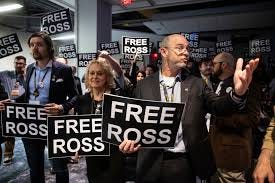
This matters, and it will matter again at the end of the piece, because the libertarian campaign to free Ulbricht spent twelve years selling him as an Eagle Scout who made some bad decisions about a website. He was not. He was a doctrinaire who acted on his doctrine, including the violent parts. The campaign required the violence to be airbrushed out of the picture, and the airbrushing was so successful that, by 2024, the President of the United States was on television describing him as a young man who had been treated unfairly.
The takedown and the sentence
The investigation that caught Ulbricht was not a triumph of cryptographic decryption. It was a triumph of operational error, of the kind every long-running underground operation eventually commits. In 2011, in an early Bitcoin Talk forum post promoting Silk Road, he had used the email address rossulbricht@gmail.com. In 2013, an IRS agent called Gary Alford ran the obvious search. The handle “altoid”, which Dread Pirate Roberts had used in early promotional posts, was tied to the gmail account, which was tied to Ulbricht’s name, which was tied to a Texas physics graduate now living in San Francisco. The FBI surveillance team picked him up from there. By the morning of 1 October 2013 they knew which library he was going to and at what time.
The seizure of the laptop in the live state was the operational pivot of the case. With administrator credentials live, prosecutors had everything: the chat logs, the wallets, the order book, the murder-for-hire correspondence. The trial in January 2015 was, on the evidence, a formality. Ulbricht’s defence rested on the argument that he had founded Silk Road but had handed it off to someone else who had been operating it as Dread Pirate Roberts at the time of arrest, and that he had been lured back to the laptop on 1 October by that other person, who was the true criminal. The jury did not believe this and there was no reason for them to. The conviction was unanimous on all seven counts.
The sentence, on 29 May 2015, was the part that did the longer-term political work. Judge Forrest gave him double life plus forty years, the maximum permitted under the statutes. She explained, in sentencing remarks that ran to twenty minutes, that the severity was intended to deter. Silk Road, she said, had not been a victimless crime. Six deaths from overdoses had been linked to drugs purchased on the site. The murder-for-hire conduct, even though uncharged, was real. The marketplace had been an operation of substantial sophistication and Ulbricht had been its sole director.
The sentence was, by the standards of US federal sentencing for first-time non-violent drug offences, extreme. The defence argued it was disproportionate. They were, narrowly, correct: it was disproportionate to the convicted-of charges, and the murder-for-hire conduct used to justify it had never been put to a jury. The Second Circuit upheld the sentence on appeal in 2017. The Supreme Court declined to hear the case in 2018. By 2019 Ulbricht was at USP Florence High in Colorado serving the first of his two life sentences, with a release date sometime after 2114, and the libertarian movement had a martyr.
The exchange founders and the lesson
While Ulbricht was being processed into Florence High, the people who had spent the period 2011 to 2013 watching Silk Road were drawing rather different conclusions. The cypherpunk-libertarian content of the project had been thrilling, but the operational record was a manual on what not to do. Run an unlicensed marketplace, settle in a fully traceable token, take a personal ownership stake in something prosecutors will eventually call a continuing criminal enterprise: these were errors. The lesson was not that the ideology was wrong. The lesson was that the ideology, applied directly, produced double life sentences. To extract value from the same technical stack on which Ulbricht had built Silk Road, the operational structure had to be different. Specifically, it had to be legal.
The legal crypto sector that absorbed Silk Road’s user base after 2013 was not staffed by people who repudiated the doctrine. It was staffed by people who had read it as a marketing manual rather than a political programme.
Coinbase had been founded in June 2012 by Brian Armstrong, a former Airbnb engineer, with Y Combinator backing. Its 2013 fundraise (Series A from Fred Wilson’s Union Square Ventures) closed the month after Ulbricht’s arrest. The pitch deck explicitly cited the Silk Road takedown as evidence that the regulated, KYC-compliant exchange was now the only viable path. Coinbase listed on Nasdaq in April 2021 at a fully diluted valuation north of $100 billion. Armstrong is now a regular White House visitor.
Binance was founded by Changpeng Zhao in July 2017, initially in Shanghai, then in Tokyo, then in Malta, then in nowhere in particular. It became the largest exchange in the world by volume. In November 2023, Zhao pleaded guilty to violations of the US Bank Secrecy Act and stepped down, paying a personal fine of $50 million and a corporate fine of $4.3 billion. He served four months in a federal prison camp in California. He emerged in September 2024 with his Binance equity intact (estimated by Bloomberg at the time at $33 billion) and has since been spending substantial time in the United Arab Emirates, where Binance has a strategic partnership with MGX, the Abu Dhabi sovereign-backed AI investment vehicle through which the World Liberty Financial USD1 stablecoin received its largest single-transaction inflow in 2025. The British arc of the same pattern runs through Nicholas C. Andrews, a director of Binance Markets Ltd (the UK arm of the exchange) from 2015 to August 2020, and now the sole listed director of Zebec Technologies plc, a crypto company incorporated on 6 August 2025 with £50,000 in share capital, a single shareholder registered in the British Virgin Islands, and a sponsorship line item at Reform UK’s Birmingham conference less than a month after incorporation. The arc is precise: a guilty plea to anti-money-laundering violations, four months in a camp, then a position as a node in the very stablecoin distribution chain that the next piece of this series will document, with the British end of the same network walking from Binance’s UK board to a BVI-fronted shell sponsoring Reform UK in the space of five years. Part 8 of this series will return to Zebec, Andrews, and the Reform UK conference sponsorship architecture in detail.
Kraken was founded by Jesse Powell in San Francisco in 2011, the same year as Silk Road. Powell had taken a long position on the Mt. Gox collapse and built Kraken as the deliberately American, deliberately compliant alternative. By 2021 it was the second-largest US exchange by spot volume. Powell stepped down as CEO in 2022. He is now an active Republican donor and an advisor on crypto policy to the Trump administration’s regulatory transition team.
The point is not that these three men are villains. They were operators in a sector that had been given a clear demonstration in October 2013 of what happened if you took the doctrine literally. They behaved rationally. They built large, compliant, well-capitalised intermediaries that did what banks do, charged what banks charge, and made arrangements with the regulators that banks make. The ideology of permissionless peer-to-peer cash that Ulbricht had taken seriously was retained at the level of marketing copy. The product was the intermediary.
This is the operational pattern that the rest of this series traces. The libertarian ideology of the early Bitcoin period was not abandoned. It was not falsified. It was promoted to recruiting material. The substance of what the surviving operators did, after 2013, was to build the most profitable set of unregulated-then-lightly-regulated financial intermediaries in modern history, while telling the customer base that this was what permissionless money looked like in practice. The customer base, in significant part, believed them.
The Mises Caucus and the doctrinal capture
The piece of institutional infrastructure that made the Ulbricht pardon possible was assembled, in plain sight, between 2017 and 2022.
The Libertarian Party of the United States had been, since its founding in 1971, an awkward coalition of small-government conservatives, Rothbardian anarcho-capitalists, civil-liberties absolutists, and a longer tail of single-issue activists. Its presidential vote share peaked in 2016 with Gary Johnson at 3.3 per cent. It was structurally marginal. It did, however, have ballot access in most states and a national-committee structure that controlled platform, branding, and the convention nomination process.
In August 2017, in the aftermath of the Charlottesville Unite the Right rally and the Trump administration’s first year, a Pennsylvania party member called Michael Heise founded the Libertarian Party Mises Caucus. The stated objective was to align the national party with the political style of Ron Paul’s 2008 and 2012 Republican presidential campaigns: non-interventionist foreign policy, anti-Federal Reserve, anti-COVID-restriction (this part came later), and culturally willing to absorb voters from the post-Trump right who found the existing Libertarian Party too socially liberal. By 2021 the caucus controlled thirty-seven state delegations. At the Reno national convention on 28 May 2022, the caucus completed what it had publicly billed for two years as “The Takeover”, sweeping every position on the Libertarian National Committee. Angela McArdle, a Los Angeles attorney and Mises Caucus board member, was elected national chair with 69 per cent of the vote.
The doctrinal content of the takeover is, for the purposes of this series, the part that matters. The Mises Caucus took its name from Ludwig von Mises, the Austrian economist, but its actual intellectual centre of gravity was the Mises Institute in Auburn, Alabama, founded in 1982 by Llewellyn Rockwell with Murray Rothbard after the latter’s expulsion from Cato. The Institute is the home of the paleolibertarian tendency, which differs from the Koch-network libertarianism that Cato represents in being more openly hostile to anti-discrimination law, more amenable to nationalist framings, more interested in monetary heterodoxy (gold standard, end the Fed), and historically more entangled with Pat Buchanan-era right-wing populism. The two factions have spent forty years in a sibling rivalry over which strand would dominate organised libertarianism in the United States. The Mises Caucus’s takeover of the Libertarian Party in 2022 was, in essence, the operationalisation of the paleolibertarian side of that rivalry, with the Institute’s vocabulary becoming the native register of the captured party.
The relevance to crypto is direct. The Mises Institute had been, since the late 2000s, one of the most aggressive promoters of Bitcoin and of the broader “sound money” framing within which Bitcoin was sold as a return to gold-standard discipline. Jeffrey Tucker, then at the Institute, was an early Bitcoin evangelist. The Institute’s online property Mises Wire published a steady stream of articles connecting Austrian economics to crypto throughout the 2010s. By the time of the 2022 takeover, the institutional libertarian-movement vocabulary on money had been Mises Institute vocabulary for a decade, and the institutional infrastructure was now staffed by people for whom that vocabulary was native.
In late 2023, according to The New Yorker‘s reporting on the Ulbricht pardon, McArdle met Donald Trump and told him that he could win the Libertarian vote if he promised to release Ross Ulbricht. The meeting was the operational hinge. Trump’s appearance at the Libertarian Party National Convention in Washington on 25 May 2024 (a Republican presidential candidate appearing at a Libertarian convention, this had not happened before) included the explicit pledge: “If you vote for me, on Day One I will commute the sentence of Ross Ulbricht to a sentence of time served.” On 21 January 2025, his second day in office, he went further. He issued a full and unconditional pardon, wiping the conviction. His Truth Social post the same day made the political accounting explicit. The pardon was issued, he wrote, “in honor of her and the Libertarian Movement, which supported me so strongly.”
McArdle herself, having captured the Libertarian Party in 2022 and delivered it to Trump in 2024, stepped down as Libertarian National Committee chair in February 2025. In June 2025 she became chair of the Mises Caucus PAC. In 2026 she registered as a Republican. The pipeline is documented in her own party-registration record. The Mises Caucus had not built itself to win Libertarian elections. It had built itself to be a takeover vehicle, and once the takeover was complete and the asset had been delivered, the operators moved to the buyer.
That, however, is only half the story. The other half is the part the libertarian press has not been keen to talk about, and which the rest of this section addresses, because it changes the architecture of everything that follows.
The bridge: McArdle and the LaRouche network
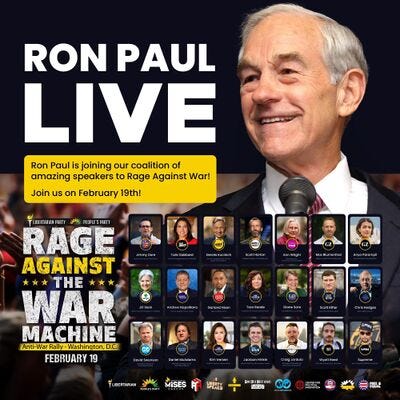
On 19 February 2023, at the Lincoln Memorial in Washington, a rally took place under the banner “Rage Against the War Machine”. The lead moderator was Angela McArdle, in her capacity as chair of the Libertarian Party. The co-moderator was Nick Brana, chair of the People’s Party. Among the nineteen invited speakers were Tulsi Gabbard (now Director of National Intelligence), Ron Paul, Jill Stein, Cynthia McKinney, Jimmy Dore, Roger Waters, Chris Hedges, and Max Blumenthal of The Grayzone. Among the speakers less familiar to a general audience was Diane Sare, the sitting LaRouche Party candidate for the United States Senate in New York, whose campaign literature at the time described Lyndon LaRouche as her mentor and “the greatest statesman of the past 100 years”. The event was promoted by the Schiller Institute. Helga Zepp-LaRouche was a participant in the surrounding event programme. The Center for Political Innovation, the LaRouche-friendly vehicle run by Caleb Maupin (a former Workers World Party organiser and regular RT guest), was a co-sponsor.
McArdle was, in other words, the lead public face of a 2023 Washington rally co-organised with a serving LaRouche electoral candidate, promoted by the Schiller Institute, and co-sponsored by Maupin’s CPI. This is not an inference from rhetorical similarity. This is a stage, photographed in colour, with the people on it identified by name and affiliation.
The Washington Outsider Center for Information Warfare, in a December 2024 report on LaRouche-network influence operations, listed McArdle by name as a libertarian collaborator of the Schiller Institute, in the same paragraph as George Galloway, Caleb Maupin, and Kim Dotcom. The Schiller Institute’s own public materials have not contested the affiliation. McArdle’s appearance on the same platform as Diane Sare in February 2023 was not a one-off booking accident. It was a documented operational alignment, sustained over the period in which the Mises Caucus was consolidating its grip on the Libertarian Party and preparing the pardon transaction.
The implication is structural, and it is the reason the next part of this series will need to revise its own previous framing. The two doctrinal estates this series has been tracking, the paleolibertarian estate centred on the Mises Institute and the LaRouche network’s “New Bretton Woods” framework, were not, in 2023, “institutionally separate” actors that would later “operate in alignment”. They were already operating in alignment, on a stage at the Lincoln Memorial, through a personally identifiable bridging operator, fourteen months before that bridging operator brokered the pardon of the crypto sector’s martyr.
McArdle’s career is therefore not the story of a Libertarian chair who eventually walked to the Republican Party. It is the story of a node that connected the LaRouche network’s anti-Western foreign-policy doctrine to the Mises Institute’s monetary-heterodoxy doctrine, that delivered the Libertarian Party to the Trump campaign in May 2024 with the Ulbricht pardon as the price, and that has since moved through three party affiliations while the underlying alignment has continued. The doctrine being aligned, in plain English, is opposition to the dollar-system order: from the paleolibertarian side, in the name of monetary purity; from the LaRouche side, in the name of “multipolar transition”; from the crypto-sector side, in the name of permissionless money. The three vocabularies are different. The position they describe is the same.
The pardon is what that position looks like when it acquires a presidential signature.
The substrate: FreeRoss, Pleasr, Snowden, Ukraine, Nym
There is a part of this story that the McArdle frame on its own does not capture, and that needs to go in here because the operation that produced the Ulbricht pardon did not run only through the Libertarian Party. It ran also, and in its early years more importantly, through a constellation of decentralised autonomous organisations whose founding personnel substantially overlap, whose political affect was genuine, and whose operational pool was harvested by the time the pardon arrived. The community that built the pardon campaign was not, in significant part, in on the longer trade. It was the substrate the longer trade ran through.
The institutional history is short and well documented. In March 2021 a Web3 collective formed in honour of the digital artist Emily “pplpleasr” Yang, taking the name PleasrDAO. In April 2021, one month later, it bought Edward Snowden’s first NFT, Stay Free, for 2,224 ETH (approximately $5.4 million at the time). The proceeds went to the Freedom of the Press Foundation, on whose board Snowden sits. That single purchase did the institutional work: it gave PleasrDAO a public identity, a moral register, and a Snowden affiliation that would be reused for years. In October 2021 PleasrDAO bought the Wu-Tang Clan’s Once Upon a Time in Shaolin for $4 million, the album that had been confiscated by the US government from Martin Shkreli after his fraud conviction. In December 2021, members of PleasrDAO and adjacent collectives launched FreeRossDAO, raising 2,836 ETH from roughly 1,320 contributors and winning the auction for a set of NFTs of Ross Ulbricht’s writings and artwork with a bid of 1,442 ETH, approximately $6.27 million at the time. The stated purpose was to fund efforts to reduce or overturn Ulbricht’s life sentences.
On 24 February 2022 Russia invaded Ukraine. Three days earlier, a Ukrainian crypto activist resident in London called Alona Shevchenko, who was also operations and community lead at FreeRossDAO, had registered the UkraineDAO Twitter account. Within hours of the invasion, on a Zoom call organised by PleasrDAO members, UkraineDAO was operational. Pussy Riot’s Nadya Tolokonnikova joined as a co-founder. Dmitry “Dima” Buterin, father of Ethereum co-founder Vitalik Buterin, took a seat on the multisignature wallet. Vitalik Buterin donated several million dollars to Ukrainian causes including UkraineDAO. By late March the organisation had raised more than $8 million.
There is a separate strand that needs introducing here because it sits in the same orbit. In April 2022, two months after UkraineDAO’s launch, the Nym Project held its public launch event at Station F in Paris with Edward Snowden as the keynote interlocutor. Nym, headquartered in Neuchâtel in Switzerland, was founded in 2018 by Harry Halpin, a self-described crypto-anarchist who had previously worked for the French government on post-Snowden privacy infrastructure under European Commission funding. Its product is a decentralised mixnet designed to provide network-level anonymity beyond what Tor offers. Its publicly listed security consultant is Chelsea Manning. The Nym launch with Snowden was the next event in a sequence: PleasrDAO’s purchase of Stay Free, the formation of FreeRossDAO, the formation of UkraineDAO, the launch of Nym. Four events, eighteen months, substantially overlapping personnel and audiences, all running on a shared moral register of privacy, anti-surveillance, and resistance to state power.
This is the substrate. It matters because it is, in significant part, the population the Ulbricht pardon campaign drew on. The libertarians who turned up at the Libertarian National Convention in May 2024 and cheered when Trump promised to commute Ulbricht’s sentence were not, in the main, McArdle-aligned operators. They were the same population that had donated to FreeRossDAO, that had bought NFTs from PleasrDAO, that had given money to UkraineDAO, and that had downloaded NymVPN. Their politics, where it was political, was a roughly coherent privacy-and-anti-surveillance position. The Buterins were their technical anchor. Shevchenko was, for a moment in 2022, their organisational anchor for the Ukraine cause. Snowden was the moral credit on which the whole edifice was financed, and Snowden, of all the figures involved, is the one this piece has to be most careful about.
The standard framing of Snowden in Anglosphere civil-liberties commentary is that he is a whistleblower in the Daniel Ellsberg tradition, who exposed unconstitutional NSA surveillance in 2013, was charged under the Espionage Act, and now lives in exile in Russia as a guest of necessity rather than choice. The framing is wrong, or at least it is selectively reported, and the reason matters for this series.
Snowden’s 2013 disclosures comprised approximately 1.7 million classified documents. The genuinely civil-liberties material concerning domestic surveillance of US persons is a fraction of that total. The bulk concerned foreign-intelligence operations, signals-intelligence methods, the agent identities and tradecraft of US and allied services, and the technical means by which Western signals-intelligence agencies (including GCHQ, FRA in Sweden, and others) collected on hostile states including Russia. The House Permanent Select Committee on Intelligence’s declassified 2016 report described the disclosures as the largest and most damaging public release of classified information in US intelligence history, and stated that, since his arrival in Moscow, Snowden has had and continues to have contact with Russian intelligence services. Snowden denies this. Glenn Greenwald denies this. The committee asserts it on the record.
Snowden left Hong Kong for Moscow on 23 June 2013. He has lived in Russia ever since. Russia granted him permanent residency in October 2020. Putin granted him Russian citizenship by presidential decree on 26 September 2022, seven months after the start of the war on Ukraine and during Russian general mobilisation. On 2 December 2022 Snowden swore the oath of allegiance to the Russian Federation and collected his Russian passport. He retains, on the public record, his US citizenship as well, and has at no point renounced it. He has appeared on Russian state media platforms, including in September 2021 at the New Knowledge online forum, a Kremlin-aligned Russian domestic propaganda venue. He has, since the invasion, been notably reserved in public commentary on the merits of the Russian war on Ukraine, while continuing to comment freely on the surveillance failings of Western states.
The structural position this produces is the one that matters for this series. From Moscow, with a Putin-decreed passport, an oath of allegiance to the Russian Federation sworn during the war on Ukraine, and a documented relationship with Russian intelligence services per the HPSCI report, Snowden provides a continuous moral subsidy to a privacy-and-anti-surveillance vocabulary that the Western crypto community then runs on. PleasrDAO’s institutional identity was founded on his 2021 NFT sale. FreeRossDAO drew on that same moral credit, which is in turn how the McArdle pipeline that delivered the 2025 Ulbricht pardon was able to recruit a constituency. UkraineDAO drew on the same moral credit and then, on the documentary record, appears to have hollowed out a Ukrainian war-relief campaign. Nym’s public launch, two months after the Russian invasion of Ukraine, was anchored by him. The Snowden brand has, in operational effect, been the legitimating credit line of a community whose members, in many cases in good faith, have provided the recruitment pool for an alignment whose political beneficiaries are in Moscow and at Mar-a-Lago.
This does not require Snowden to be a witting Russian asset, although the HPSCI report explicitly suggests he is. It is sufficient that he sits where he sits, signs the oaths he has signed, holds the passport he holds, declines to criticise the war his hosts are waging, and continues to license his moral authority to a Western crypto-privacy community whose operational consequences include the strengthening of cabinet-level positions in Washington that are structurally favourable to Moscow’s strategic objectives. The cypherpunks, on the analysis this series has been building, were the substrate. So were the Web3 community, the Ukraine-solidarity DAO donors, and the privacy-infrastructure users. Snowden is the part of the substrate that has a Russian passport.
The Buterins, on the evidence, did not. Chelsea Manning, on the evidence, did not. Harry Halpin and the Nym engineering team, on the evidence, did not. Shevchenko’s role is, on the Kyiv Post’s reporting, considerably more compromised, although whether by malice or by ordinary financial opportunism is a question the documentary record does not settle. The point is not to flatten these distinctions. The point is that the moral credit binding the whole edifice together was supplied, materially, by the figure with the Russian passport, and that the political asset eventually delivered by the operation built on top of all this was the freeing, by Donald Trump, of a man who had paid for six contract killings in the name of voluntary markets.
Two things then happened in 2023, in parallel, that the standard accounts of the Ulbricht pardon do not connect.
The first is the McArdle operation already documented in this piece. The Mises Caucus completed its capture of the Libertarian Party in May 2022, McArdle co-moderated the Rage Against the War Machine rally at the Lincoln Memorial in February 2023 with serving LaRouche electoral candidates and Schiller Institute promotion, and McArdle met Trump in late 2023 to broker the Ulbricht pardon as the price of the Libertarian vote. The campaign-to-free-Ross constituency, built up over twelve years by the FreeRossDAO substrate, was harvested as a political asset by an operator whose foreign-policy doctrine is structurally opposed to the doctrine most FreeRoss donors would have said they held.
The second is the visible collapse of UkraineDAO. Tolokonnikova left publicly within days of the original NFT auction, alleging that donor funds had been repurposed as a $5,000 monthly salary for Shevchenko in breach of the “100 per cent” pledge. The Kyiv Post then ran a multi-part investigation in April 2023 alleging falsely claimed Ukrainian government endorsement (Deputy Minister Alex Bornyakov went on the record denying any relationship), six-figure sums in unaccounted-for donor funds, and several unexplained transfers including one that moved $134,700 to a Coinbase wallet never used again. Shevchenko declined to answer. The Ukrainian state, on the public record, has no relationship with UkraineDAO.
The Eagle Scout cover story for Ulbricht is one half of how this was done. The Russia-resident-whistleblower cover story for the operational pool that built the campaign to free him is the other half. Both were necessary. Both worked.
What the pardon was
The standard liberal commentary on the Ulbricht pardon in January 2025 was that it represented Trump’s contempt for the rule of law and his willingness to use the pardon power for political reward. This is correct as far as it goes, but it is also analytically thin. The structural function of the pardon was different and more interesting.
It was the closing transaction in a twelve-year exchange. Ulbricht had been imprisoned in 2013 for taking the libertarian-cypherpunk doctrine literally and building an unregulated marketplace on it. Between 2013 and 2024, the sector that grew up on the same technical stack as Silk Road, but with the doctrine downgraded from programme to marketing, had become extraordinarily profitable. The largest US exchange (Coinbase) had a public market capitalisation in the hundreds of billions. The largest stablecoin issuer (Tether, the subject of the previous part of this series) was generating in the order of $13 billion a year in revenue from US Treasury yield. The political capital this generated was deployed, in 2024, to elect a presidential candidate who had promised the sector regulatory accommodation, who appointed a Commerce Secretary (Howard Lutnick) whose family bank holds approximately 5 per cent of Tether equity through convertible debt, and who appointed a Treasury Secretary (Scott Bessent) with publicly articulated views on a “Bretton Woods realignment”.
The pardon of Ulbricht was, against this background, a small expense. It cost nothing fiscally. It cost nothing politically: the libertarian constituency it pleased had already voted, and the broader public had no strong view. It paid back, with a single signature, a debt the sector had carried for twelve years. The debt was not to Ulbricht personally. It was to the cover story that had allowed everyone who came after him to operate. The doctrine had needed a martyr. Ulbricht had been the martyr. The sector that benefited from his martyrdom now had the political access to liberate him, and the liberation was the demonstration that the access existed.
Bharara, the US Attorney for the Southern District of New York who had prosecuted Ulbricht in 2015, declined to comment on the pardon when contacted by CNN. Judge Forrest, whose twenty-minute sentencing remarks had been built around deterrence, retired from the federal bench in 2018 to join the Wall Street firm Cravath, Swaine and Moore as a partner. The deterrent function of the sentence she imposed was undone in twenty-four hours by a presidential signature. The signal it sent through the sector was not the signal she had intended.
The closing point
The Ross Ulbricht story has been told, in the libertarian press and increasingly in the mainstream, as a story of redemption. A young Eagle Scout, intellectually curious, became enamoured of an ideology, made some bad decisions about a website, was sentenced disproportionately, and was eventually pardoned by a President willing to correct an obvious injustice. This is not, as a matter of the documentary record, the story.
The actual story is shorter and harder. A serious doctrinaire built the technical and ideological proof-of-concept for what became a multi-trillion-dollar financial sector. He was imprisoned for building it in the form his doctrine demanded. The operators who came after him kept the technology, kept the marketing, and quietly discarded the doctrine, because his sentence had shown them exactly what the doctrine cost when you meant it. Twelve years on, the pardon was not justice arriving late. It was a payment. The buyer was a presidential administration the sector had spent over a decade financing. The invoice was settled with the institutional vehicle, a captured Libertarian Party, that had delivered the votes. What the rest of this series documents is the ledger behind that payment, entry by entry.
Ulbricht did eleven and a half years of prison time for taking the cypherpunk ideology at face value. The people who pardoned him built the largest private claim on US Treasury yield in history, hold cabinet positions in the United States government, and have donated, through their British distribution partner, more money to Reform UK than any living person has ever given to a British political party. The constituency that demanded the pardon, and that turned up to libertarian conventions and donated to FreeRossDAO and bought Snowden NFTs from PleasrDAO and gave money to UkraineDAO and downloaded NymVPN, did not understand that it was the operational substrate of a longer trade. The pardon was the receipt for services rendered, by a doctrine that survived its founder’s incarceration because the people who came after him understood, in a way he never did, that the ideology was a recruitment vector and the political access was the product. The constituency was the recruitment.
The next part of this series returns to LaRouche whose intellectual asset is now operational at the State Department, in Hong Kong publishing, and on a podium with Angela McArdle. The earlier assumption of these pieces, which was that Mises Institute paleolibertarianism and the LaRouche network’s “New Bretton Woods” framework constituted separate intellectual estates that had only recently begun operating in alignment, has to be revised in light of the documentary record. The estates were not separate. The Schiller Institute lists Mises Caucus operators among its collaborators. Mises Caucus operators co-moderate rallies with serving LaRouche electoral candidates. The same operators broker pardons for the crypto sector’s martyrs and then move to the Republican Party. And the substrate population that made the political demand for the pardon coherent, the privacy-and-anti-surveillance Web3 community that runs from Snowden and Assange through the Buterins through Shevchenko through Halpin, was harvested as the recruitment pool for an operation that did not share its objectives. The alignment is not a recent emergence. It is an established fact of the documentary record, which the next part will pursue in the depth it deserves.
Next: Part 5, Later LaRouche. The doctrine after the doctrinaire died, the personnel chain that connects a 1989 mail-fraud conviction in Alexandria, Virginia, to a 2025 appointment at the State Department’s Policy Planning Staff, and the public-event record that shows how completely the Schiller Institute has integrated with parts of the American libertarian and anti-war ecosystem that present themselves as opposed to it.
Previously: Part 1, Bretton Woods: a history. Part 2, Lyndon LaRouche and Bretton Woods. Part 3, The development of crypto and stablecoins.