


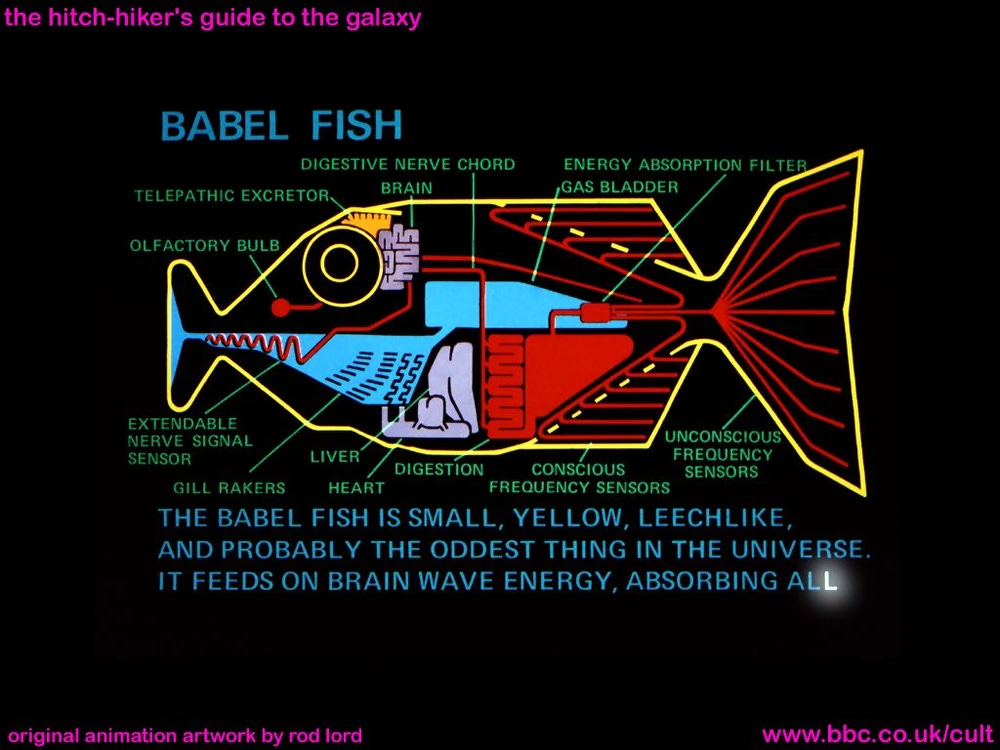
In The Hitchhiker’s Guide to the Galaxy, Douglas Adams invented the Babel fish — a creature so useful it proved the existence of God, which in turn proved the non-existence of God, because proof denies faith and without faith God is nothing. “And God promptly vanished in a puff of logic.”
Reform UK has a Babel fish problem. The proof of what’s wrong with them is so structurally complete that explaining it either confirms they can’t hear it or confirms they can’t fix it. Every attempt to help them vanishes in a puff of political economy.
Let me show you.
On Sunday, a Reform councillor called Joseph Boam posted something quietly devastating on X.
“Sometimes I genuinely wonder what the point is of being an elected councillor.”
The same week, Reform’s deputy leader Richard Tice was pressed on his tax arrangements. His response, when you strip away the performance, amounted to telling the interviewer to get lost. “You’re a naughty person if you save money in a pension scheme.”
These two men are experiencing the same thing. They just don’t know it yet.
Here’s the problem.
Reform is an attention business. It exists to produce outrage, convert that outrage into media visibility, and monetise that visibility into political relevance. This is not a criticism. It is a description. The party’s entire value proposition — to voters, to donors, to Nigel Farage personally — is that it generates more attention per pound spent than any competitor in British politics.
Attention is Reform’s product. Everything else is a side effect.
When Boam ran for his council seat, he was generating attention. Anti-establishment energy. Local frustration given a face. He won because the attention engine worked. His voters chose him because he was loud about the things they were angry about.
Then he got elected. And he discovered something that no one had warned him about.
The seat didn’t add to what he already had. It replaced it — at a much lower rate. Before the election, he was an attention entrepreneur. Afterwards, he was a councillor. The council doesn’t generate attention. It generates paperwork. Committee meetings. Compliance obligations. Bin collections. The tedious, grinding, invisible machinery of local government.
His income — in the economic sense, not the financial one — dropped the moment he won.
He was richer as a candidate than he is as a councillor.
Tice has the same problem at higher altitude.
Before Reform had formal positions, before there were frontbenchers and treasurers and deputy leaders, Tice’s financial arrangements were his own business. Nobody audited them because nobody had standing to. He was a businessman backing a political movement. The scrutiny was minimal.
Now he holds a position. The position comes with institutional visibility. And institutional visibility comes with institutional costs. His tax arrangements are suddenly everyone’s business. “Dubai Dick” isn’t a nickname — it’s a liability that attaches to every public appearance, every media interview, every policy announcement he tries to make about the economy.
He can’t shake it because the institution made him visible on a dimension he was previously invisible on. The scrutiny is not an attack. It is a structural consequence of holding a formal role.
And his response — aggression, dismissal, deflection — is the response of a man who priced in the attention and forgot to price in the audit.
Now zoom out.
Farage himself is running the same calculation at national scale. Before he won Clacton, his operation was pure attention. GB News appearances. Trump photo opportunities. Rally speeches. The cost structure was minimal because he had no institutional obligations. No constituency surgeries. No parliamentary attendance expectations. No campaign finance reporting deadlines.
Clacton changed the accounting. The seat imposed costs he’d never had to pay. And the policy influence it theoretically granted was negligible — he’s one MP. He can’t pass legislation. He can’t chair committees. He can’t shape government. The institutional return on the seat is a fraction of the attention return he was already earning without it.
So he keeps doing what he was doing before. The US trips. The media appearances. The rally circuit. Because that’s where the return is. But now the institution is visible in the background, and every day he spends doing attention work instead of constituency work is a day the gap between promise and delivery gets wider.
His polling was at 31% in January. By March, depending on which pollster you believe, it’s somewhere between 26% and 29%. The direction is down. The attention hasn’t decreased. If anything, the Iran war coverage, the Gorton by-election, and the Worcestershire council tax debacle have all generated more media visibility, not less.
More attention. Less support. That divergence is the signal.
The attention isn’t converting any more.
This is the part that’s hard to see from inside. When you’re an outsider, attention is the product. Every eyeball is a vote is a donation is a unit of political relevance. The conversion is automatic. You say something outrageous, people notice, your numbers go up.
But the moment you hold institutional positions, attention splits into two kinds. There’s attention that reinforces your credibility — the kind that makes people think “yes, this lot could actually run things.” And there’s attention that undermines it — the kind that makes people think “this is a circus.”
Reform is generating a lot of the second kind. Farage saying he wished his party “hadn’t bothered” taking control of Worcestershire Council. Tice telling journalists to do one when they ask about his taxes. Frontbenchers contradicting each other on Iran within the same news cycle — Farage saying Britain should support Trump’s operation, Jenrick saying it wasn’t necessary, Farage then reversing himself by the weekend.
Each of these generates attention. None of it generates credibility. The signal is loud but incoherent. Is Reform a serious governing party or a protest movement? A parliamentary operation or a media brand? Pro-intervention or anti-war?
When the signal is incoherent, the attention doesn’t convert. People watch but they don’t buy. The product is still on the shelf but the packaging keeps changing and no one trusts what’s inside.
There’s a deeper trap.
Reform’s voters didn’t sign up for an institution. They signed up for the opposite of an institution. The entire emotional proposition is that the institutions have failed, the establishment is corrupt, the system is rigged, and Reform is the wrecking ball that’s going to smash through it.
This works brilliantly in opposition. It works brilliantly when you have no power. The anger is the product and the product sells.
But the moment Reform starts being an institution — setting council tax rates, managing budgets, coordinating frontbench positions, disciplining candidates — it starts behaving like the thing its voters hate. Every act of institutional competence is, for the core base, evidence of betrayal.
Worcestershire is the proof. Reform took control. They had to raise council tax by nearly 9%. That’s institutional reality — the council was bankrupt, the money has to come from somewhere. But for Reform voters, the party that was supposed to smash the system just sent them a bigger bill. The system won. Reform became it.
Farage knows this. That’s why he said he wished they hadn’t bothered. He can feel the trap closing.
And now there’s Rupert Lowe.
Lowe has announced he’s turning Restore Britain into a political party. He doesn’t have councillors. He doesn’t have a frontbench. He doesn’t have a shadow cabinet or a council tax problem or a deputy leader with awkward tax arrangements. He has zero institutional baggage.
He is Farage circa 2019. Pure attention. No obligations. Clean signal.
For Reform voters who are starting to feel that their party smells a bit... institutional, Lowe is right there. He doesn’t need to be better than Farage. He just needs to be purer. He just needs to not have a Worcestershire.
This is exactly the dynamic that Farage used against the Conservatives for twenty years. He was always the cleaner option. Every time the Tories did something institutional — compromised on Europe, failed to cut immigration, raised taxes — a slice of their base looked at Farage and saw the uncontaminated alternative.
Now Farage is the Tory. And Lowe is him.
The sequence is visible over decades if you care to look. Conservative → UKIP → Brexit Party → Reform → Restore Britain. Five containers. One direction. Each one purer than the last. Each one shedding the institutional residue of its predecessor. Each transition happening faster than the one before, because each new container acquires institutional contamination more quickly under modern media scrutiny.
The interval between “fresh outsider” and “compromised institution” is compressing. It took decades for the eurosceptics to leave the Tories. It took years for UKIP to become the Brexit Party. Reform to Restore Britain is happening before Reform has even fought a general election as a serious contender.
So here’s the paradox.
I could explain all of this to Reform. I could sit down with Boam, or Tice, or Farage, and walk through the mechanics. The attention trap. The institutional cost spike. The coordination failure. The template purity problem. The Lowe escape valve. All of it.
And one of three things would happen.
They wouldn’t listen. Because the explanation contradicts the template they’re operating inside, and people absorb new information into existing templates rather than updating their mental models. The framework says “your movement is structurally incapable of governing.” The template says “we’re the ones who are going to fix everything.” The template wins. It always wins. That’s what templates do.
Or they’d listen but couldn’t act. Because the trap is structural, not informational. Knowing the equation doesn’t change the coefficients. Boam would still face the same pointless committee meetings. Tice would still face the same tax scrutiny. Farage would still face the same choice between attention and governance. Understanding why you’re trapped doesn’t open the door. It just lets you see the lock more clearly.
Or — and this is the beautiful one — they’d listen, understand, and act on it. They’d professionalise. Build institutional infrastructure. Discipline their frontbench. Coordinate their messaging. Develop actual policy. Become, in other words, a proper political party.
At which point their base would leave for Lowe. Because building institutional infrastructure is the betrayal. Becoming competent is the signal that confirms you’ve become the establishment. The voters who came for the wrecking ball don’t stay for the construction project.
Every branch of the decision tree confirms the same prediction. There is no path that leads to Reform becoming a successful governing party without losing the voters who made it a successful protest movement.
I could explain your problem. If I did, you wouldn’t listen. If you wanted to listen, I can’t tell you.
QED.
The Angry Dogs is a Substack about the hidden mechanics of political attention. All revenue is donated to Ukrainian causes.
I agree with the point about narrative structure, which is why I restacked the piece, but one might have applied the same argument with regard to the insurgent labour movement in the early 20th century. Movements learn and evolve, so, for me the fundamental question remains why Farage, Twice and Lowe are today's voice of insurgency.
“And one of three things would happen.”
You might also come down with a case of ‘Dubai Dick’ 😱